Everyday thousands of children are being sexually abused. You can stop the abuse of at least one child by simply praying. You can possibly stop the abuse of thousands of children by forwarding the link in First Time Visitor? by email, Twitter or Facebook to every Christian you know. Save a child or lots of children!!!! Do Something, please!

3:15 PM prayer in brief:
Pray for God to stop 1 child from being molested today.
Pray for God to stop 1 child molestation happening now.
Pray for God to rescue 1 child from sexual slavery.
Pray for God to save 1 girl from genital circumcision.
Pray for God to stop 1 girl from becoming a child-bride.
If you have the faith pray for 100 children rather than one.
Give Thanks. There is more to this prayer here

Please note: All my writings and comments appear in bold italics in this colour

Showing posts with label Saudi Arabia. Show all posts

Friday, 3 May 2024

Islam Hates Women > Saudi Arabia sentences women's rights activist to 11 years in prison in secret trial


Saudi court ‘secretly’ hands 11-year

sentence to women's rights activist


A Saudi court has recently sentenced women's rights activist Manahel al-Otaibi to 11 years in prison in a "secret hearing", according to two human rights groups who denounced the ruling as contradictory to the kingdom’s “narrative of reform and women’s empowerment”.  


Over the past few years, Saudi Arabia has carefully crafted an image of an open, transformed and glamorous society where women can now drive, female dress codes have been relaxed and the government has invested hugely in sports and entertainment. 

But over the last two years the government has convicted and sentenced dozens of people for expressing their views against the authorities online, according to a statement published Tuesday by human rights groups.

In the statement, Amnesty International and ALQST, a London-based Saudi rights organisation, called for the immediate and unconditional release of Manahel al-Otaibi, a 29-year-old fitness instructor and women’s rights activist who was sentenced to 11 years in prison by a Saudi court on January 9. 

The court's decision only emerged publicly in Saudi Arabia's formal reply to a request from the United Nations human rights office about Otaibi's case, Amnesty said in a statement on Tuesday. 

The document, dated January 24 and seen by AFP on Tuesday, indicated that Otaibi "was convicted of terrorist offences that have no bearing on her exercise of freedom of opinion and expression or her social media posts".

Social media posts 

Despite unrelated charges, Otaibi was found guilty of “terrorist offences” by Saudi Arabia’s Specialised Criminal Court (SCC), the NGOs said. 

The SCC was established in 2008 to handle terrorism-related cases but has been widely used to try political dissidents and human rights activists

Muslims like their women and girls to be quiet and invisible!

Otaibi was arrested in November 2022 after publishing social media posts calling for an end to her country's male guardianship laws and requirements for women to wear the traditional body-covering abaya. 

According to Saudi Arabia’s Permanent Mission in Geneva, Otaibi has violated the kingdom’s counter-terrorism law which criminalises “any person who creates, launches, or uses a website or a program on a computer or on an electronic device … or to publish information on the manufacture of incendiary devices, explosives, or any other devices used in terrorist crimes“, as well as “any person who, by any means, broadcasts or publishes news, statements, false or malicious rumours, or the like for committing a terrorist crime”.   

“Manahel’s conviction and 11-year sentence is an appalling and cruel injustice,” said Bissan Fakih, Amnesty’s campaigner on Saudi Arabia. 

Otaibi’s family only learned of her 11-year sentence through the Saudi government's formal reply to a UN request for information about her case.  

Otaibi’s older sister Foz al-Otaibi told AFP that she was shocked by the news, adding that her sister "did not do anything that deserved to be imprisoned for up to 11 years".  

In a video posted on X on Wednesday, Foz appealed to fans of Saudi-funded football clubs to call for her sister’s release. 

Foz, who has 2.5 million followers on the social media app Snapchat, faced similar charges but fled Saudi Arabia after being summoned for questioning in 2022.   

Abuse in prison 

Following her arrest, Otaibi was subjected to physical and psychological abuse in Riyadh’s Malaz Prison, Amnesty and ALQST said.  

“Since the moment she was arrested, Saudi Arabia’s authorities have subjected her to a relentless catalogue of abuses, from unlawful detention for supporting women’s rights to enforced disappearance for over five months while she was being secretly interrogated, tried and sentenced and subjected to repeated beatings by others in the prison,” Fakih said. 

Contact between Otaibi and her family was cut off between November 2023 and April 2024.   

When Otaibi was finally allowed to contact her family again on April 14, she told them she was being held in solitary confinement and had a broken leg as a result of physical abuse. 

Otaibi also said she was denied healthcare. 

“Saudi authorities must immediately and unconditionally release Manahel al-Otaibi and all those currently detained in the kingdom for the peaceful exercise of their human rights. Pending al-Otaibi’s release, the authorities must ensure her safety and access to adequate healthcare,” said Lina Alhathloul, ALQST’s Head of Monitoring and Advocacy. 

Zero-tolerance policy  

Saudia Arabia’s sentencing of Otaibi “directly contradicts the authorities’ narrative of reform and women’s empowerment", the NGOs said. 

“With this sentence the Saudi authorities have exposed the hollowness of their much-touted women’s rights reforms in recent years and demonstrated their chilling commitment to silencing peaceful dissent,” Fakih said. 

"What's at stake is freedom of political expression,” said Arnaud Lacheret, professor of political science at Skema Business School and author of "La femme est l'avenir du Golfe" ("Women are the future of the Gulf"). 

“Problems arise as soon as there is the slightest criticism of the regime,” he said. 

While Saudi Arabia has lifted several restrictions imposed on women in recent years such as the ban on driving and the abaya dress code, human rights activists say that the country still discriminates against women. 

The Personal Status Law, which came into force in 2022, continues to restrict women’s rights in the kingdom by enshrining the male guardianship system, activists say.  

Despite the Saudi government touting the law as “comprehensive” and “progressive”, it contains discriminatory provisions against women concerning marriage, divorce, and decisions about their children, Human Rights Watch said in a March report

“It is time that Saudi authorities amended the discriminatory provisions in the Personal Status Law and abolished the male guardianship system in its entirety,” Fakih said. 

Otaibi’s sentencing came amid an intensified crackdown on free speech in Saudi Arabia, Amnesty and ALQST said, highlighting the lengthy prison terms handed to several women including Salma al-Shehab, 27, Fatima al-Shawarbi, 30, Sukaynah al-Aithan, 40, and Nourah al-Qahtani, 45.  

Shehab, a PhD student and mother of two, was arrested in 2021 during a visit to Saudi Arabia from the UK and is currently serving a 27-year sentence for social media posts critical of the government. 

“Saudi authorities have adopted a zero-tolerance policy for any criticism, no matter how innocuous. They have shuttered all human rights groups, wiping out any form of independent civil society in the kingdom,” Amnesty said in a petition against repression. 

Mohammed al-Ghamdi, a government critic who denounced alleged corruption and human rights abuses on social media, was arrested in June 2022 and sentenced to death last year. He had just 10 followers on X, formerly Twitter, as well as on YouTube. 

According to Amnesty International, as of January 31, 2024, at least 69 people were “being prosecuted for exercising their rights to freedom of expression, association and peaceful assembly, including human rights defenders, peaceful political activists, journalists, poets and religious dignitaries”.

(with AFP)


Thursday, 2 July 2020

Another Step into the 20th Century for Saudi Women

Saudi man arrested for viral video insulting women

Public Prosecution takes action after man says 'women should stay at home'

Khitam Al Amir, Senior Staff Writer, Gulf News

Dubai: Saudi Arabia’s Public Prosecution has ordered the arrest of a man who appeared in a viral video insulting Saudi working women, local media has reported.

The order was issued by the Public Prosecution in accordance with articles 15 and 17 of the Saudi Law of Criminal Procedure.


The accused man has used abusive words against working women by insulting their dignity and decrying their engagement in the job market. The suspect also criticised women’s support and empowerment in society. “Women should stay at home,” he said in the video.

“We follow with interest everything that would prejudice women’s rights of guaranteed by the Saudi law, or anything that would undermine their dignity and legitimate freedom, whatever the pretexts are,” the Public Prosecution said in a statement in reaction to the abusive video against women.

When the abusive man heard about the prosecution’s order of his arrest, he appeared in another video saying that he was kidding and did not mean to insult women.

The Cybercrime Monitoring Centre has examined the video to verify its content on social media and found that it carried a direct abuse to Saudi women and criticising the support and empowerment of women in society.

Following the circulation of the video, complaints poured in on social media platforms asking competent authorities to take legal action against him.

The Saudi law has granted women new freedoms. As the society opens, women surge into job market, but their male counterparts do not always agree.

In 2017, King Salman Bin Abdul Aziz ordered that women be allowed access to government services such as education and healthcare without the need for consent from a guardian. He also issued a decree allowing women to drive in the Kingdom.

And then he arrested several women who had complained about women's rights in the kingdom.


Friday, 17 April 2020

Saudi Princess Basmah Says She's in Prison and Poor Health

Life is very difficult for women in most Islamic countries. They have few rights and often are required to be virtually invisible in public. While being royalty might be better, it is still far from being a reasonable lifestyle. This story adds to the list of Princesses who have escaped Islam, or have simply disappeared for wanting freedom, or just speaking the truth.

By Clyde Hughes

Saudi Princess Basmah bint Saud bin Abdulaziz al-Saud attends a discussion at the Middle East Institute (MEI) in Washington, D.C., on April 12, 2017. Michael Reynolds/EPA

April 17 (UPI) -- A Saudi princess posted on social media this week that she has been held in prison with her daughter and pleaded to be released for medical reasons.

Princess Basmah bint Saud bin Abdulaziz al-Saud, 56, the outspoken daughter of Saudi Arabia's King Abdul Aziz, who ruled the country from 1953-64, appealed to her uncle, King Salman and cousin, Crown Prince Mohammed bin Salman, to be freed.

"I am currently being arbitrarily held at Al-Ha'ir prison without criminal, or otherwise any charges against my person," the princess said on her official Twitter account. "My health is deteriorating to an extent that is serve, and that could lead to my death."

Al-Ha'ir prison is considered by some to be the worst prison in the Middle East.

A former business partner of the princess confirmed the tweets Thursday and said someone hacked into her account and deleted them.

The princess and her daughter were taken into custody last March when they tried to leave Saudi Arabia for Switzerland. She said at the time she needed urgent medical treatment.

Al-Saud has been known for years to support progressive causes, which were seen as controversial in Saudi Arabia. She called for women's rights, reforms during the Arab Spring and changing how the country is run from an absolute monarchy to a constitutional monarchy.

"The arrest of a Saudi princess should come as no surprise," said Rothna Begum, senior women's rights researcher at the humanitarian watchdog Human Rights Watch. "Princess Basmah has been openly critical of the country's women's rights record in the past and her arrest shows that no woman, no matter her background, is untouchable if she is deemed to be a potential threat."


Nothing is more dangerous to a misogynistic monarchy than an intelligent woman. A society that cannot endure questioning and criticism is a very weak society indeed.


Wednesday, 31 July 2019

Out of Islam: Stories of Women Attempting to Escape Their Uber-Misogynistic Muslim Families

Escape bids by rebel princesses
throw spotlight on UAE rights

Stuart WILLIAMS and Lucie PEYTERMANN
AFP

Sheikh Mohammed bin Rashed al-Maktum (C) and his wife Princess Haya (R) are locked in a legal battle in the UK over the welfare of their children (AFP Photo/Karim SAHIB)

Paris (AFP) - Princess Haya, who is battling her husband Dubai's ruler Sheikh Mohammad bin Rashid Al-Maktoum in a UK court, is the third princess who has sought to escape the Gulf emirate in recent years.

Activists say the attempts by Haya and two of Sheikh Mohammed's daughters to escape the United Arab Emirates (UAE) throw a harsh spotlight on the country's rights record, even as it tries to present a glitzy and modern image to the West.

In 2000, Sheikha Shamsa bint Mohammed bin Rashid Al-Maktoum tried to escape the family's entourage during a holiday in England, but was reportedly picked up two months later and forcibly returned to Dubai.

And in 2018, another daughter, Sheikha Latifa, fled Dubai before being allegedly captured at sea off India. Supporters released a harrowing video, purportedly by her, in which she describes her living conditions.

Princess Haya, 45, the half-sister of Jordan's King Abdullah and an equestrian competitor in the Olympics for her native Jordan, surfaced this year in Britain where she has applied for a forced marriage protection order.

- 'Endemic failings' -

The cases have tarnished efforts by Sheikh Mohammed, who is also prime minister of the UAE and a familiar figure on the global horse racing circuit as founder of the Godolphin stables, to present Dubai as a contemporary model in the Middle East.

The city has expanded exponentially in recent years as its rulers turned it into a global investment and tourism hub no longer dependent on energy revenues.

In November 2018, Dubai hosted a world tolerance summit that was denounced by rights groups as brazen hypocrisy given its record on human rights.

A new edition of the event, scheduled for November, will take place under the patronage of Sheikh Mohammed with the aim to "strengthen the UAE's stance to be a model for tolerance and positive coexistence".

Rights groups accuse the UAE of holding opponents without legal basis, including award-winning rights activist Ahmed Mansoor, who was sentenced to 10 years in prison in 2018 on accusations of spreading false information.

Prominent academic Nasser Bin Ghaith was also handed a 10-year jail term in 2017 over a series of tweets criticising the UAE authorities.

Human Rights Watch said in July that the UAE was continuing to hold at least five Emirati prisoners, including an activist and members of a registered Islamist political movement, even after they completed their sentences.

Contacted by AFP, the UK-based group Detained in Dubai, which says it assists people or companies caught up in the UAE's legal system, said: "The cases of Princess Latifa and Princess Haya highlight many of the endemic failings, if not legalised abuses, that plague the UAE legal system."

The failings of the UAE's legal system were "particularly sharp in relation to the rights of women," it added.

Emirati media used to extensively cover the movements of Haya, who in 2016 said of her husband that "every single day I thank God that I am lucky enough to be close to him." But the last story about Haya from the official WAM news agency dates back to February.

Latifa's story

Latifa (L) was not seen in public until images emerged of her in December 2018 with former Irish president
Mary Robinson (R) in Dubai (AFP Photo/STRINGER)

Latifa's disappearance was a source of international intrigue, with supporters claiming she was captured on a yacht in March 2018 during an escape bid and forcibly returned to Dubai.

She was not seen in public until images emerged of her in Dubai meeting the former UN human rights chief and former Irish president Mary Robinson.

Robinson confirmed Latifa had planned her escape and recorded a video, and described her as "clearly troubled."

After her disappearance, supporters released a video which they said Latifa recorded before her escape bid, where she launched a scathing attack on her father, saying he only cared about his reputation.

"If you are watching this video it is not such a good thing. Either I am dead or in a really bad situation," says the woman in the video, who claimed to be Latifa.

Shamsa's story is very brief

Echoing British press reports from the time, the woman said "my sister Shamsa" had tried to escape in England in 2000 but was then abducted by "bunch of guys" after two months on the run and returned to Dubai via France.

Now "she has no freedom, she has a psychiatrist with her and she is surrounded by nurses."

The circumstances surrounding Shamsa's disappearance are even more mysterious, and she has not been seen in public for almost two decades.


'He will never stop looking for us':
Saudi Sisters who Fled Allegedly Abusive Father
Seek Asylum in Canada

Dua and Dalal al-Showaiki say their father tried to
force them to marry older men
CBC Radio 

Saudi sisters Dua, left, and Dalal al-Showaiki have been hiding in Istanbul for six weeks from their father, who they claim abused them for having dreams of independence and tried to force them to marry older, religious men. (Submitted by Toby Cadman)

Two Saudi sisters who have been hiding in Istanbul for six weeks after fleeing years of alleged abuse by their father are hoping to be granted asylum in Canada.

Dua, 22, and Dalal al-Showaiki, 20, describe their father as controlling and abusive and say he tried to force them to abandon their dreams of independence in order to marry older, religious men.

After years of contemplating their escape, the sisters said they made the drastic decision to flee on June 10 while on a family vacation in Turkey's largest city.

"We didn't have, like, anyone to help us," Dua told The Current, speaking from their 11th safe house in Istanbul. "We didn't have any choice. Just run away."

It's so hard for me to live in Saudi Arabia.
I don't have any future there.
- Dua al-Showaiki

Dalal describes her family life as a "jail" in which she is unable to make her own decisions. "If sometimes my father told us, like, 'This morning, you can't go to school at your college.' I can't complain to anyone."

The situation is worse for Dua, who realized as a teen that she was gay. Homosexuality is considered a crime in Saudi Arabia and is punishable by death or flogging.

"It's so hard for me to live in Saudi Arabia," she said. "I don't have any future there."

The getaway

During the family vacation, Dua and Dalal say their father seized their passports and money before locking them in a hotel room. When he opened the door to use the bathroom, the sisters say they were ready — wearing shoes and with cellphones in hand — to make a dash for the exit.

"I was running, I don't know where I must go. But I was hiding in the streets," Dua recalled.

The recent high-profile getaways of other Arab women — Saudi Arabia's Rahaf Mohammed, Dubai princess Sheikha Latifa, and Saudi sisters Maha and Wafa al-Subaie — almost thwarted their plan. They said their family was on high alert, attuned to the possibility.

After making their escape, the sisters then reached out to an online network of Saudi women for help.

"I told them that I am on the street. I don't have any place to go … and they helped me," Dua said. "They know people in Turkey and they [gave] me their contact."

Dua and Dalal have been hiding in Istanbul for 50 days. After making their escape, they relied on an online network of Saudi women for help finding a safe house. (DuaDalal/Twitter)

The sisters have been holed up in Istanbul ever since, taking to social media to publicize their plight and campaign for asylum in Canada.

Dua and Dalal spend most of their time indoors and move frequently for fear their father will find them and forcibly bring them back to their home country. Turkey is one of a handful of countries that Saudis can travel to without a prior visa.

"He will never stop looking for us, so he can clear the shame," said Dalal.

She believes if they were to return to their home in the port city of Jeddah, about 90 kilometres east of Mecca, her father would kill them or have them thrown in jail, where they would be subject to torture.

The sisters say their getaway and public campaign has also led them to receive a steady stream of online threats.

Life free of oppression

Asked why they have chosen Canada as their preferred destination, Dalal says it's because it's a safe place. "They support gay people, they support ex-Muslims and everyone," she said


🇸🇦 Dua & Dalal 🇸🇦
@DuaDalal
 I'm Dua and my sister Dalal have fled from Saudi Arabia to Turkey. My father wanted to marry us to old men and religious militants. We were beaten and harassed. We were threatened with imprisonment in the Women's Welfare Center,#SaveDuaandDalal
 #SaudiSistersRescue @hrw_ar


Toby Cadman, a British lawyer who has been advising the sisters, says he has credible evidence that family members may try to compel Turkish authorities to illegally return Dua and Dalal to Saudi Arabia. 

"The environment in Turkey is really not safe," he said, referencing a large number of Saudi nationals who visit the country each year.

The sisters are currently waiting for their application to be processed by the Office of the United Nations High Commissioner for Refugees (UNHCR), which is responsible for determining which refugee cases to refer to Canada.

In an email to The Current, a spokesperson for Immigration Minister Ahmed Hussen said the office is unable to comment on the sisters' case due to privacy regulations.

"Individuals cannot apply directly for resettlement to Canada, nor can they make claims at an Embassy of Canada," Mathieu Genest wrote. "The UNHCR determines which cases to refer to Canada and will request expedited processing when appropriate."

Asylum seekers whose claims are determined to be eligible will get a hearing at the Immigration and Refugee Board of Canada, he said, which will select "foreign nationals for resettlement who have no reasonable prospect of finding another durable solution."

Toby Cadman, centre, is a British lawyer who has been advising the sisters on their asylum claim. He says he hopes they will have a chance at a normal life.  (Submitted by Toby Cadman)

Cadman is optimistic their case will warrant an urgent decision by UNHCR and says he hopes the sisters will have a chance at "a life like you and I would consider to be normal."

"We've already heard about the system of abuse, which we know exists in Saudia Arabia," he told The Current.

"You also have two individuals that have been subjected to physical and mental abuse over a number of years. They've also been subjected to sexual abuse by family members in an environment where no care is given to protect them."

The Saudi embassy in Ottawa did not respond to The Current's request for comment.

Plight of women's rights

Saudi Arabia has a long history of brutally punishing those who demand equality, defend women's rights and advocate for social reform.

It consistently ranks among the world's worst countries for women's rights and equality. The World Economic Forum positioned it 141 out of 149 in its 2018 report on gender equality.

The country's highly restrictive guardianship laws require women to be granted permission from a male relative to work, travel abroad, marry and receive certain kinds of medical treatment.

This past spring, a sweep of arrests targeting individuals supportive of women's rights and those with ties to jailed activists saw 12 people detained. Women who have stood trial for charges related to their activism have told court they were abused during interrogations.

Asked if they would resettle in another country if it offered them asylum before Canada, the sisters replied they'd be willing to go nearly anywhere.

"If anyone in any country agreed to take us, of course, we're going to go," Dua said.


Maha and Wafa al-Subaie

Saudi sisters Wafa and Maha granted asylum

By Anne-Marie Bissada

Sisters Maha and Wafa al-Subaie post a photo of themselves leaving Georgia

The two Saudi sisters who made international headlines in April seeking help to leave Georgia before their family or officials forced them back to Saudi Arabia, have finally been offered asylum in an undisclosed location.

It was a story that made headlines as sisters Maha and Wafa fled their abusive family and arrived in Georgia 17 April where they started to ask for help in relocation to a third country.

“We decided to leave Saudi Arabia because life there had become unbearable from the torture. We were threatened and abused daily by our family, father and mother and brothers,” Maha had said in an interview with RFI.

In direct contact with RFI and other news outlets, the sisters explained that they had been planning to leave since 2014 after their lives had become unbearable from the constant repression at the hands of their family and the government.

Under the Saudi male guardianship system, a woman, regardless of her age, is under constant surveillance by an official male guardian.

Easy access to Georgia

Georgia is one of the few countries that Saudi citizens can travel to without a visa, making it an easier destination for the girls to get to.

But ultimately, the longer they waited there, the more precarious their situation became as twitter trolls, reportedly from their family, began harassing them and tweeting threats to the sisters.

Your face does not indicate torture, you are lies, you do not deserve asylum there are women who deserve it more than you
  amss (@amss70535077) April 22, 2019

Under Islamic law it is not permissible to scar or bruise a Muslim woman's face. Beatings must occur elsewhere on the body.

The UNHCR did work with the sisters in helping them find a safe place in Georgia.

Success story

In the end, a tweet and a photo telling their supporters that they had finally been accepted in a third country.


Rima. 🦋
@rima246
 "As we settle in our new home and life we will continue to support Saudi women. Your sweet and thoughtful messages helped us through some very hard times." 

Beautiful message from @GeorgiaSisters2 to the thousands who signed their petition: https://www.change.org/p/unhcr-help-resettle-saudi-sisters-maha-and-wafa-al-subaie-to-a-third-safe-country/u/24531500 …


For the time being as they settle into their new lives, the sisters have asked for privacy from the media.

The location of their new home is also not known, to ensure their safety.

Maha and Wafa al-Subaie have left Georgia
Twitter / @GeorgiaSisters2

While the sisters and other girls fleeing the Saudi Kingdom have found a happy ending, others have not been lucky as in the case of Dina Ali Lasloom.

She made it as far as the Philippines in 2017, but was then forced back to the kingdom. Her current whereabouts and condition remain unknown.


Sunday, 6 January 2019

Saudi Women to be Notified of Divorce by Text Message Under New Law

Believe it or not, this is a big improvement for Saudi women

Thomson Reuters 

A Saudi woman is seen on her mobile phone in Riyadh, Saudi Arabia, in January 2017. Women in Saudi Arabia will be notified by text message if they are divorced under a new law designed to protect them from having their marriage ended without their knowledge, the government said on Sunday. (Faisal Al Nasser/Reuters)

Women in Saudi Arabia will be notified by text message if their husband divorces them under a new law designed to protect them from having their marriage ended without their knowledge, the government said on Sunday.

The new law, that came into effect on Sunday, was seen as a way to end secret divorces and ensure women are fully aware of their marital status so they can protect rights such as alimony.

The move comes as Crown Prince Mohammed bin Salman has started to give women more rights in the conservative kingdom, which included lifting a ban on women driving last year.

"Saudi courts have started to send such [divorce] notifications ... a step aimed at protecting the rights of female clients," the Saudi Ministry of Justice said in a statement on their website.

It said women could check their marital status on the ministry's website or visit the relevant court to get a copy of divorce papers.

"In most Arab countries, men can just divorce their wives," said Suad Abu-Dayyeh from global rights group, Equality Now.

"At least women will know whether they are divorced or not. It is a tiny step, but it is a step in the right direction," she told the Thomson Reuters Foundation by phone.

But Abu-Dayyeh said knowing about a divorce does not mean a woman will get alimony or the custody of her children.

'This system strangles Saudi women'

In recent years women in Saudi Arabia have been allowed to enter sports stadiums for the first time, vote in local elections, and take a greater role in the workforce as Saudi Arabia tries to diversify its oil-dependent economy.

But many Saudi women have taken to social media to push from more freedom, including protesting against the country's strict dress codes with women required to wear an abaya — a loose, all-covering robe — when in public.

Campaigners said the main sticking point remained Saudi Arabia's guardianship policy, whereby women must have permission from a male relative to work, travel, marry and even get some medical treatment.

"The male guardianship system is a core issue and it must be dismantled. It controls women in each and every step of their lives. This system strangles Saudi women," said Abu-Dayyeh.

Although many have hailed the Saudi government's reforms, there has also been a crackdown on dissent with about a dozen female activists arrested.

In November, rights groups Amnesty International and Human Rights Watch accused Saudi Arabia of torturing and sexually harassing some detained female activists — allegations denied by a Saudi official to Reuters.

A group of British parliamentarians and lawyers on Wednesday requested an "urgent response" from the Saudi ambassador by Jan. 9 to allow them to speak with the detained activists.


Wednesday, 20 June 2018

Detainees Held Without Charges Decry Emiratis’ Sexual Abuses in Yemen

CAUTION: Graphic, disturbing descriptions follow

No ages are given in this piece but we can probably assume that some men in their late teens and early 20s are included.

CAIRO (AP) — The 15 officers who arrived at the prison in southern Yemen hid their faces behind headdresses, but their accents were clearly foreign — from the United Arab Emirates. They lined up the detainees and ordered them to undress and lie down. The officers then searched the anal cavity of each prisoner, claiming that they were looking for contraband cellphones.

The men screamed and wept. Those who resisted were threatened by barking dogs and beaten until they bled.

Hundreds of detainees suffered similar sexual abuse during the event on March 10 at Beir Ahmed prison in the southern city of Aden, according to seven witnesses interviewed by The Associated Press. Descriptions of the mass abuse offer a window into a world of rampant sexual torture and impunity in UAE-controlled prisons in Yemen.


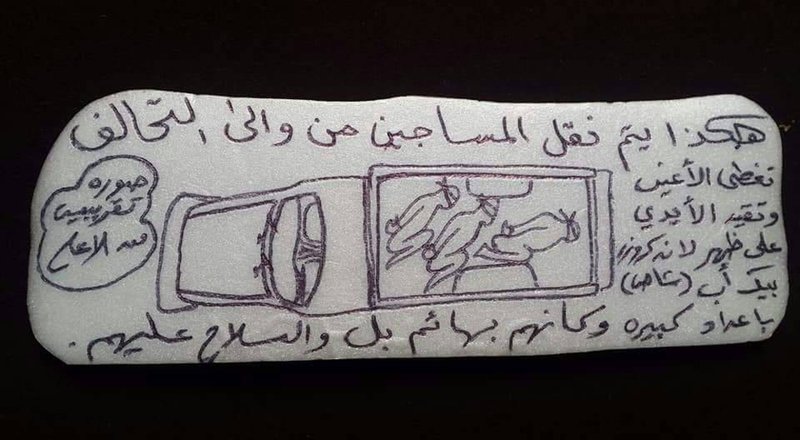
A drawing of prisoners being transported in a pickup truck to an Emirati-run prison in Yemen. The Arabic reads: “This is how they transport the prisoners from and to the coalition. Blindfolded and handcuffed in the back of a Land Cruiser pickup in large numbers as if they are animals and under gunpoint.”

The UAE is a key U.S. ally whose secret prisons and widespread torture were exposed by an AP investigation last June. The AP has since identified at least five prisons where security forces use sexual torture to brutalize and break inmates.

Yemen’s war began in 2015, after Iranian-backed Houthi rebels took over much of the country’s north. Saudi Arabia and the UAE are leading a coalition to fight the rebels, but UAE forces have overtaken wide swaths of territory, towns and cities in the south. The U.S. is backing the coalition with billions of dollars in arms, and partners with the Emiratis in anti-terrorism campaigns.

Emiratis have swept up hundreds of Yemeni men into a network of at least 18 hidden prisons on suspicion of being al-Qaida or Islamic State militants. The prisoners are held without charges or trials.

The AP first asked the Pentagon about grave rights abuses committed by the UAE one year ago. But despite well-documented reports of torture reported by the AP, human rights groups and even the United Nations, Marine Maj. Adrian Rankine-Galloway, a Pentagon spokesman, said that the U.S. has seen no evidence of detainee abuse in Yemen.

“We have received no credible allegations that would substantiate the allegations put forth in your line of question/story.”

U.S. officials have acknowledged that American forces receive intelligence from UAE partners and have participated in interrogations in Yemen. But Rankine-Galloway said he could not comment on intelligence sharing with partners.


A drawing of a prisoner being abused at a prison in Yemen run by the United Arab Emirates. Arabic from right to left reads: “Anti-terrorism,” “Innocent citizen,” and “Real terrorism behind their back, they don’t look at.”

UAE officials did not respond to requests for comment.

A drawing of a prisoner being tortured at an Emirati-run prison in Yemen. The Arabic reads: “with water after beating.”

Witnesses said Yemeni guards working under the direction of Emirati officers have used various methods of sexual torture and humiliation. They raped detainees while other guards filmed the assaults. They electrocuted prisoners’ genitals or hung rocks from their testicles. They sexually violated others with wooden and steel poles.

“They strip you naked, then tie your hands to a steel pole from the right and the left so you are spread open in front of them. Then the sodomizing starts,” said one father of four.

From inside the prison in Aden, detainees smuggled letters and drawings to the AP about the sexual abuse. The drawings were made on plastic plates with blue ink pen.

The artist told the AP that he was detained last year and has been in three different prisons. “They tortured me without even accusing me of anything. Sometimes I wish they would give me a charge so I can confess and end this pain,” he said. “The worst thing about it is that I wish for death every day and I can’t find it.”

He spoke on condition of anonymity for fear of further abuse.

The drawings show a man hanging naked from chains while he is being electrocuted, another inmate on the floor surrounded by snarling dogs as several people kick him, and graphic depictions of anal rape.

“Naked after beating,” one Arabic caption says. Another drawing shows a man’s rectum being forced open.

“This is how they search the prisoners,” the caption reads.

Of the five prisons where the AP found sexual torture, four are in Aden, according to three Yemeni security and military officials who spoke to the AP on condition of anonymity for fear of retaliation.

One is at the Buriqa base — the headquarters for the Emirati forces. A second is at the house of Shallal Shaye, the Aden security chief closely allied with the UAE, and a third is at a nightclub-turned-prison called Wadah. The fourth is at Beir Ahmed, where the March atrocities occurred.

U.S. personnel have been seen at the Buriqa base, along with Colombian mercenaries, according to two prisoners and two security officials. The detainees could not say whether the Americans, some of whom wear military uniforms, are members of the U.S. government or mercenaries.

But it is the UAE that has taken the lead in southern Yemen.

The humiliation of the entire prison population in March may have been triggered by a series of hunger strikes among prisoners, who are held for months or years. At least 70 detainees were ordered released earlier this year by state prosecutors but most remain in detention. The Yemeni government has said that it has no control over the UAE-run prisons and Hadi has ordered an investigation into reports of torture.

The incident in March began when soldiers opened cells at 8 a.m., ordered all detainees out to the prison yard, then lined them up and forced them to stand under the sun until noon. When the Emirati force arrived, the detainees were blind-folded, handcuffed and led in groups or individually into a room. The Emiratis told the victims to undress and lie down — and then spread their legs open, touched their genitals and probed their rectums.

“You are killing my dignity,” one prisoner was heard crying. A second screamed to the Emiratis, “Did you come to liberate us or strip our clothes off?”

The Emiratis shouted back: “This is our job!”

One prisoner said that when the Emiratis forced them to stand naked, “All I could think of was Abu Ghraib” — referring to the prison outside Baghdad where U.S. soldiers committed abuses against detainees during the Iraq war.

“They were searching for mobile phones inside our bodies,” another witness told the AP. “Do you believe this! How could anyone hide a phone in there?”

In the same city, at the UAE-run prison inside the Buriqa military base, two prisoners told the AP they think American personnel in uniform must be aware of the torture - either because they have heard screams or seen marks of torture. Prisoners said that they have no knowledge of Americans being directly involved in the abuse.

“Americans use Emiratis as gloves to do their dirty work,” said one senior security official at the Riyan Prison in the city of Mukalla. He spoke on condition of anonymity because of security concerns.

Two other security officials, who were once close to the Emiratis, said that mercenaries including Americans are present at all the Emirati military camps and sites, including the prisons. Their mission is mainly to guard.

The father of four said that sometimes the screaming from the beatings is so intense that he can feel his cell shake.

“It’s beyond imagination,” he said.

A former security chief who himself was involved in torturing detainees to extract confessions told the AP that rape is used as a way to force detainees to cooperate with the Emiratis in spying.

“In some cases, they rape the detainee, film him while raping, use it as a way to force him to work for them,” he said. He spoke on condition of anonymity, because of security concerns.

Based on the AP investigation last year, the House of Representatives voted on May 24 to require Defense Secretary Jim Mattis to determine whether U.S. military or intelligence personnel violated the law in interrogations of detainees in Yemen.

The House adopted the measure as part of the 2019 defense authorization bill, which is still under consideration by the Senate. The amendment was sponsored by Rep. Ro Khanna, a Democrat from California. The Defense Department would have to submit a report within 120 days to Congress.

Khanna called the AP’s report Wednesday “a shocking revelation of the ongoing human rights abuses happening in Yemen.”

“Now, with greater urgency than ever before, we need the Pentagon to launch an investigation and determine whether our nation has been involved in torturing prisoners in Yemen,” he said.

The war has left over 10,000 people dead, displaced millions, and pushed the already poor country to the edge of famine.

After Houthi rebels forced out the government of President Abed Rabbo Mansour Hadi, he fled to Riyadh, where the Saudi government kept him for more than a year. He was only allowed to return to Yemen Thursday at the beginning of an offensive led by the UAE to take control of the major port city of Hodeida, the key entry point for humanitarian aid.

The UAE’s control over southern Yemen, and the prisons, has left many Yemenis worried that innocent civilians are being pushed into the arms of the very extremists that Emirati forces claim they are fighting.

“In the prisons, they are committing the most brutal crimes,” said a Yemeni commander currently in Riyadh. “Joining ISIS and al-Qaida became a way to take revenge for all the sexual abuses and sodomization. From here, the prisons, they are manufacturing ISIS.”

He spoke on condition of anonymity to avoid retaliation from the Emiratis.

One middle-aged man said he has been in prison since 2016, and has been moved across the network of secret prisons multiple times. He said he was interrogated 21 times, during which he was tortured with electricity, beatings, and attack dogs while he was blindfolded and chained.

“They beat me up with electric wires, with steel, an electric shock, or they take off the clothes except for the underwear and stomp on my body and face with their boots. The soldiers would carry you up in the air and dump you on the ground.”

The AP previously confirmed 18 detention sites, but he named 21, including 13 prisons and 8 military camps.

Another prisoner gave the AP what he said were the real names of five Emirati torturers. UAE officials did not respond to requests for comment about the men.

One of the most brutal torturers is Yemeni, a former prisoner called Awad al-Wahsh, who was detained and tortured before agreeing to work with the Emiratis, four witnesses told the AP. His supervisor, Yosran al-Maqtari, could not be reached for comment. Al-Maqtari is Aden’s chief of anti-terrorism.

Other torturers named by detainees are Emirati officers known to prisoners by their noms de guerre: Abu Udai, Abu Ismail, and Hitler.

The prisoners who were sexually abused in March had tried to fight back. They had organized three hunger strikes to protest their treatment. They had launched a campaign with their families to get human rights groups to secure their release.

That’s when the 15 Emirati officers showed up with their dogs.

___

The Associated Press reported this story with help from a grant from the Pulitzer Center on Crisis Reporting.

___

Associated Press reporters Lolita C. Baldor and Desmond Butler in Washington contributed to this report.