Everyday thousands of children are being sexually abused. You can stop the abuse of at least one child by simply praying. You can possibly stop the abuse of thousands of children by forwarding the link in First Time Visitor? by email, Twitter or Facebook to every Christian you know. Save a child or lots of children!!!! Do Something, please!

3:15 PM prayer in brief:
Pray for God to stop 1 child from being molested today.
Pray for God to stop 1 child molestation happening now.
Pray for God to rescue 1 child from sexual slavery.
Pray for God to save 1 girl from genital circumcision.
Pray for God to stop 1 girl from becoming a child-bride.
If you have the faith pray for 100 children rather than one.
Give Thanks. There is more to this prayer here

Please note: All my writings and comments appear in bold italics in this colour

Showing posts with label Abubakar Shekau. Show all posts

Wednesday, 21 March 2018

Boko Haram Returns Nigerian Kidnapped Schoolgirls

Witnesses say Boko Haram militants have returned an unknown number of the 110 girls who were abducted from their Nigeria school a month ago


Here we go again. This article indicates that almost all the girls who were kidnapped last month have been returned. There is no mention of 80 girls having been rescued days later (see story below). Was that another Nigerian lie to suggest that the military was actually doing something? You seriously can't believe anything that comes out of this God-forsaken country where truth is extremely unlikely in any area of life.

Falmata Abubakar, one of the girls freed from the Government Girls Science and Technical College Dapchi, is photographed after her release by Islamist Terrorist in Dapchi, Nigeria, Wednesday March. 21, 2018. Witnesses say Boko Haram militants have returned an unknown number of the 110 girls who were abducted from their Nigeria school a month ago. (AP Photo/Jossy Ola)

THE CANADIAN PRESS

Boko Haram extremists returned almost all of the 110 girls abducted from their Nigeria boarding school a month ago with an ominous warning, witnesses said Wednesday.

The fighters rolled into Dapchi around 2 a.m. in nine vehicles and the girls were left in the centre of town. As terrified residents emerged from their homes, the extremists said “this is a warning to you all,” resident Ba’ana Musa told The Associated Press.

“We did it out of pity. And don’t ever put your daughters in school again,” the extremists said. Boko Haram means “Western education is forbidden” in the Hausa language.

Nigeria’s government said 101 of the 110 schoolgirls, most of them Muslim, had been confirmed freed and that the number “would be updated after the remaining ones have been documented.”

“No ransoms were paid,” the information minister, Lai Mohammed, said in a statement. The girls were released “through back-channel efforts and with the help of some friends of the country, and it was unconditional.”

In Islam it is forbidden to rape a Muslim girl unless you are married to her or unless she was behaving badly (her hair was showing, etc.). Only non-Muslim girls can be taken as slaves/sex slaves by Muslim men. They must have been thoroughly disappointed to find that most of the girls were Muslim. Poor research on their part.

Family members were en route to the town Wednesday morning.

“When I get there we will do a head count to see if all of them have been released,” said Bashir Manzo, whose 16-year-old daughter was among those kidnapped during the Feb. 19 attack.

Manzo confirmed that his daughter was among those freed.

“As I speak to you there is jubilation in Dapchi,” he said.

The mass abduction and the government response brought back painful memories of the 2014 attack on a boarding school in Chibok. Boko Haram militants abducted 276 girls, and about 100 of them have never returned. Some girls were forced to marry their captors, and many had children fathered by the militants.

The Chibok girls were mostly Christians.

The latest mass abduction is thought to have been carried out by a Boko Haram splinter group aligned with the Islamic State, one that has criticized the leader of the main Boko Haram organization for targeting civilians and has focused instead on military and Western targets.

Residents in Dapchi fled on Wednesday morning upon hearing that Boko Haram vehicles were headed toward the town.

“We fled but, from our hiding, we could see them and surprisingly, we saw our girls getting out of the vehicles,” Umar Hassan told the AP.

“They assembled the girls and talked to them for some few minutes and left without any confrontation,” said another resident, Kachallah Musa.

The girls were at the general hospital in Dapchi “and the counsellors are there with them,” the information minister told reporters. As with the released Chibok schoolgirls, “they will be quarantined and be counselled before they go back to their schools.”

Their release came a day after an Amnesty International report accused the Nigerian military of failing to heed several warnings of the imminent attack last month. The military has called the report an “outright falsehood.”

Nigeria’s government celebrated the girls’ release. “GREAT NEWS from Dapchi, Yobe State. Thank God for the safe return of our sisters. Alhamdulillah!” an aide to President Muhammadu Buhari, Bashir Ahmad, said on Twitter.


Nigerian army failed to act before 110 girls abducted
By Susan McFarland

School girls abducted by Boko Haram in 2014 meet Nigerian President Muhammadu Buhari at the Presidential Villa in Abuja, Nigeria. A report Tuesday by Amnesty International accuses the Nigerian army of failing to act on warnings of another mass abduction last month. File Photo by STR/EPA

UPI -- A report by Amnesty International accuses the Nigerian army of failing to act on "advance warnings" given hours before Boko Haram militants abducted 110 girls from a school last month.

The human rights group alleges the army and police received at least five calls on Feb. 19, warning that gunmen were heading to the Government Girls Science and Technical College in Dapchi.

The report says witnesses and residents said they alerted army officials and police after seeing a convoy of gunmen heading toward the school.

Amnesty called for an investigation into the circumstances that led to the abductions of at least 110 girls after Boko Haram stormed the school. The Nigerian army rescued about 80 girls two days later at a border town between Borno and Yobe.

The latest report I can find from Nigeria pegs the number rescued at 76. It seems that rescue is confirmed even while I doubt just about everything that comes out of that corrupt country, and even though major news sources carried this story, it is still doubtful.

"The Nigerian authorities must investigate the inexcusable security lapses that allowed this abduction to take place without any tangible attempt to prevent it," said Osai Ojigho, Amnesty International's Nigeria director.

In 2014, Boko Haram kidnapped 270 girls from a school in the town of Chibok, and about 20,000 people have been killed since the terrorist group began its insurgency there in 2009.

One of the abducted Chibok schoolgirls was rescued in January and 82 were released in exchange for five top Boko Haram commanders last May. Twenty-one others had previously been freed after negotiations.

"Evidence available to Amnesty International suggests that there are insufficient troops deployed in the area, and that an absence of patrols and the failure to respond to warnings and engage with Boko Haram contributed to this tragedy," Ojigho said.

"The Nigerian authorities have failed in their duty to protect civilians, just as they did in Chibok four years ago. Despite being repeatedly told that Boko Haram fighters were heading to Dapchi, it appears that the police and military did nothing to avert the abduction."


Thursday, 22 February 2018

Nigerian Army Rescues 80 Schoolgirls Abducted by Boko Haram

Can it be true?

One has to be reluctant to believe anything that comes out of Nigeria, especially if it's good news. Let's hope and pray it is true and pray for those not yet accounted for.
By Daniel Uria

Boko Haram militants are loaded onto an aircraft by the Nigerian military to be taken to a rehabilitation center in Gombe where they reportedly are to begin a de-radicalisation process, in Maiduguri, Nigeria, on July 8,. The terror group may have abducted more than 100 school girls after a raid Monday. File Photo by Usuf Osman/EPA

UPI -- The Nigerian army rescued about 80 girls abducted by Boko Haram militants in a raid at a school on Wednesday.

The girls were rescued at a border town between Borno and Yobe and were taken to the Geidam Army Base to undergo medical checks, CNN reported.

Mohammed Alamin, the commissioner of education for Yobe state, said the school will be visited to check names off a list in order to confirm the exact number of girls rescued.

Alamin couldn't confirm if any bodies were recovered at the scene and the Yobe state government said more details about the number of girls rescued and their condition will be provided in "due course."

Up to 111 girls were initially unaccounted for after Boko Haram stormed the Government Girls Science Secondary School (2nd story on link) in Dapchi on Monday evening, Yobe state police commissioner Abdulmaliki Sumonu said.

"Eight hundred and fifteen students returned to the school and were visibly seen, out of 926 in the school. The rest are missing," said Sumonu.

Sumonu said he could not confirm if the missing students had been kidnapped, adding not all of the girls live at the boarding school and some may not have been present during the raid.

"It's a very sensitive situation," he said.

President Muhammadu Buhari said he ordered the military and police to "mobilize immediately" to find the girls and dispatched his defense minister on a fact-finding trip.

"I share the anguish of all the parents and guardians of the girls that remain unaccounted for. I would like to assure them that we are doing all in our power to ensure the safe return of all the girls," Buhari said.

In 2014, Boko Haram kidnapped 270 girls from a school in the town of Chibok and about 20,000 people have been killed since the terrorist group began its insurgency in 2009.

One of the abducted Chibok schoolgirls was rescued in January, 82 were released in exchange for five top Boko Haram commanders in May 2017 and 21 were freed in October 2016 after negotiations with Boko Haram.


Tuesday, 22 August 2017

Boko Haram Used 83 Children as Suicide Bombers in 2017 – UNICEF

© Afolabi Sotunde / Reuters

Boko Haram has dramatically increased the use of children in suicide bomb attacks on civilians in Nigeria, UNICEF reported Tuesday.

There has been a four-fold increase in the use of weaponized children as part of the Islamist insurgency which has ravaged the country’s northeast for eight years, UNICEF said in a statement.

So far this year, 83 children have been used as "human bombs," the majority of whom were girls.

Such attacks are used to sow fear among the population, especially of children who have been released, rescued or escaped from Boko Haram or similar Islamist terrorist groups.

“There is an extraordinary level of tension obviously in these communities and... people are afraid of children who have been victimized in this absolutely appalling way," UNICEF spokesperson Marixie Mercado said, as cited by VOA News.

"There are instances of children being ostracized by their communities and worse. Terrible things are happening to children after already horrific things have happened to them,” she added.

In total, 55 attacks used girls, often younger than 15 years old, 27 used boys and one even used a baby strapped to a young girl to carry out a suicide bomb attack.

A total of 19 children were used in such attacks last year, reports AP.

UNICEF described such terrorist attacks as an "atrocity," while stressing that the children involved are "victims, not perpetrators."

"There were two girls taught by Boko Haram to be suicide bombers ... The girls confirmed that they were taught that their life was not worth living, that if they die detonating the bomb and killing a lot of people, then their lives will be profitable," Nigerian aid worker Rebecca Dali said, as cited by Reuters.

This is Islamic insanity!

So far, 1.7 million people have been displaced by the Islamist insurgency in the northeast of the country, 85 percent of whom come from Borno state, the main focus of such attacks.

The insurrection is now in its eighth year, having claimed the lives of more than 20,000 and forced more than 2 million people to flee their homes, reports Reuters.

At least 170 people have been killed since June 1 of this year.

Mercado added that while Boko Haram has not claimed responsibility for all such attacks, no other group is yet known to employ such tactics.

In response to the Islamist threat, Nigeria launched the Mobile Strike Force which is designed to specifically end the Boko Haram-led insurgency.  

According to the Nigerian Bulletin, Maj.-Gen. Ibrahim Attahiru said: “That is why we launched MST. We finally want to wreck them. This force will have various fighting platforms and equipment to attack deep into the hinterlands and achieve the conduct of long range voyages. All these will undoubtedly help us to succeed in Operation Lafiya Dole and improve our efficiency.”

Operation Lafiya Dole is the name of the operation to rid Nigeria of Boko Haram and capture Abubakar Shekau. A recent shake-up at the top of the Nigerian Army should bring new energy to the operation. It has certainly gone on too long.


Thursday, 13 October 2016

21 Nigerian Schoolgirls Released by Boko Haram

Deal brokered by Swiss government and International Red Cross, spokesman says
The Associated Press

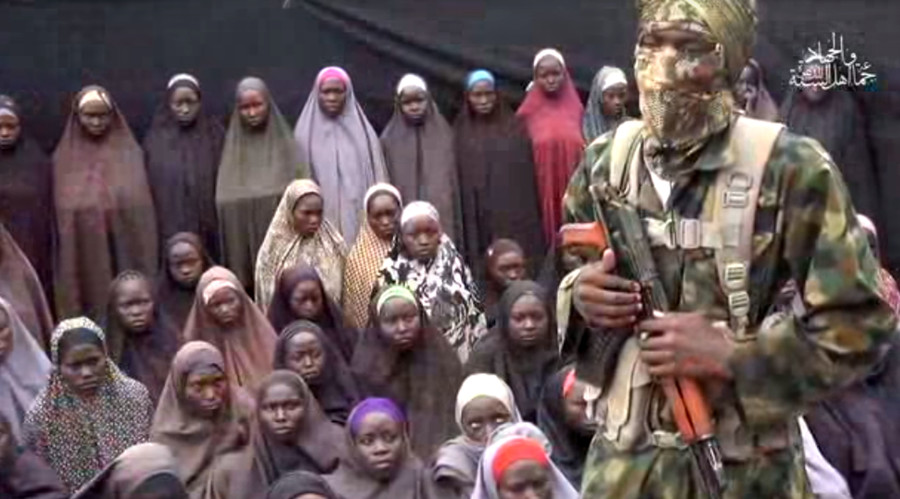
This undated image taken from video shows an alleged Boko Haram soldier standing in front of a group of girls said to be among the 276 abducted Chibok schoolgirls held since April 2014, in an unknown location. (Site Institute via AP)

Twenty-one of Nigeria's Chibok schoolgirls kidnapped by Boko Haram more than two years ago have been freed in a swap for detained leaders of the Islamic extremist group, the government and military said Thursday.

Some 197 girls remain captive, though it is not known how many of them may have died.

The freed girls, the first to be released as a result of government action, are in the custody of the Department of State Services, Nigeria's secret intelligence agency, according to presidential spokesman Garba Shehu.

Their release was negotiated between the government and Boko Haram in talks brokered by the International Committee of the Red Cross and the Swiss government, he said. Negotiations will continue for the release of the other students, he said.

'We thank the federal government and,
like Oliver Twist, we ask for more.'
— Prof. Hauwa Biu, activist

A military officer familiar with the talks said four detained Boko Haram leaders were released Wednesday night in Banki, a town on the northeast border with Cameroon. The officer spoke on condition of anonymity because he is not authorized to speak to the press on the matter. The girls were flown by helicopter to Maiduguri, the northeastern capital of Borno state and birthplace of Boko Haram, he said.

Congratulations to President Buhari, the Red Cross and the Swedish Diplomats involved. None of this could have been accomplished under Buhari's predecessor. It gives us hope that more girls may yet be saved, although, I'm quite sure, none are anywhere close to the same girls they were two years ago.

There is, unfortunately, no indication in this report whether the negotiators were dealing with Abubakar Shekeau's group or Abu Musab al-Barnawi's group. 

"We are extremely delighted and grateful," the Bring Back Our Girls movement said on Facebook. The group, which has campaigned within Nigeria and internationally for the release of the students, said it awaits the names of the released girls.

"We thank the federal government and, like Oliver Twist, we ask for more," said Prof. Hauwa Biu, a women's rights activist in Maiduguri.

Nigeria Kidnapped Girls
Young girls known as Chibok Ambassadors carry placards bearing the names of schoolgirls kidnapped by Boko Haram, during a demonstration, in Abuja, Nigeria in 2015. (Sunday Alamba/Associated Press)

International outrage

Negotiations last year failed when Boko Haram demanded a ransom of $5.2 billion for the girls' freedom, according to a recently published authorized biography of President Muhammadu Buhari by American historian John Paden. It was not clear if any money changed hands in this swap.

The abduction of 276 schoolgirls in April 2014 and the government's failure to quickly free them has caused international outrage and brought Boko Haram, Nigeria's home-grown Islamic extremist group, to the world's attention. Dozens of the girls escaped on their own, but most remain missing.

In May, one of the girls, Amina Ali Nkeki, escaped on her own. Shortly after her release Nkeki told her family that some of the kidnapped girls died of illness and that others, like her, have been married to fighters and are pregnant or already have babies, her mother told the press.

Since then Nkeki has been in the custody of the secret service where she is receiving medical care and trauma counselling, according to the government. Buhari's government has been criticized for keeping her isolated. The Bring Back Our Girls group and Human Rights Watch have asked whether Nkeki now is a detainee of the government.


Friday, 16 September 2016

Nigeria Admits Failed Chibok Girls Swap Deals


Nigeria said it was committed to rescuing the 218 Chibok girls still held captive by Boko Haram (AFP Photo/)

Abuja (AFP) - Nigeria opened negotiations with Boko Haram over the release of the kidnapped Chibok girls last year, but the talks were derailed due to a split in the extremist group, a minister said Friday.

Speaking at a press conference in the capital Abuja, information minister Lai Mohammed said the Department of State Services (DSS) started negotiations with the Islamists in July 2015.

In exchange for the girls, who were kidnapped in April 2014 from a school in the remote northeastern town of Chibok, Boko Haram demanded the release of some of its fighters.

Out of the 276 girls kidnapped, scores escaped in the hours after the kidnapping, while another was rescued earlier this year.

Mohammed said that by August 2015 the government was close to clinching the swap deal when Boko Haram issued a new set of demands.

"This development stalled what would have been the first release process of the Chibok girls," Mohammed said.

New talks that began in November were eclipsed by a leadership struggle happening in Boko Haram at the time.

The first signs of a rift appeared after longtime chief Abubakar Shekau pledged allegiance to IS in March 2015 and changed Boko Haram's name to Islamic State West Africa Province (ISWAP).

By August this year, Abu Musab al-Barnawi -- the son of Boko Haram's founder Mohammed Yusuf -- was appointed head of the group, with recent reports of clashes between rival factions in northeast Nigeria's Borno state, near Lake Chad.

Mohammed said Nigeria was committed to rescuing the remaining 218 Chibok girls still held captive by Boko Haram, who have killed at least 20,000 people in northeast Nigeria in a wave of raids, suicide attacks and bombings since 2009.

"In spite of the current division amongst members of the terrorist group, which has seriously affected efforts to release the girls, renewed efforts have commenced using our trusted assets and facilitators," Mohammed said.

Sunday, 14 August 2016

Kidnapped Chibok Schoolgirls Reportedly Featured in Latest Boko Haram Footage

© Fgghhfc Ffhjjj
© Fgghhfc Ffhjjj / YouTube

Footage purportedly showing Boko Haram’s new leader has emerged online, displaying a masked gunman demanding that Nigeria’s government release their fighters in exchange for the abducted Chibok schoolgirls.

The new video is thought to feature Abu Musab al-Barnawi, the recently appointed successor to Abubakar Shekau, who has not been seen since early 2015.

While as yet unverified, the video is similar to previous Boko Haram releases.

In the 11-minute clip, a man dressed in military clothing with a gun slung across his shoulder claims that a number of the kidnapped girls have been killed in Nigerian air strikes, while at least 50 young women in head scarves can be seen lined up against a darkened backdrop.

One of the captives, identified by the BBC as Maida Yakubu, is then directed to appeal to her parents to put pressure on the Nigerian government to release imprisoned Boko Haram fighters.

“We are suffering here, the aircraft has come to bombard us and killed many of us. Some are wounded. Every day we are in pains and suffering. Some of our husbands that we married also are injured, some dead. No one cares for us,” the girl is reported to have said.

Posted to Twitter on Sunday by a Nigerian journalist, the broadcast claims to be a message to the “family of Chibok girls”.

According to the Associated Press, the latest video includes an ultimatum to the families warning that they will never find the girls again if the fighters are not released first.

© acleddata.com
© acleddata.com

In a 2014 raid on a Chibok town secondary school, the Nigerian militant group kidnapped 276 girls, more than 200 of whom are still believed to be in captivity.

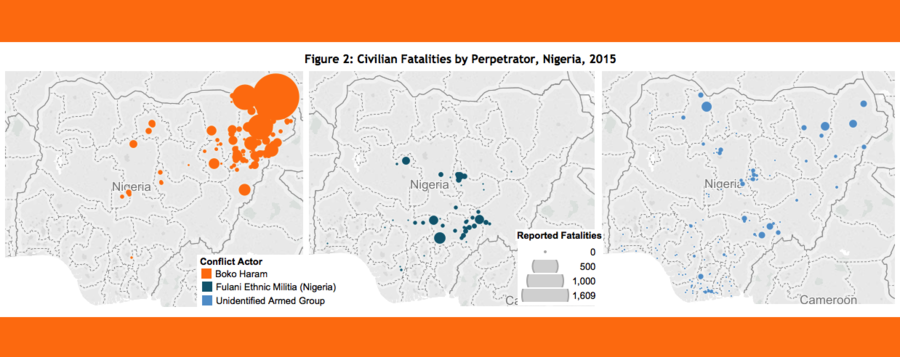
Last year Nigerian president Muhammadu Buhari said that government forces had “technically” beaten Boko Haram. However, a January report from the Armed Conflict Location & Event Data Project stated that the group remains the most prominent perpetrators of violence against civilians.

  video, no translation

In an interview with RT.com, the mother of a Chibok captive spoke of the profound impact the girls’ abduction has had on the community.

“It was terrible. We have been crying days and nights, seeking help from heaven. Seeking help from the Nigerian army,” she said.

“We are dying. We lost 15-20 parents. Some killed by Boko Haram after the abduction, some died due to a heart attack, blood pressure or diseases.”

It’s estimated that the terrorist group killed more than 6,000 people in attacks last yea