Everyday thousands of children are being sexually abused. You can stop the abuse of at least one child by simply praying. You can possibly stop the abuse of thousands of children by forwarding the link in First Time Visitor? by email, Twitter or Facebook to every Christian you know. Save a child or lots of children!!!! Do Something, please!

3:15 PM prayer in brief:
Pray for God to stop 1 child from being molested today.
Pray for God to stop 1 child molestation happening now.
Pray for God to rescue 1 child from sexual slavery.
Pray for God to save 1 girl from genital circumcision.
Pray for God to stop 1 girl from becoming a child-bride.
If you have the faith pray for 100 children rather than one.
Give Thanks. There is more to this prayer here

Please note: All my writings and comments appear in bold italics in this colour

Showing posts with label drug addictions. Show all posts

Tuesday, 4 June 2024

Drugs, Madness > What is destroying a generation of our children?


‘It destroys you’: Grieving B.C. dad calls for

involuntary youth detox program


“When you’re on the sidelines watching your child self-destruct and you can’t do anything to force them into rehab, it breaks your heart,” grieving father Greg Sword told Global News.


His daughter Kamilah was only 14 years old when she died from an overdose of MDMA, cocaine and hydromorphone.

In the months leading up to her death, she was hospitalized twice after overdosing and met with counsellors and psychiatrists.

But it wasn’t enough to save her.

“It’s disheartening to be in B.C. and finding out that if I lived in a different province, I could have forced my daughter into rehab,” Sword said.

In Alberta, there is a program called PChAD, which stands for Protection of Children Using Drugs Program.

Under that act, parents can ask for a court protection order and involuntarily commit their child under 18 to a detox and stabilization safe house for up to 15 days.

Sword said his daughter’s situation left him feeling hopeless and alone.

“People judge you,” he said.

“You constantly get judged. And you feel like you’re a bad parent. You feel like you’re you’re screwing up, you feel like you’re making mistakes constantly and anytime you reach out, the answer’s ‘no.'”

Click to play video: 'Youth deaths from toxic drugs on the rise'
4:59
Youth deaths from toxic drugs on the rise

Sword said it was challenging that even when his daughter was ready to receive help, there was no space for her in a rehab facility.

“It’s just a messed up thing where a child can’t vote, can’t drive, can’t get alcohol, but they can make the decision of what drug they want to use,” he said.

“Even though it’s supposed to be illegal for them, but they can choose whatever drug they want and if you’re a parent and you find out, you can’t do anything to stop them from doing it.”

Sword said the experience was frustrating and upsetting.

B.C.’s Minister of Mental Health and Addictions, Jennifer Whiteside, was not available to speak to Global News about the issue but provided a statement.

“We’re taking significant steps to expand access to treatment and create more early intervention services for youth, aiming to prevent small problems from becoming bigger in the future,” Whiteside said in the statement.

“For example, we’re opening Foundry centres in 35 communities, offering free counselling, health, and addiction services for youth as young as 12. We are also expanding youth treatment beds and services, supporting thousands of young people each year to get the help they need.”

In a follow-up statement, the ministry added that it takes the need to balance individual rights with the obligation to help people living with mental illness seriously, and that the government’s priority remains voluntary treatment.

“There are situations where patients need to be held involuntarily, and the BC Mental Health Act does provide tools for physicians in those cases,” it said.

BC, and Canada, for that matter, have yet to realize the connection between the use of drugs by teens and the spectacular rise in mental illnesses.

Click to play video: 'UBC prof’s book examine’s youth toxic drug crisis'
5:22
UBC prof’s book examine’s youth toxic drug crisis

Critics of the Alberta program say involuntary confinement can harm the relationship between parents and children, worsening their substance use.

Timothy McConnell, better known as TJ, took his life in January 2021 in a solitary cell at the Edmonton Remand Centre.

His mom, Lana Greene, told Global News that going into the PChAD program with TJ was a desperate decision.

“It’s hard to explain, but he didn’t think anything was wrong, so he wasn’t wanting any help,” Greene said.

She said the process broke the trust between her and her son, who was 17 at the time.

TJ was 23 years old when he took his own life but Greene said she believes the involuntary rehab program was the beginning of the end for them.

“He was very angry,” she said.

Greene said she feels that PChAD was the beginning of the end for any trust her son could have in the rehab system.

“He didn’t want to speak to me. So I went to Edmonton and stayed at some family’s house so I would be nearby if he changed his mind,” she said.

“What ultimately happened, was his program ended and I picked him up and he came home and packed his bag and left again.

Youth and addictions expert, Danya Fast, told Global News that treatment programs like that can have a negative effect.

“They can sometimes conclude that the systems and services in place are absolutely not trying to help them,” she said.

“They’re trying to control them, and actually become very, very effective at evading care.”

Sword said he knows that PChAD isn’t a perfect answer for youth who need help with drugs and substance abuse but he believes it would have made a difference.

“Now I’ve got nothing,” he said.

=====================================================================================


Chad Daybell sentenced to death 

for killing first wife, 2nd wife’s kids


Chad Daybell should be put to death for the murders of his first wife and his second wife’s two youngest children, a jury has decided.


The jury in Idaho unanimously agreed Saturday that Daybell, 55, deserves the death sentence for the gruesome murders of Tammy Daybell, 16-year-old Tylee Ryan and 7-year-old Joshua “JJ” Vallow.

He was found guilty of first-degree murder and conspiracy charges last Thursday, after a lengthy case where prosecutors argued his crimes were fuelled by sex, money, power and “doomsday” spiritual motivations.

According to CNN, Daybell maintained a neutral expression as the death sentence was read in court. The judge said jurors had “found beyond a reasonable doubt … that the aggravating circumstances when weighed against the mitigating circumstances do not make the imposition of the death penalty unjust.”
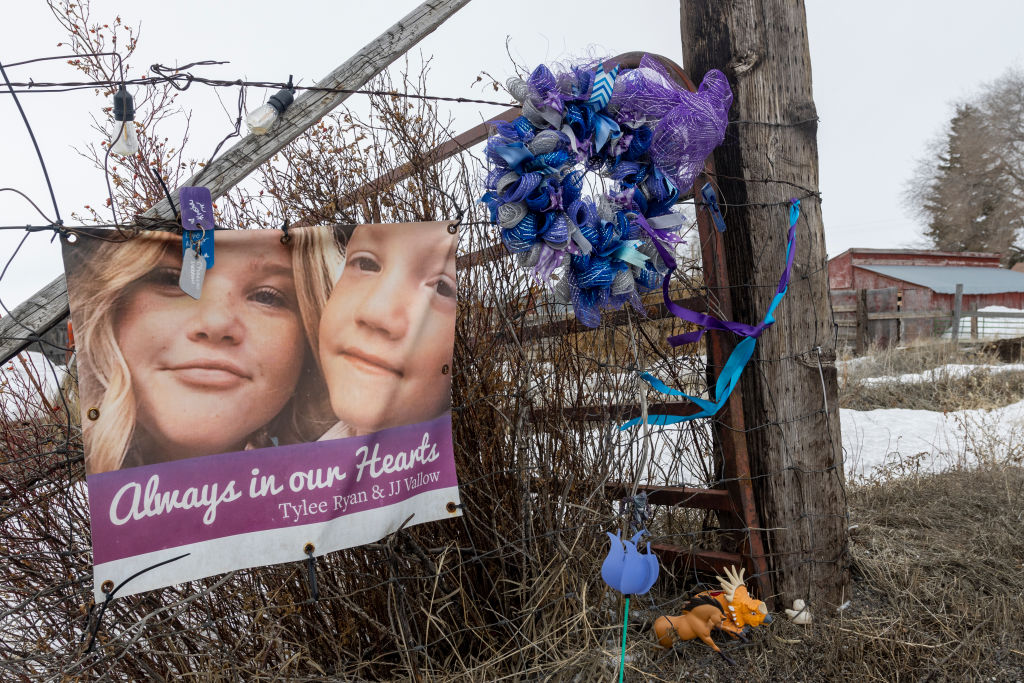
FILE – A picture of Tylee Ryan (L) and J.J. Vallow is seen on a fence opposite the property where their bodies were found in 2020, on April 4, 2023 in Rexburg, Idaho. Natalie Behring / Getty Images

To impose the death penalty, the jurors had to unanimously find that Daybell met at least one of the “aggravating circumstances” that state law says qualifies someone for capital punishment. They also had to agree that those aggravating factors weren’t outweighed by any mitigating factors that might have lessened his culpability or justified a lesser sentence.

The jury decided there were aggravating factors including an utter disregard for human life and the murders being especially heinous and cruel.

Last week’s guilty verdict came about a year after Lori Vallow Daybell, Daybell’s second wife, was also convicted for the murder of her children and sentenced to life in prison without the possibility of parole. She was also convicted of conspiring to murder Daybell’s first wife, Tammy, and has been accused of arranging her fourth husband’s murder so she and Daybell could be together.

FILE – Lori Vallow Daybell sits in a police car after a hearing at the Fremont County Courthouse in St. Anthony, Idaho, on Aug. 16, 2022. Tony Blakeslee / East Idaho News via AP

The Daybell and Vallow Daybell investigation began in late 2019 when several family members reported concerns to police that they hadn’t seen or spoken to JJ and Tylee in months. Their bodies were eventually found buried in Chad’s yard in eastern Idaho in 2020.

Friends of the couple would go on to tell police, and testify in court, that the pair held fringe religious beliefs, including that they had been reincarnated in order to gather people before a biblical apocalypse.

Before Vallow Daybell’s two youngest children disappeared, she referred to them as “zombies,” former friend Melanie Gibb testified during last year’s trial. The couple claimed that zombies were people who had been possessed by dark spirits, and the only way to free the person’s trapped soul was to destroy their body by killing them.

FILE – This combination of undated file photos released by the National Center for Missing & Exploited Children show missing children Joshua Vallow, left, and Tylee Ryan. National Center for Missing & Exploited Children via AP, File

Authorities believe the two children were killed in September 2019. Tammy was found dead on Oct. 19, 2019, a few weeks before Daybell and Vallow Daybell married, although it was initially believed she died in her sleep.

During Daybell’s nearly two-month-long trial, prosecutors painted a picture of a self-published author who wrote doomsday-laced fiction, promoted unusual spiritual beliefs including apocalyptic prophecies and tales of possession by evil spirits in order to justify the killings.

“This has been a tough case because of its complexity, both in telling the story of an investigation that spanned years and trying to figure out the best way to present it in a way that would make sense to others,” Fremont County Prosecutor Lindsey Blake said outside the Boise courthouse after the sentencing.

Daybell’s lawyer, John Prior, argued during the trial that there wasn’t enough evidence to tie Daybell to the killings, and suggested Vallow Daybell’s older brother, Alex Cox, was the culprit. Cox died in late 2019 and was never charged.

During the sentencing hearing, Prior asked the jurors to judge Daybell on his life before he met Vallow Daybell, describing her as a bomb that blew him off the trajectory of an otherwise wholesome life. But Daybell also declined to offer any mitigating evidence during the sentencing hearing. Mitigating evidence is often used to encourage jurors to have sympathy for a defendant in an effort to show that a life sentence would be more appropriate than capital punishment.

Were Chad and Lori drug users in their past, or were they simply nuts to begin with?


Monday, 20 May 2024

Kids and Drugs > Kids always lose, but courageous Mom cuts the losses


Defying Odds: Amid a Family of 10 Addicts, This

Alberta Woman Conquers Addiction for Her Kids

The Epoch Times

5/8/2024
Updated:
5/10/2024

Danielle Swampy is pictured on the left at a time when she was in active addiction, and on the right in recent photo after successful recovery. (Courtesy of Danielle Swampy)

Danielle Swampy grew up on a reserve in central Alberta in a home that was falling apart, literally and figuratively. Both of her parents were addicted to crack. Her eight siblings all grew up to be addicts. Her boyfriend’s parents were addicts.

“All I ever seen was addiction. It was normalized. Everyone in my family did it,” Ms. Swampy told The Epoch Times. And getting out of it was practically unheard of.

Ms. Swampy did though—but not before experiencing some horrifying events.

She left home in a stupor one night and passed out on the street, leaving her toddlers home alone. Child services took them away. At her lowest point, she was kidnapped and tortured for days by a group of men because of her drug debts.

Divine intervention saved her, she says, when a sign came to her just when she was about to give up entirely.

Father Her Best Friend Despite Abuse

Ms. Swampy was raised primarily by her father. She was young when her mother left and she saw her only on occasion.

“There were days when I would be crying because my stomach was hurting from so much hunger,” she said. Her home didn’t have clean water, so she would go to a neighbour’s to fill jugs.

“Whenever my dad would get too drunk or something, he would sort of take his anger out on me, quite often hitting, stuff like that. But I would do the same thing,” she said, so she didn’t consider it abuse.

Despite their difficulties, her father was her best friend, she said.

He tried to keep her safe, or at least what he considered safe, and so he allowed her to have parties at their house. “The way he viewed it was that if we did it in front of him, then at least he'd know I was safe rather than me doing it behind his back.”

She started smoking marjiuana when she was 12 and soon got into drinking and taking pills, including oxycodone and “benzos” (benzodiazepines, a depressant).

When Ms. Swampy was 14, she became pregnant. She and the baby’s father continued in a relationship and prepared themselves for parenthood as best they could.

“I was still having a lot of issues with my own addiction as well as his addictions,” she said. “But I knew at that time that I didn’t want to continue down this path after I had the child.”

“I put myself in a group home,” she said. “I knew that what my dad showed me was not something I wanted to show my daughter.”

Baby Girls

She stayed sober through the pregnancy, and pregnancy was the only thing that kept her sober, she said. Without it, “I couldn’t go a single hour. I needed to be on something all the time.”

She had a baby girl, whom she raised for the first year while living in the group home. But in time she went back to doing drugs.

“And then I got pregnant again.” She was 16.

She and her boyfriend decided to move to Red Deer, about 8 kilometres from the Maskwacis reserve where she grew up.

“For a while, we were doing okay. We were doing alright. We were only smoking weed, we weren’t doing anything else.”

She had a second baby girl.

She and her boyfriend were close to turning 18, when they were due to receive a comfortable payment of government money. “We had plans to make our lives better for ourselves and our children,” she said.

But they started getting into harder drugs and heavy drinking became a problem. Her boyfriend’s mother died, which was hard for them both to cope with.

Then one night, Ms. Swampy decided to drink by herself after she had put the kids to bed and while her boyfriend was out.

“I ended up blacking out. I don’t remember what happened,” she said. Her boyfriend came home at some point, and they had argued.

“I ended up leaving that night, completely wasted, not remembering. And it was during the dead of winter,” she said.

The police found her passed out in the snow and put her in a cell for the night.

Her boyfriend had left the house, too, not thinking about the children there. Their older daughter was 3 at the time and the youngest was 1.

They shared a house with a tenant in the basement who worked for children’s services. “So when our kids woke up around the middle of the night, and were crying and [the tenant] realized that no one was responding to that, they called children’s services. My kids were apprehended that night.”

“It was torture when I woke up the next morning and realized,” she said.

“I just kind of gave up at that point because I thought they would be better off without me,” Ms. Swampy said.

For the first six months, she tried to stay clean in the hope of getting her children back. But she kept turning to drugs to deal with the stress of her situation.

“I felt myself giving up at that time, giving into the urge to just drink all the time, to use [drugs] all the time. And this was the year that I actually started using meth,” she said.

After her first use of methamphetamine she spent the next three days in a deep depression. “I laid in bed contemplating suicide basically. I don’t even know why I started doing it again. Because that first time was horrible.”

At the end of the six months she had a court date and failed the scheduled drug test. “I knew I used that morning, so I already knew that it wasn’t gonna turn out very good.”

What she was told in court that day made her feel unfit to be a mother.

“They pretty much had me convinced that I was too young to be a mom. I shouldn’t be doing this job, that I should just allow somebody else to. They pretty much convinced me that I couldn’t be a mom to my kids,” Ms. Swampy said.

“I broke down and I cried and I ended up signing a piece of paper that just signed my children away, basically. It gave them all rights.”

After that she lost herself to drugs, overdosing multiple times and being revived in the hospital.

The Darkest Dark Before the Light

It was around this time that her little brother, who was 15, committed suicide. “He was the type of kid that fell through the cracks,” she said.

Her father’s health, which had been declining for years, swiftly deteriorated after that, and within three weeks, they buried him as well.

“There was a lot of deaths happening at this time and throughout my whole life. On my reserve, there’s death all the time,” she said. Two of her other siblings have also committed suicide.

She and her boyfriend broke up and she decided to move to Edmonton to try starting fresh, but her life there became even worse.

She had a new boyfriend and he beat her frequently. She became homeless and started injecting meth into her arms.

“I was doing it so often, four to five times a day. The longest time I stayed awake from that was 12 days in total,” she said.

Danger was all around her.

“Something was always happening. There was always shootings. I’ve been in multiple situations where a house I was in was getting raided or someone was getting beat up, someone was getting stabbed, as well as myself. I was always getting beat up wherever I went,” Ms. Swampy said.

“And then a situation happened that completely shattered my world,” she said. “There was a situation that happened to me that was either going to kill me or save me. Looking back at it now, it definitely saved me—I mean, it killed me first and then it saved me.”

It happened several years ago now and although she has spent a lot of time dealing with it throughout her recovery, it remains hard for her to talk about.

“I ended up getting kidnapped and tied up for three days in a house to pay off a debt while I was drugged up by multiple men,” she said. “I remember glimpses. I remember being tortured, beat up, drugged.”

She said being drugged saved her, in a way, from experiencing the full horror of the situation. Her captors injected her with heroin and fentanyl, which she continued using after she was released.

“I was basically trying to kill myself. I was trying my best to overdose,” she said.

Stealing cars became her main way to get drug money.

She knew she couldn’t continue what she was doing. One day while in downtown Edmonton looking for drugs she had in mind three options for her future: running away to another city, killing herself, or getting treatment.

It was then that a woman she didn’t know walked up to her.

“She just randomly came up to me and she handed me a small little makeup bag. It was in the shape of lips. She handed it to me and she was like, ‘Here, give this to someone you know. I have no use for it,’” Ms. Swampy recalled.

“I looked inside the bag, and it was two bracelets big enough for two little girls.”

Thinking of her daughters, she chose treatment. “I sort of just took that as divine intervention—as a sign—like, ‘okay, I’ll go.'”

Recovery and a Final Test

She was given a bed at Poundmaker’s Lodge addiction treatment centre in Edmonton. It’s a 12-step, abstinence-based recovery that combines indigenous traditional wisdom with the standard 12-step addiction recovery program used by Alcoholics Anonymous.

Ms. Swampy spent a year in recovery programs, and the biggest test she faced along the way was coping with another death. Her mother’s.

“Our relationship was always difficult over the years, but she was still my mom, she was still there in some ways,” Ms. Swampy said.

“She was very proud of me. Actually, I was the only daughter of hers that she was proud of, because all of my sisters and brothers—like I said, my entire family were addicts.”

Ms. Swampy had always turned to drugs to deal with pain, especially with the other deaths in her family. When she was able to get through the grief over her mother without relapsing, she knew she could stay clean.

She has been sober for more than six years now. She lives in a four-bedroom house with her two girls, who are now teenagers. From the time she lost them to the time she got them back, more than eight years had passed.

It has taken a lot of work to rebuild her relationship with them. But they see that, out of all the people in their life, all their family, their mom is the one who has put the work into recovering so she could be there for them.

Danielle Swampy (L) poses with her two daughters at a time when she had first started to reconnect with them. (Courtesy of Danielle Swampy)

Ms. Swampy is in college studying child and youth care, and she said she has learned that the absence of a mother in a child’s early years makes an impact on their attachment. She can see it with her own girls.

“My youngest, she’s very detached. It’s hard for me to forgive myself sometimes. But she’s trying and I’m trying, so I only have hope that our relationship will continue to get better,” Ms. Swampy said.

“They don’t necessarily like that it has taken so long, but they know that I’ve worked very hard to get them back,” she said.

“All the things that have happened throughout my recovery, I just keep telling myself, as long as I stay clean, It’s going to be okay.”

She now helps others in recovery at Poundmaker’s, and her message for others on the difficult road out of addiction is always, “Just don’t give up. Everything is going to be okay as long as you continue to do the next right thing and stay clean.”

Well done, Danielle, you are an inspiration to many. God bless you!