So far in the 21st century nearly a third of a billion children have been sexually abused, most of them multiple times, some thousands of times. 6 out of 7 are girls. Anything you can do to get this message to as many people as possible will help save abused children all over the world, and maybe even some of the abusers. Please read "Save A Child from Sexual Abuse by 3:15 PM" under "First Time Visitor?" May God bless you and anoint this ministry.
Everyday thousands of children are being sexually abused. You can stop the abuse of at least one child by simply praying. You can possibly stop the abuse of thousands of children by forwarding the link in First Time Visitor? by email, Twitter or Facebook to every Christian you know. Save a child or lots of children!!!! Do Something, please!
3:15 PM prayer in brief:
Pray for God to stop 1 child from being molested today.
Pray for God to stop 1 child molestation happening now.
Pray for God to rescue 1 child from sexual slavery.
Pray for God to save 1 girl from genital circumcision.
Pray for God to stop 1 girl from becoming a child-bride.
If you have the faith pray for 100 children rather than one.
Another useful program to help women survivors of abuse gets dumped by the Trudeau government.Last month they dropped a program that helped rape survivors in Ontario. This month they drop a program in Manitoba for sex assault survivors. In 8.5 years, Trudeau has done nothing to help protect women and children from sexual abuse, nothing! And he calls himself a feminist!
Manitoba program helping sexual assault survivors
loses federal funding
By Daisy Woelk Global News
Posted April 12, 2024 3:45 pm
2 min read
At Manitoba’s largest domestic violence shelter, the 38 beds are near capacity all the time, and stays aregetting longer. The narrative is the same at shelters giving safe housing for women and children across the province. Rosanna Hempel reports. – Nov 2, 2023 AManitobaorganization helpingsexual assaultsurvivors is scrambling afterfederal fundingfor one of its programs was stopped.
“It was a devastating blow,” said Coral Kendel, the centre’s executive director.
She said this means the program is about $75,000 down, adding at this rate it will barely last past May, sustained by savings and community donations.
“We’re the only such program in the entire Interlake Eastern Region who provides supportive services to survivors of sexualized violence, and those indirectly impacted,” she said. “We deliver hundreds of counselling sessions each year, for folks 13 (years old) plus all over the region.”
Ottawa said the cash injections were a part of a three-year funding commitment that was set to end on March 31 this year. But, Kendel said the cut-off was still unexpected.
“Based on our relationship (with the department), and based on communication that we had with them back in December when they reached out — saying they’re looking to continue funding for their sexual assault centres — we were anticipating that it would be continued, and the government would see that as a priority.”
A federal spokesperson said the email was to “gauge their interest in potentially continuing the project. That email made it clear that not all funding requests were guaranteed to be approved.”
The spokesperson said comment could not be made on decisions about funding for specific projects, but there are a “a number reasons funding may not be allocated, including resource limitations.”
Kendel said the community has gathered to try and help SHCC with donations through a go-fund me page started by a survivor. Private donations and foundation donors have also had a part to play, she said.
Overall, support has come out to around $10,000, Kendel said. But, “we need something sustainable,” she said, adding the centre can’t do this every year if it survives that long.
Rate of family violence victims in Canada in 2016 which were physically or sexually assaulted, by province:
I believe the high (extremely high) numbers in northern Canada are a reflection of the high indigenous populations there. No government has ever created any comprehensive, effective program to address this extraordinary issue.
This may have been the only program designed to help rape victims get justice in Canada that was funded by the federal government of Justin Trudeau. Meager as it is, it appears Justin no longer has the money to ensure women victims get justice. Trudeau has done absolutely nothing to help children avoid sexual predators in the 8.5 years he has been in office. Not a single thing! He will answer to God for that!
Federal funding drying up for program that reviews
sex assault cases
By Paola Loriggio The Canadian Press
Posted March 14, 2024 4:38 am
Updated March 14, 2024 8:54 am
5 min read
Yes, this is Canadian news
A unique Canadian program meant to ensure sexual-assault cases aren’t closed inappropriately by police is set to run out of federal funding at the end of the month, its national co-ordinator said.
The Violence Against Women Advocate Case Review program is the only system in the world that brings together front-line experts and advocates to review every police sexual-assault investigation that doesn’t lead to charges in the areas it operates, according to Sunny Marriner, who leads the project.
The program was first set up in a few communities in 2016 but drew national attention after the Globe and Mail’s 2017 investigation into sexual-assault allegations dismissed as unfounded. It’s currently in place in more than two dozen communities across several provinces, including Ottawa, Kingston, Ont., Saint John, N.B., Regina, and Calgary.
Committees are also in various stages of development in a handful of other communities, some of them held up by the uncertainty regarding funding, said Marriner, who previously worked as the executive director of the Ottawa Rape Crisis Centre.
The program received a three-year grant from Women and Gender Equality Canada that is set to run out on March 31, Marriner said. It previously received a similar grant in its earlier years. Organizers have spoken to the federal government about the need for sustainable funding but haven’t heard anything back, and there are “no other avenues” at this time, she said.
5:26
Hockey Canada CEO says organization undergoing major changes in midst of sexual assault case
A spokesperson for Women and Gender Equality Canada said the project was funded over 38 months under the ministry’s gender-based violence program. It received funding through the Ottawa Coalition to End Violence Against Women.
“At the federal level, WAGE provides time-limited funding through the ongoing GBV program to support organizations working in the gender-based violence sector; but provinces and territories have their own jurisdiction over operational and core funding,” spokesperson L. Kronick said in an emailed statement.
“Information about future funding opportunities will be communicated by WAGE with stakeholders and the public. WAGE does not offer ongoing operational funding to organizations.”
Some local committees have received money provincially through sexual assault support centres, but that funding has been “piecemeal,” Marriner said.
“What it really needs is consistency,” she said.
Without new funding, “it’s going to be hard to support communities if they want to start (their own committee),” she added.
Though the committees – which consist of advocates and front-line staff from sexual assault support centres – work on a volunteer basis, they need support over time to function smoothly, Marriner said. That can involve training or travel, all of which requires funding, she said.
3:55
International Day for the Elimination of Violence Against Women
Marriner and other advocates started laying the groundwork for the program in 2011 after hearing of a similar initiative in Philadelphia, she said.
While the Canadian program has some overlap with the Philadelphia model – both rely on front-line, independent experts in sexual violence – there are key differences, she said.
The Philadelphia program is based on random sampling and seeks to identify overarching best practices rather than helping individual complainants, she said. Under the Canadian model, the experts review “every single case that does not proceed to charges” in local areas, under strict confidentiality agreements, she said.
Marriner said it’s been apparent to those in the field for decades that the vast majority of sexual assaults reported to police were not leading to charges.
“What we always hear is this huge emphasis on people saying that survivors are not reporting (allegations to police), and I will always say that they’re not focusing on the important question, which is that the survivors who are reporting, the vast majority of them get sent home … without any explanation why or scrutiny or oversight,” she said.
“There’s no safety net for survivors when their cases don’t proceed. So it’s entirely about filling that gap.”
Every local committee operates in the same way, with each member reviewing a share of the cases independently on a quarterly basis, she said. That’s partly because police compile crime statistics quarterly, and partly so that there’s still “some investigative potential,” she said.
They then make recommendations as needed, including on whether cases should be reopened and other investigative avenues explored, she said.
2:34
Staffing issues still affecting care for sex, domestic assault victims in Winnipeg: nurse
Police services are not required to follow those recommendations, however – nor are they required to work with the program in the first place, Marriner said.
While the Canadian Association of Chiefs of Police has championed the model, some police services have been “adamantly opposed” to implementing it, she said.
It’s normal for the committee and police to disagree, but over time, if the committee feels the process is being treated as “an optics exercise,” they can and should walk away, she said.
“If police are going to agree to do this, they need to be all in. It can’t be kind of agreeing to do it because it looks good externally, but still determining internally to not allow it to have impact,” she said.
“I definitely have communities where we struggled with that and continue to struggle with that. And then other communities where the chief is immediately meeting with the team and implementing their recommendations the next day.”
4:35
London police chief apologizes to woman in Hockey Canada sex assault case
Marriner said she hopes to develop a national framework to collect statistics on the program’s activities, including how many files have been returned for additional investigation. While reducing the number of inappropriately dismissed cases is the first priority, the program has had other effects anecdotally, particularly on improving investigative documentation, she said.
Even if new funding isn’t immediately secured, “I’m not going to stop,” Marriner said, noting advocacy work is often plagued by financial insecurity.
The program has recently come under the spotlight again as the sexual assault case of five former members of Canada’s world junior hockey team makes its way through the courts.
Police last month said the case – which was closed without charges in 2019 before being reopened three years later – had not been referred to the review program, as it should have been. They declined to explain why, and why the file was closed in the first place, citing the court case.
Dillon Dube, Carter Hart, Michael McLeod, Cal Foote and Alex Formenton were charged with sexual assault earlier this year in connection with an alleged sexual assault at a London, Ont., hotel. McLeod is also facing an additional charge of sexual assault for “being a party to the offence.” All five plan to defend themselves against the allegations and have opted for a jury trial.
Delays in civil justice system forcing one woman to go one-on-one against the man she says raped her
Jane Skrypnek
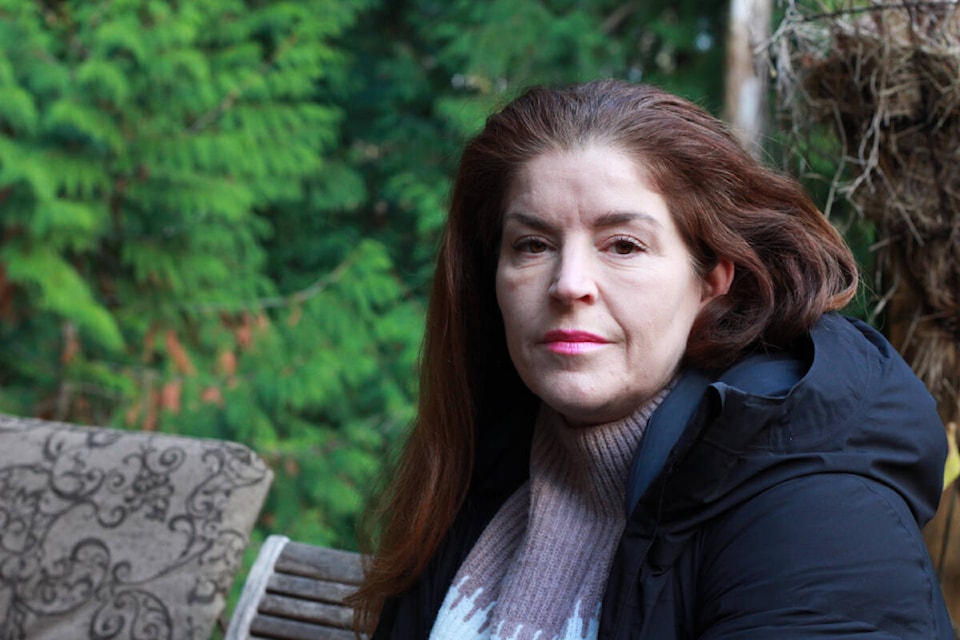
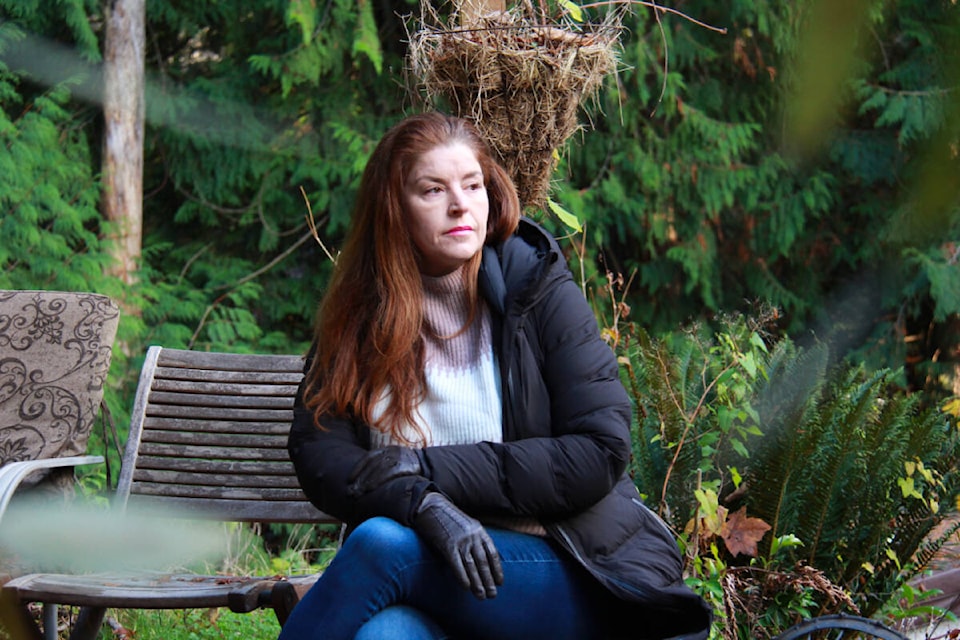
Elisha Bonnis sits in a treed area on her sister’s property on the Sunshine Coast on Nov. 29, 2023. She says it is one spot where she is able to find some peace. (Jane Skrypnek/Black Press Media)
When Elisha Bonnis woke up on a Monday morning in mid-November last year, she thought it was the beginning of the end. Not in the usual sense that implies impending disaster, she had already faced almost every kind of nightmare she could imagine. No, that morning Bonnis believed she would finally be standing up in court to face the man she says raped her on her birthday some nine years earlier.
Monday, Nov. 20 was supposed to mark the end of her fight, the end of devoting her life to gaining validation for herself and ensuring repercussions for him.
Her healing, she believed, was about to begin.
The single 52-year-old mother went about the morning as planned. She put on a long black dress and a grey blazer, an outfit she had picked out to make herself feel strong and professional. Strong, so she could hold herself together; professional, because she had learned over the last four-and-a-half years of pursuing civil action that her appearance and demeanour mattered. Credibility is crucial in a courtroom and she knew the judicial system’s history of holding sexual assault survivors to a higher standard than their assailants.
Bonnis spoke very little to her loved ones as she got ready to leave, her mind busy running over her testimony and her hands occupied packing one bag with water and snacks and a second with items that bring her comfort – a bottle of vanilla essential oil, a few beach rocks inscribed with the words of loved ones, and a bandana her boyfriend gifted her.
On the drive to the Vancouver courthouse, nausea and nerves twisted through her gut. She felt prepared and confident in many ways, but was terrified for the process. Taking deep, long breaths, she put on a playlist she had curated for that moment. Rise Up by Andra Day and Til it Happens to You by Lady Gaga flowed in through Bonnis’ ears and carved out a small safe place in her brain.
Elisha Bonnis sits in a treed area on her sister’s property on the Sunshine Coast on Nov. 29, 2023. She says it is one spot where she is able to find some peace. (Jane Skrypnek/Black Press Media)
She met her lawyer outside the courthouse and they made their way into the scheduling area to wait to be assigned a judge. Bonnis perched on a padded wooden chair and faced away from the entrance so she wouldn’t have to see the defendant enter.
She knew something had gone wrong when their scheduled 10 a.m. start time came and went. The clock kept ticking and others who were waiting on their own trials began to talk amongst themselves, voicing their concerns. Then, a courthouse staff member came out and told them the chief justice of the supreme court wanted to see them all.
The various groups filed into an upstairs courtroom and slid onto hard, wooden pews. Bonnis took a seat in a row just in front and to the side of the defendant, so she could see him in the periphery of her vision. Her heart beating uncontrollably as she heard the chief justice enter and speak: There were no judges, and everyone’s trials had been cancelled. This, he said, was the direct result of the federal government underfunding the judicial system.
Bonnis’ stomach dropped.
“It felt like just being let down one more gigantic, profound time.”
‘Crisis point’: Civil trial delays increasing across the country
Stories like Bonnis’ are becoming more common in B.C. and throughout Canada as delays that have been mounting for years in the civil justice system worsen.
It’s an issue legal professionals have long been sounding the alarm on, but they say little is being done at the government level and the average person is rarely aware of just how bad things can be unless they are battling through the system firsthand.
Civil trials can be heard at the provincial or supreme court level, but in B.C. civil sexual assault cases are always at the latter. There, one of the clearest measures of decline is in the per cent of trials being suddenly cancelled. Known as being “bumped” in legal terms, the cancellations occur when there aren’t enough judges available. Like Bonnis, people often don’t find out until the day of. And, once bumped, it could be months or years until they receive a new trial date, for which there is no guarantee it will occur either.
This means everything they’ve done to prepare – bringing in people from out of town, paying for expert reports, preparing witnesses to take the stand — will likely have to be done all over again.
“All of the exact fears I had, all of them have totally played themselves out in even a worse way than I imagined,” Bonnis says.
A few days before Christmas, she heard from her lawyer, who said they could get a new trial date but needed another $50,000 to move forward. It’s an amount Bonnis simply cannot afford.
That means she’s on her own now. She will have to represent herself, navigate the justice system, request medical and financial reports from experts to support her case, and learn how to question witnesses. When a trial does eventually happen, she will also be the one cross-examining her alleged rapist.
“It’s just the most inhumane, surreal possibility,” Bonnis says. “I know it’s not insurmountable, because I’ll do it. But oh my god, what’s that going to do to me?”
In 2009, about 5.3 per cent of civil trials at the B.C. Supreme Court were bumped, according to the court’s annual report. In 2014, that number increased to 10.2 per cent. Another five years later, in 2019, it reached 19 per cent. At that time, the B.C. Supreme Court described the situation as having hit “critical proportions.”
Yet the issue is still growing. The latest annual report, published in March 2023, shows almost 25 per cent of civil cases were bumped during the year prior.
Raji Mangat, the executive director of West Coast Women’s Legal Education and Action Fund, says she believes things have reached a crisis point.
The longer a trial takes, Mangat says, the more trauma a person endures, the more money they are forced to spend and the longer they have to wait to move on and heal.
“I can see why a lot of people just give up, because it’s so much to take on.”
Last summer, a national not-for-profit of legal professionals known as The Advocates’ Society released a report on the delays, calling on all levels of government to take urgent action.
The society pointed to a series of issues fuelling the problem, including the federal government’s failure to fill judicial vacancies, general understaffing and underfunding of the civil system, and outdated technology and procedures.Things were further exacerbated last year in B.C. when the provincial committee responsible for screening applicants for the federal justice minister went inactive for five months.
The Canadian Bar Association’s B.C. branch voiced concern about this as well in a letter directly to Minister Arif Virani in August.
“We’re not really getting any answers from government,” Scott Morishita, the branch’s president, says.
Black Press Media requested an interview with the B.C. Supreme Court, but was declined, andthe office of the federal justice minister did not respond to multiple requests prior to publication.
In a phone interview with Black Press Media, B.C. Attorney General Niki Sharma called Bonnis’ experience unacceptable. She said while it is important to take time to choose the right people to fill judicial positions, the process needs to speed up.
As of the end of January 2024, the B.C. Supreme Court is short 11 of its intended 95 judges. Assuming they carry an equal caseload, that amounts to about 12 per cent of the court’s capacity.
Vancouver-based litigation lawyer and The Advocates Society director Craig Ferris says newer and younger judges tend to take on more work than older ones, though, so the level of capacity lost is likely even higher.
Ferris says even if B.C. had its full complement of judges, delays would persist, however. He notes that while B.C.’s population has grown exponentially over the years, the number of judicial vacancies has not kept up.
Since 2002, the oldest year the Government of Canada was able to provide, the number of judicial positions at the B.C. Supreme Court has increased by seven, from 88 to 95. During the same period, the province’s population jumped from 4.1 million to 5.5 million people.
If every position were filled, B.C. would have 1.72 supreme court judges per 100,000 British Columbians right now compared to 2.15 judges per 100,000 people in 2002.
“They just keep trying to do more work with the same number of people. It is simply not working,” Ferris says.
Delays only exacerbate the burden survivors already bear
For Bonnis, the cost of such shortages is the difference between having a lawyer cross-examining the defendant and having to do it herself. But the sacrifice survivors of sexual assault make to enter the justice system begins long before they actually face anyone in the courtroom.
Few people choose to go that route at all. In Canada, just six per cent of sexual assault survivors made a report to police in 2019, according to Statistics Canada’s latest General Social Survey. Bonnis was hesitant to be a part of that small fraction, plagued by the shame and fear that most survivors report feeling, but she eventually decided to go the Vancouver Police Department.
She told officers that she was sexually assaulted on the night of her birthday in 2014.
According to her civil claim, she held a stand-up comedy night for friends and family on that day, headlined by herself. The defendant, who Bonnis knew from the comedy community, offered to get her home in a cab at the end of the night. Bonnis says in her claim that she told the friend multiple times that she didn’t want anything to happen between them and that he told her he would get her safely inside and then leave. Once there though, Bonnis says she passed out and woke up to him sexually assaulting her.
None of these allegations have been proven in court. Police investigated Bonnis’ case in 2018 and recommended sexual assault charges against the defendant to Crown Counsel, but the prosecution service said they didn’t believe they could prove Bonnis’ case “beyond a reasonable doubt” – the standard required for criminal offences.
Because sexual violence cases can lack physical evidence or witnesses, and rely primarily on the testimony of the survivor and assailant, they often don’t meet the Crown’s threshold for prosecution. A 2012 book called “Sexual Assault in Canada” by Elizabeth Sheehy found just 18.5 per cent of cases reported to police by women against men result in prosecution.
“It would take dramatic changes in women’s willingness to report these assaults to the police, or a concerted effort to alter current police and prosecutor policies, to improve this dismal rate of attrition and address what amounts to impunity for sexually violent men in Canada,” she wrote.
Bonnis believes her case is strong enough that it should have been taken on in the criminal system. She remembers calling the Crown prosecutor and begging him over and over again to reconsider.
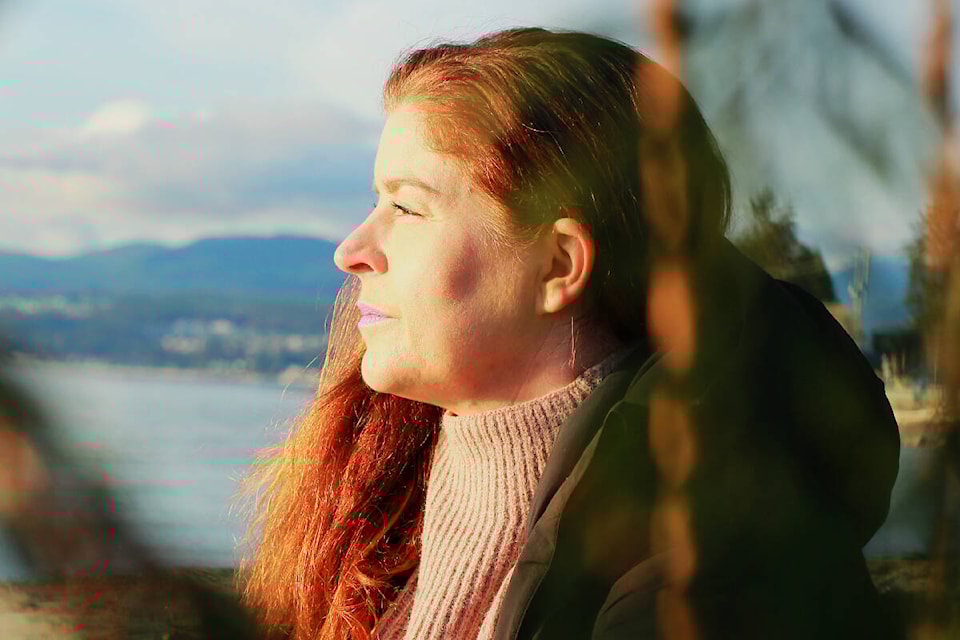
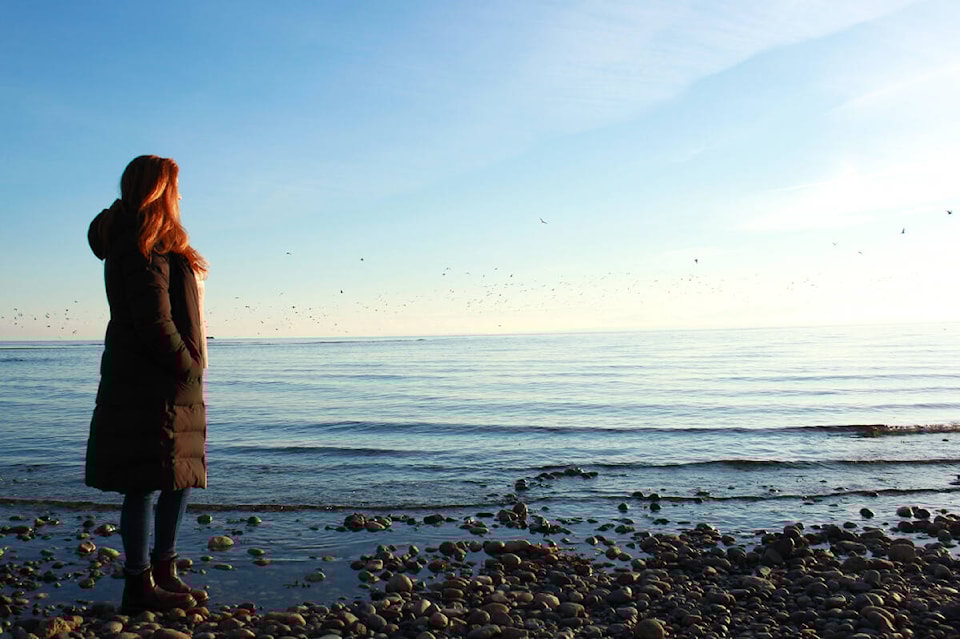
Elisha Bonnis looks out at the ocean off the Sunshine Coast, during a trip to the beach with her two dogs on Nov. 29, 2023. (Jane Skrypnek/Black Press Media)
Through all of this, her mental and physical health improve and plunge as her hope rises and falls.
She was diagnosed with Post-Traumatic Stress Disorder in the aftermath of the assault and now suffers from long episodes of anxiety and depression. Sometimes she shuts herself off from the world for weeks or months at a time. Even when she is around others, Bonnis says nightmares will shake her from her sleep and worm their way into her waking life in the form of intrusive thoughts. There are days when everything will be going perfectly well until the smallest of inconveniences send her spiralling for hours.
On two occasions, Bonnis says her blood pressure spiked so high she had to be rushed to the emergency room.
The retraumatization survivors endure while seeking justice is further magnified by the fact that they can’t always receive proper mental-health care when a trial is ongoing. Therapists will often caution patients against sharing the specifics of their sexual assault, in case counselling notes are introduced into the trial, says Community Legal Assistance Society lawyer Jennifer Khor. Any discrepancy between those records and what a survivor testifies could then be used against them.
This has been the case for Bonnis, who says she has received counselling for her trauma, but has yet to tell a health professional the specifics of the assault. Discussing this piece feels critical to her.
Her decline in mental health means she can no longer handle working full-time and has had to cut her job as an elementary school teacher in half. Other places she used to find joy and purpose are too overwhelming now.
Many areas of the stand-up comedy world no longer feel safe.
“My world has been devastated professionally, emotionally, physically, in every possible way.”
The let down of the criminal system sunk Bonnis into a state of despair until she learned about the possibility of justice through civil means. It’s a route some sexual assault survivors end up pursuing, not just in hopes of recovering financial damages, but as a means of having their story and trauma recognized in a formal capacity. The bar for a winning judgement is also more achievable, with a complainant having to prove their case “on a balance of probabilities,” rather than “beyond a reasonable doubt.”
The barrier here, though, is cost. A lawyer will often work on contingency if they believe there is a strong likelihood of a payout at the end, but if the defendant doesn’t have any assets, they will require payment up front. Bonnis says this is what her lawyer told her. Not only does it mean she has sunk tens of thousands of dollars into her case so far, it also means she is unlikely to see a dime from the proceedings if she wins.
But the result of a civil suit still holds weight for her.
“This legal validation is everything.”
Without it, Bonnis says, people perceive her as “just one more woman running around and saying ‘Oh, he raped me.’” Despite progress over the years, Bonnis says her experience is that society at large, and even some people close to her, are reluctant to believe survivors.
A civil ruling isn’t a conviction, but if Bonnis wins it will give her something official that says she was wronged and another person’s actions altered her life forever. And, although she likely won’t get paid, a ruling in her favour would still put a number value on how much she should be compensated – how much being sexually assaulted costs in the eyes of the court.
Defendant countersuing, denies wrongdoing
The defendant, who is now a permanent resident of the United States, is countersuing Bonnis for defamation and breaching the terms of a non-disparagement agreement. Black Press Media has chosen not to name him while that trial remains before the court.
In response to Bonnis’ claim, the defendant denies any wrongdoing. He claims in legal documents that while getting out of the taxi in front of Bonnis’ then-apartment, she asked him to come inside her home for a drink and that any sexual contact that occurred between them was consensual.
Black Press Media reached out to the defendant for comment. This included leaving a voicemail to a phone number listed on court documents, as well as sending two emails and additional messages to a social media account connected to his professional website. As of deadline, he had not responded to these requests.
‘It completely consumes your whole life’
For Bonnis, freeing up the money for the trial has meant selling her home in Vancouver, taking out lines of credit, borrowing from family members and allowing a friend to set up an online fundraiser, something Bonnis says she struggled not to feel shame over. It’s also meant she hasn’t had money available for other things, like paying for her son’s post-secondary education.
“It’s destroyed me financially,” she says. “There’s a ton of guilt.”
Just before her trial was supposed to start, Bonnis took one more step to come up with some last-minute money. She traded in the electric vehicle she was so proud of owning for the cheapest used car she could find.
“It was the last thing I had left from my life in Vancouver. It was the last thing I really owned that was of great value. That day I felt like I had lost everything I had built.”
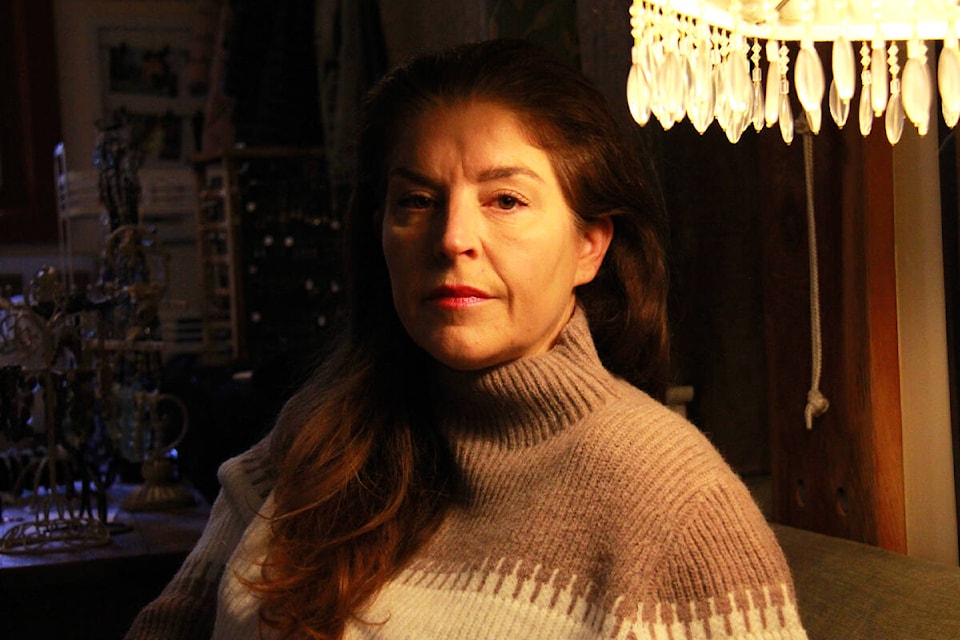
Elisha Bonnis sits in the living room of her home on the Sunshine Coast on Nov. 29, 2023. (Jane Skrypnek/Black Press Media)
Bonnis lives in a compact one-bedroom home on her sister’s property along the Sunshine Coast now.
She’s seated there in an armchair on a Wednesday at the end of November as her two Brussels Griffons, Honey and Boo, ask for attention at her feet. When she reaches down to pet them, the sleeve of her brown and cream knit sweater slides up and reveals part of a series of coloured floral tattoos she recently got done on her left arm.
The poinsettia, dahlia, peony, morning glory, stephanotis and forget-me-nots each represent a person in her life, but Bonnis got the tattoos for a very practical reason. One symptom of her PTSD is the urge to obsessively pick away at her skin, and the disorder has left raw spots and scars over much of her body. Planning for the tattoos forced her to let one area heal, so the ink could be safely applied. Now, she says, the artwork itself stops her from scraping at that arm. Her plan is to do the same for more of her body.
It’s the same kind of slow healing she hopes to be able to achieve for her mind as well. For now, though, she feels incapable of moving forward in that way. The irony of pursuing justice, she says, is that it retraumatizes a person for years on end and leaves them in a state of limbo.
“It completely consumes your whole life.”
The civil process is also intensely intrusive. While Bonnis works to prove that she was sexually assaulted and how she has suffered since then, the defendant does everything in his power to discredit her and write off her injuries to other incidents in her life. This means digging through her past.
Bonnis says the defendant has every document on her from birth to present. He knows where she has lived, where she has gone to school, anytime she has visited a doctor or hospital, whether she’s ever had a driving violation, what she’s filed in her tax returns and who she has ever had a sexual relationship with. Now that she has no lawyer as a go-between, Bonnis says he also knows her personal email and home address.
Civil sexual assault lawyer Janelle O’Connor says while many survivors of sexual violence enter the justice system to try to take back control after being violated, the level of disclosure demanded of them can sometimes leave them feeling even more powerless.
“In an ideal world we have a method that takes into account the trauma that has already been endured by survivors,” she says. In reality, O’Connor says the system likely contributes to underreporting and causes some of those who do come forward to withdraw. Worsening delays are only increasing those barriers to justice.
Advocates are concerned by how this impacts current survivors, as well as future ones and the progression of sexual assault law in general. The fewer cases that make it into the system, the less chance there is for precedents to be set and enduring sexual assault myths and stereotypes to be dispelled.
Bonnis is spending much of her time now preparing to face the defendant in court, on her own, with a new trial tentatively scheduled for March 2024. She’s applied to receive the three free hours of legal advice B.C. recently introduced for sexual assault survivors, but is otherwise alone, googling how to make legal applications and question witnesses.
In many ways she says it feels surreal, but in others it is what she is used to now. She’s sunk countless hours into this process over the years and says she’s lost faith that people who hold the power to create change for sexual assault survivors truly care to do so.
“We’re on our own. We have to do it ourselves. And the cost is way too great.”
Elisha Bonnis looks out at the ocean off the Sunshine Coast, during a trip to the beach with her two dogs on Nov. 29, 2023. (Jane Skrypnek/Black Press Media)