So far in the 21st century nearly a third of a billion children have been sexually abused, most of them multiple times, some thousands of times. 6 out of 7 are girls. Anything you can do to get this message to as many people as possible will help save abused children all over the world, and maybe even some of the abusers. Please read "Save A Child from Sexual Abuse by 3:15 PM" under "First Time Visitor?" May God bless you and anoint this ministry.
Everyday thousands of children are being sexually abused. You can stop the abuse of at least one child by simply praying. You can possibly stop the abuse of thousands of children by forwarding the link in First Time Visitor? by email, Twitter or Facebook to every Christian you know. Save a child or lots of children!!!! Do Something, please!
3:15 PM prayer in brief:
Pray for God to stop 1 child from being molested today.
Pray for God to stop 1 child molestation happening now.
Pray for God to rescue 1 child from sexual slavery.
Pray for God to save 1 girl from genital circumcision.
Pray for God to stop 1 girl from becoming a child-bride.
If you have the faith pray for 100 children rather than one.
Judges in the state of Texas who refuse to perform same-sex marriages based on their sincerely held religious beliefs will no longer face disciplinary action for doing so.
The Texas Supreme Court amended its judicial code of conduct last week to explicitly protect judges in a ruling that stems from a lawsuit filed by McLennan County Justice of the Peace Dianne Hensley, who in 2019 refused to marry same-sex couples, stating it would be "inconsistent with her religious faith."
At the time, the State Commission on Judicial Conduct (SCJC) issued a public warning against her, arguing the refusal cast doubt on her "capacity to act impartially" as a judge. Hensley then stopped performing all weddings.
But on Oct. 24, the court approved adding a new comment to Canon 4 of the Texas Code of Judicial Conduct: "It is not a violation of these canons for a judge to publicly refrain from performing a wedding ceremony based upon a sincerely held religious belief." The change took effect immediately.
In December 2019, Hensley sued the commission under the Texas Religious Freedom Restoration Act (TRFRA), claiming the warning substantially burdened her free exercise of religion. She sought $10,000 in lost income from forgoing opposite-sex weddings, plus attorney's fees. Lower courts dismissed the case in 2021, citing a failure to exhaust administrative remedies. However, in July 2024, the Texas Supreme Court reversed most of that judgment, ruling that Hensley's religious freedom claims were "clearly sufficient" under TRFRA and allowing the suit to proceed.
The new comment follows a request from the U.S. 5th Circuit Court of Appeals for clarification on the state's judicial code amid Hensley's ongoing federal challenge. It effectively removes the sanction against her and shields other judges from similar punishment.
Jonathan Saenz, president and attorney for Texas Values, which filed an amicus brief in support of Hensley in 2023, stated the update "should make it crystal clear that this religious freedom applies statewide, including in the case of Judge Diane Hensley," and could resolve her lingering lower court challenges.
“The Texas Supreme Court got it right with this important victory for religious freedom. In a state where religious freedom is widely supported, it’s common sense that a judge should not be punished for sincerely held religious beliefs,” Saenz said. “A judge should not have to choose between their conscience and their career.”
In Texas, judges and justices of the peace are not required to officiate weddings, but in the wake of the 2015 Obergefell v. Hodgesruling, they were expected to perform them for both same-sex and opposite-sex couples or neither. The new rule allows them to selectively refrain based on religious objections.
The guidance arrives as the U.S. Supreme Court is set to hold a private conference on Nov. 7 to consider a challenge to same-sex marriage from Kim Davis, the former Kentucky county clerk who refused licenses to gay couples after the Obergefell decision legalizing it nationwide.
Delays in civil justice system forcing one woman to go one-on-one against the man she says raped her
Jane Skrypnek
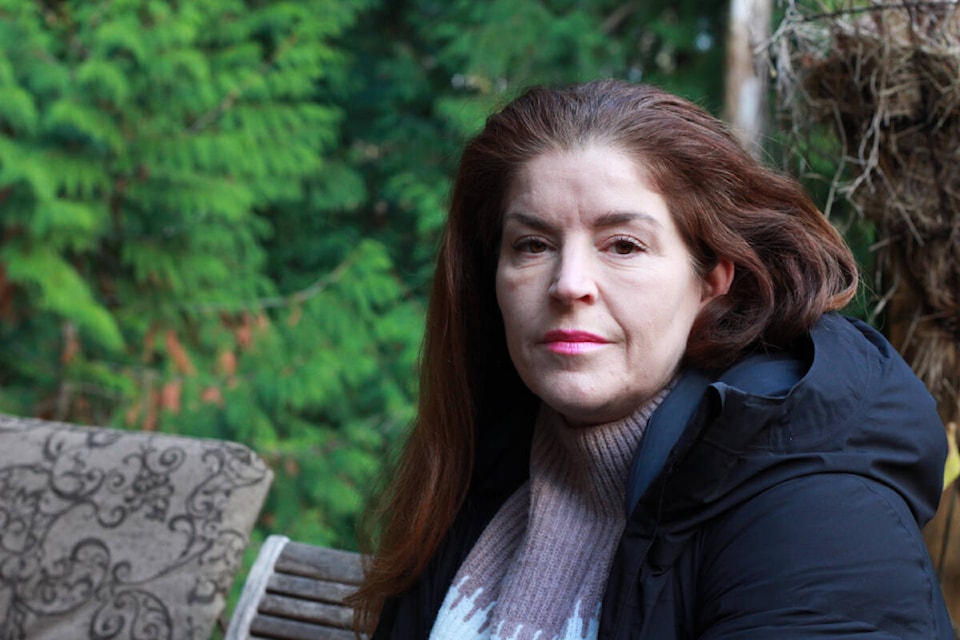
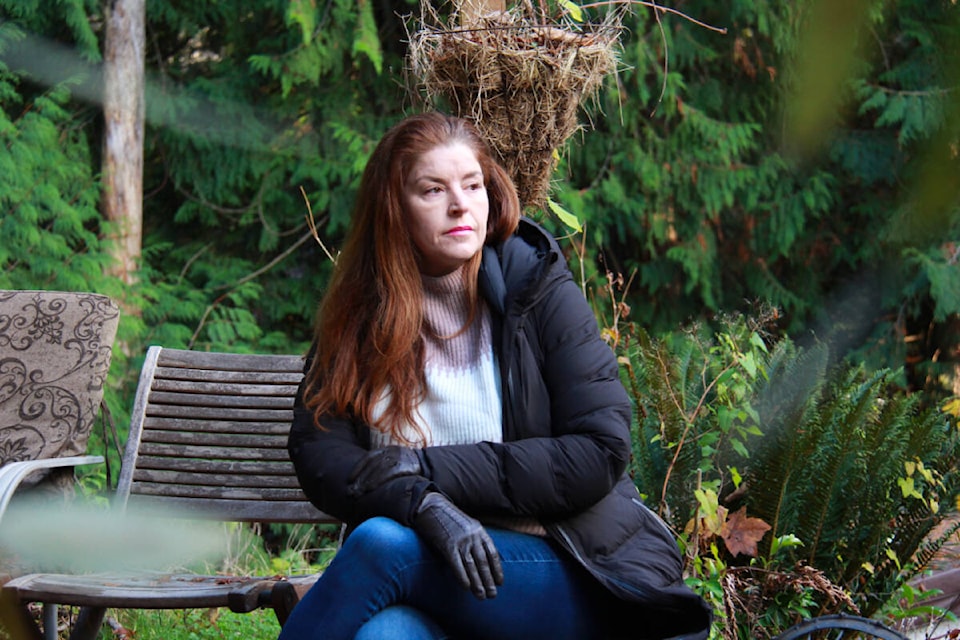
Elisha Bonnis sits in a treed area on her sister’s property on the Sunshine Coast on Nov. 29, 2023. She says it is one spot where she is able to find some peace. (Jane Skrypnek/Black Press Media)
When Elisha Bonnis woke up on a Monday morning in mid-November last year, she thought it was the beginning of the end. Not in the usual sense that implies impending disaster, she had already faced almost every kind of nightmare she could imagine. No, that morning Bonnis believed she would finally be standing up in court to face the man she says raped her on her birthday some nine years earlier.
Monday, Nov. 20 was supposed to mark the end of her fight, the end of devoting her life to gaining validation for herself and ensuring repercussions for him.
Her healing, she believed, was about to begin.
The single 52-year-old mother went about the morning as planned. She put on a long black dress and a grey blazer, an outfit she had picked out to make herself feel strong and professional. Strong, so she could hold herself together; professional, because she had learned over the last four-and-a-half years of pursuing civil action that her appearance and demeanour mattered. Credibility is crucial in a courtroom and she knew the judicial system’s history of holding sexual assault survivors to a higher standard than their assailants.
Bonnis spoke very little to her loved ones as she got ready to leave, her mind busy running over her testimony and her hands occupied packing one bag with water and snacks and a second with items that bring her comfort – a bottle of vanilla essential oil, a few beach rocks inscribed with the words of loved ones, and a bandana her boyfriend gifted her.
On the drive to the Vancouver courthouse, nausea and nerves twisted through her gut. She felt prepared and confident in many ways, but was terrified for the process. Taking deep, long breaths, she put on a playlist she had curated for that moment. Rise Up by Andra Day and Til it Happens to You by Lady Gaga flowed in through Bonnis’ ears and carved out a small safe place in her brain.
Elisha Bonnis sits in a treed area on her sister’s property on the Sunshine Coast on Nov. 29, 2023. She says it is one spot where she is able to find some peace. (Jane Skrypnek/Black Press Media)
She met her lawyer outside the courthouse and they made their way into the scheduling area to wait to be assigned a judge. Bonnis perched on a padded wooden chair and faced away from the entrance so she wouldn’t have to see the defendant enter.
She knew something had gone wrong when their scheduled 10 a.m. start time came and went. The clock kept ticking and others who were waiting on their own trials began to talk amongst themselves, voicing their concerns. Then, a courthouse staff member came out and told them the chief justice of the supreme court wanted to see them all.
The various groups filed into an upstairs courtroom and slid onto hard, wooden pews. Bonnis took a seat in a row just in front and to the side of the defendant, so she could see him in the periphery of her vision. Her heart beating uncontrollably as she heard the chief justice enter and speak: There were no judges, and everyone’s trials had been cancelled. This, he said, was the direct result of the federal government underfunding the judicial system.
Bonnis’ stomach dropped.
“It felt like just being let down one more gigantic, profound time.”
‘Crisis point’: Civil trial delays increasing across the country
Stories like Bonnis’ are becoming more common in B.C. and throughout Canada as delays that have been mounting for years in the civil justice system worsen.
It’s an issue legal professionals have long been sounding the alarm on, but they say little is being done at the government level and the average person is rarely aware of just how bad things can be unless they are battling through the system firsthand.
Civil trials can be heard at the provincial or supreme court level, but in B.C. civil sexual assault cases are always at the latter. There, one of the clearest measures of decline is in the per cent of trials being suddenly cancelled. Known as being “bumped” in legal terms, the cancellations occur when there aren’t enough judges available. Like Bonnis, people often don’t find out until the day of. And, once bumped, it could be months or years until they receive a new trial date, for which there is no guarantee it will occur either.
This means everything they’ve done to prepare – bringing in people from out of town, paying for expert reports, preparing witnesses to take the stand — will likely have to be done all over again.
“All of the exact fears I had, all of them have totally played themselves out in even a worse way than I imagined,” Bonnis says.
A few days before Christmas, she heard from her lawyer, who said they could get a new trial date but needed another $50,000 to move forward. It’s an amount Bonnis simply cannot afford.
That means she’s on her own now. She will have to represent herself, navigate the justice system, request medical and financial reports from experts to support her case, and learn how to question witnesses. When a trial does eventually happen, she will also be the one cross-examining her alleged rapist.
“It’s just the most inhumane, surreal possibility,” Bonnis says. “I know it’s not insurmountable, because I’ll do it. But oh my god, what’s that going to do to me?”
In 2009, about 5.3 per cent of civil trials at the B.C. Supreme Court were bumped, according to the court’s annual report. In 2014, that number increased to 10.2 per cent. Another five years later, in 2019, it reached 19 per cent. At that time, the B.C. Supreme Court described the situation as having hit “critical proportions.”
Yet the issue is still growing. The latest annual report, published in March 2023, shows almost 25 per cent of civil cases were bumped during the year prior.
Raji Mangat, the executive director of West Coast Women’s Legal Education and Action Fund, says she believes things have reached a crisis point.
The longer a trial takes, Mangat says, the more trauma a person endures, the more money they are forced to spend and the longer they have to wait to move on and heal.
“I can see why a lot of people just give up, because it’s so much to take on.”
Last summer, a national not-for-profit of legal professionals known as The Advocates’ Society released a report on the delays, calling on all levels of government to take urgent action.
The society pointed to a series of issues fuelling the problem, including the federal government’s failure to fill judicial vacancies, general understaffing and underfunding of the civil system, and outdated technology and procedures.Things were further exacerbated last year in B.C. when the provincial committee responsible for screening applicants for the federal justice minister went inactive for five months.
The Canadian Bar Association’s B.C. branch voiced concern about this as well in a letter directly to Minister Arif Virani in August.
“We’re not really getting any answers from government,” Scott Morishita, the branch’s president, says.
Black Press Media requested an interview with the B.C. Supreme Court, but was declined, andthe office of the federal justice minister did not respond to multiple requests prior to publication.
In a phone interview with Black Press Media, B.C. Attorney General Niki Sharma called Bonnis’ experience unacceptable. She said while it is important to take time to choose the right people to fill judicial positions, the process needs to speed up.
As of the end of January 2024, the B.C. Supreme Court is short 11 of its intended 95 judges. Assuming they carry an equal caseload, that amounts to about 12 per cent of the court’s capacity.
Vancouver-based litigation lawyer and The Advocates Society director Craig Ferris says newer and younger judges tend to take on more work than older ones, though, so the level of capacity lost is likely even higher.
Ferris says even if B.C. had its full complement of judges, delays would persist, however. He notes that while B.C.’s population has grown exponentially over the years, the number of judicial vacancies has not kept up.
Since 2002, the oldest year the Government of Canada was able to provide, the number of judicial positions at the B.C. Supreme Court has increased by seven, from 88 to 95. During the same period, the province’s population jumped from 4.1 million to 5.5 million people.
If every position were filled, B.C. would have 1.72 supreme court judges per 100,000 British Columbians right now compared to 2.15 judges per 100,000 people in 2002.
“They just keep trying to do more work with the same number of people. It is simply not working,” Ferris says.
Delays only exacerbate the burden survivors already bear
For Bonnis, the cost of such shortages is the difference between having a lawyer cross-examining the defendant and having to do it herself. But the sacrifice survivors of sexual assault make to enter the justice system begins long before they actually face anyone in the courtroom.
Few people choose to go that route at all. In Canada, just six per cent of sexual assault survivors made a report to police in 2019, according to Statistics Canada’s latest General Social Survey. Bonnis was hesitant to be a part of that small fraction, plagued by the shame and fear that most survivors report feeling, but she eventually decided to go the Vancouver Police Department.
She told officers that she was sexually assaulted on the night of her birthday in 2014.
According to her civil claim, she held a stand-up comedy night for friends and family on that day, headlined by herself. The defendant, who Bonnis knew from the comedy community, offered to get her home in a cab at the end of the night. Bonnis says in her claim that she told the friend multiple times that she didn’t want anything to happen between them and that he told her he would get her safely inside and then leave. Once there though, Bonnis says she passed out and woke up to him sexually assaulting her.
None of these allegations have been proven in court. Police investigated Bonnis’ case in 2018 and recommended sexual assault charges against the defendant to Crown Counsel, but the prosecution service said they didn’t believe they could prove Bonnis’ case “beyond a reasonable doubt” – the standard required for criminal offences.
Because sexual violence cases can lack physical evidence or witnesses, and rely primarily on the testimony of the survivor and assailant, they often don’t meet the Crown’s threshold for prosecution. A 2012 book called “Sexual Assault in Canada” by Elizabeth Sheehy found just 18.5 per cent of cases reported to police by women against men result in prosecution.
“It would take dramatic changes in women’s willingness to report these assaults to the police, or a concerted effort to alter current police and prosecutor policies, to improve this dismal rate of attrition and address what amounts to impunity for sexually violent men in Canada,” she wrote.
Bonnis believes her case is strong enough that it should have been taken on in the criminal system. She remembers calling the Crown prosecutor and begging him over and over again to reconsider.
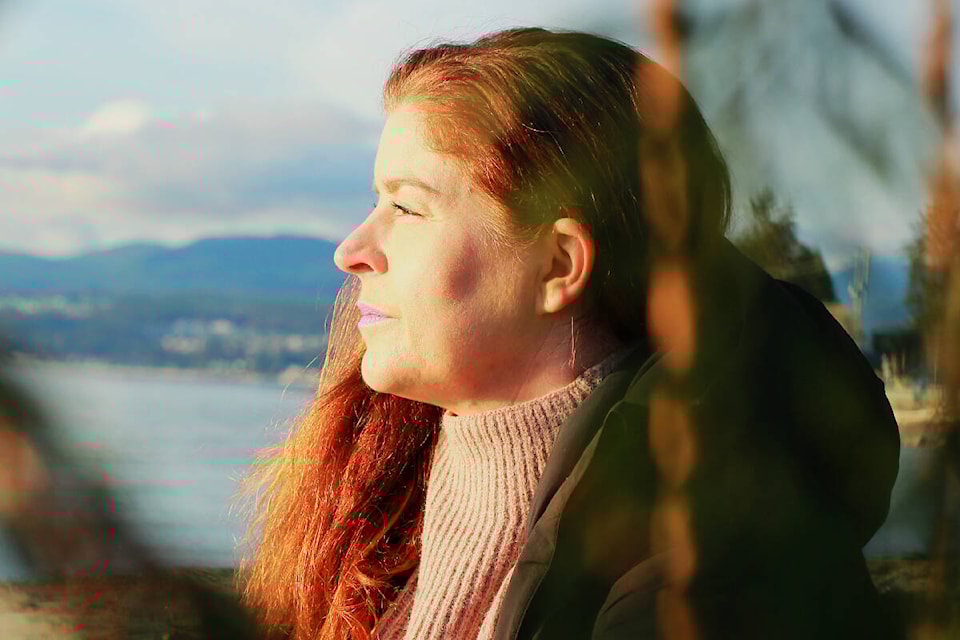
Elisha Bonnis looks out at the ocean off the Sunshine Coast, during a trip to the beach with her two dogs on Nov. 29, 2023. (Jane Skrypnek/Black Press Media)
Through all of this, her mental and physical health improve and plunge as her hope rises and falls.
She was diagnosed with Post-Traumatic Stress Disorder in the aftermath of the assault and now suffers from long episodes of anxiety and depression. Sometimes she shuts herself off from the world for weeks or months at a time. Even when she is around others, Bonnis says nightmares will shake her from her sleep and worm their way into her waking life in the form of intrusive thoughts. There are days when everything will be going perfectly well until the smallest of inconveniences send her spiralling for hours.
On two occasions, Bonnis says her blood pressure spiked so high she had to be rushed to the emergency room.
The retraumatization survivors endure while seeking justice is further magnified by the fact that they can’t always receive proper mental-health care when a trial is ongoing. Therapists will often caution patients against sharing the specifics of their sexual assault, in case counselling notes are introduced into the trial, says Community Legal Assistance Society lawyer Jennifer Khor. Any discrepancy between those records and what a survivor testifies could then be used against them.
This has been the case for Bonnis, who says she has received counselling for her trauma, but has yet to tell a health professional the specifics of the assault. Discussing this piece feels critical to her.
Her decline in mental health means she can no longer handle working full-time and has had to cut her job as an elementary school teacher in half. Other places she used to find joy and purpose are too overwhelming now.
Many areas of the stand-up comedy world no longer feel safe.
“My world has been devastated professionally, emotionally, physically, in every possible way.”
The let down of the criminal system sunk Bonnis into a state of despair until she learned about the possibility of justice through civil means. It’s a route some sexual assault survivors end up pursuing, not just in hopes of recovering financial damages, but as a means of having their story and trauma recognized in a formal capacity. The bar for a winning judgement is also more achievable, with a complainant having to prove their case “on a balance of probabilities,” rather than “beyond a reasonable doubt.”
The barrier here, though, is cost. A lawyer will often work on contingency if they believe there is a strong likelihood of a payout at the end, but if the defendant doesn’t have any assets, they will require payment up front. Bonnis says this is what her lawyer told her. Not only does it mean she has sunk tens of thousands of dollars into her case so far, it also means she is unlikely to see a dime from the proceedings if she wins.
But the result of a civil suit still holds weight for her.
“This legal validation is everything.”
Without it, Bonnis says, people perceive her as “just one more woman running around and saying ‘Oh, he raped me.’” Despite progress over the years, Bonnis says her experience is that society at large, and even some people close to her, are reluctant to believe survivors.
A civil ruling isn’t a conviction, but if Bonnis wins it will give her something official that says she was wronged and another person’s actions altered her life forever. And, although she likely won’t get paid, a ruling in her favour would still put a number value on how much she should be compensated – how much being sexually assaulted costs in the eyes of the court.
Defendant countersuing, denies wrongdoing
The defendant, who is now a permanent resident of the United States, is countersuing Bonnis for defamation and breaching the terms of a non-disparagement agreement. Black Press Media has chosen not to name him while that trial remains before the court.
In response to Bonnis’ claim, the defendant denies any wrongdoing. He claims in legal documents that while getting out of the taxi in front of Bonnis’ then-apartment, she asked him to come inside her home for a drink and that any sexual contact that occurred between them was consensual.
Black Press Media reached out to the defendant for comment. This included leaving a voicemail to a phone number listed on court documents, as well as sending two emails and additional messages to a social media account connected to his professional website. As of deadline, he had not responded to these requests.
‘It completely consumes your whole life’
For Bonnis, freeing up the money for the trial has meant selling her home in Vancouver, taking out lines of credit, borrowing from family members and allowing a friend to set up an online fundraiser, something Bonnis says she struggled not to feel shame over. It’s also meant she hasn’t had money available for other things, like paying for her son’s post-secondary education.
“It’s destroyed me financially,” she says. “There’s a ton of guilt.”
Just before her trial was supposed to start, Bonnis took one more step to come up with some last-minute money. She traded in the electric vehicle she was so proud of owning for the cheapest used car she could find.
“It was the last thing I had left from my life in Vancouver. It was the last thing I really owned that was of great value. That day I felt like I had lost everything I had built.”
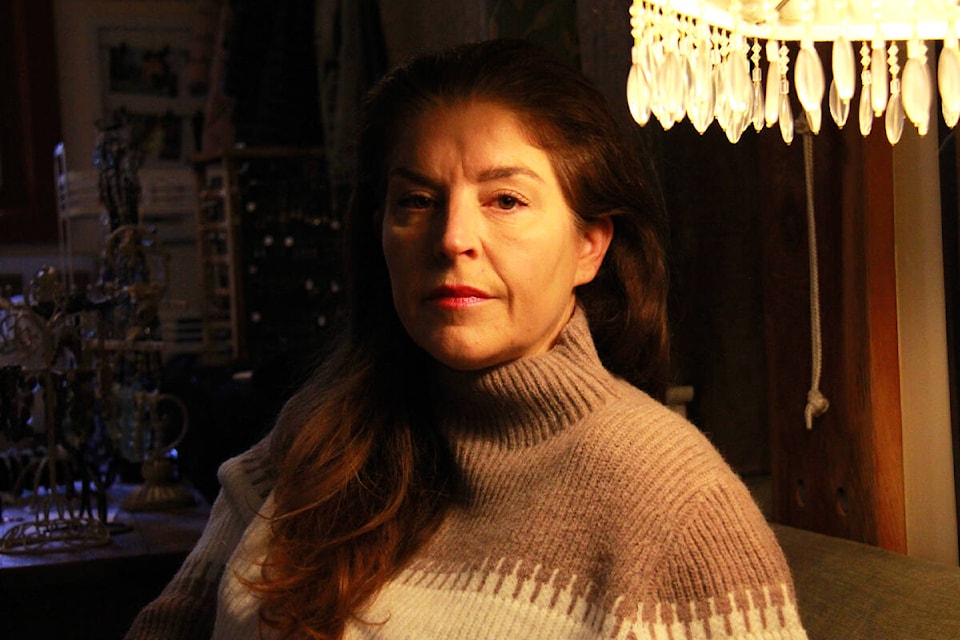
Elisha Bonnis sits in the living room of her home on the Sunshine Coast on Nov. 29, 2023. (Jane Skrypnek/Black Press Media)
Bonnis lives in a compact one-bedroom home on her sister’s property along the Sunshine Coast now.
She’s seated there in an armchair on a Wednesday at the end of November as her two Brussels Griffons, Honey and Boo, ask for attention at her feet. When she reaches down to pet them, the sleeve of her brown and cream knit sweater slides up and reveals part of a series of coloured floral tattoos she recently got done on her left arm.
The poinsettia, dahlia, peony, morning glory, stephanotis and forget-me-nots each represent a person in her life, but Bonnis got the tattoos for a very practical reason. One symptom of her PTSD is the urge to obsessively pick away at her skin, and the disorder has left raw spots and scars over much of her body. Planning for the tattoos forced her to let one area heal, so the ink could be safely applied. Now, she says, the artwork itself stops her from scraping at that arm. Her plan is to do the same for more of her body.
It’s the same kind of slow healing she hopes to be able to achieve for her mind as well. For now, though, she feels incapable of moving forward in that way. The irony of pursuing justice, she says, is that it retraumatizes a person for years on end and leaves them in a state of limbo.
“It completely consumes your whole life.”
The civil process is also intensely intrusive. While Bonnis works to prove that she was sexually assaulted and how she has suffered since then, the defendant does everything in his power to discredit her and write off her injuries to other incidents in her life. This means digging through her past.
Bonnis says the defendant has every document on her from birth to present. He knows where she has lived, where she has gone to school, anytime she has visited a doctor or hospital, whether she’s ever had a driving violation, what she’s filed in her tax returns and who she has ever had a sexual relationship with. Now that she has no lawyer as a go-between, Bonnis says he also knows her personal email and home address.
Civil sexual assault lawyer Janelle O’Connor says while many survivors of sexual violence enter the justice system to try to take back control after being violated, the level of disclosure demanded of them can sometimes leave them feeling even more powerless.
“In an ideal world we have a method that takes into account the trauma that has already been endured by survivors,” she says. In reality, O’Connor says the system likely contributes to underreporting and causes some of those who do come forward to withdraw. Worsening delays are only increasing those barriers to justice.
Advocates are concerned by how this impacts current survivors, as well as future ones and the progression of sexual assault law in general. The fewer cases that make it into the system, the less chance there is for precedents to be set and enduring sexual assault myths and stereotypes to be dispelled.
Bonnis is spending much of her time now preparing to face the defendant in court, on her own, with a new trial tentatively scheduled for March 2024. She’s applied to receive the three free hours of legal advice B.C. recently introduced for sexual assault survivors, but is otherwise alone, googling how to make legal applications and question witnesses.
In many ways she says it feels surreal, but in others it is what she is used to now. She’s sunk countless hours into this process over the years and says she’s lost faith that people who hold the power to create change for sexual assault survivors truly care to do so.
“We’re on our own. We have to do it ourselves. And the cost is way too great.”
Elisha Bonnis looks out at the ocean off the Sunshine Coast, during a trip to the beach with her two dogs on Nov. 29, 2023. (Jane Skrypnek/Black Press Media)
I have been very reluctant to get into the notion of 'the Illuminati', and global conspiracies of child predators, satanic abuse, and murder. I am inclined to believe that international rings of satanic rituals involving child sacrifice are unlikely. However, I have no doubt that there are paedophile rings operating at the highest levels of many governments around the world. Some of them are documented on this blog - see sidebar: The Great Belgium... 60 Minutes... Demi and Nirvana...
By Reina Michaelson, Dr., ‘Young Victorian of the Year’ for Community Service, and ‘Young Australian of the Year’ for Community Service
The following is a summary of events that detail the infiltration of a high-profile, powerful group of child sex offenders into my child abuse prevention organisation. What was uncovered as a result of this infiltration was the existence of an Illuminati-based child pornography and pedophile ring that is operating in Australia, under the protection of senior-ranking members of Victoria Police. The members of the network include senior management and executives from a major television network, media celebrities, high-ranking politicians, police officers in charge of pedophile and child pornography investigations, senior management representatives from the Department of Education, directors of “child-focused” service clubs, wealthy businessmen, and others. I have tried to keep the account as brief as possible while trying to include all relevant information. The description covers events from 1995 until present. The names of individuals have been changed.
Department of Education Protects Pedophile Teacher
In 1995 I started running Australia’s first child sexual abuse prevention program in schools, the Child Sexual Abuse Prevention Program (CSAPP). This school-based program teaches children how to protect themselves from sexual abuse and what to do if someone tries to sexually abuse them. The program also teaches adults how they can best protect children under their care from sexual abuse. My assistant and I were at a particular high school in the northern region working with Year 9 boys. We received a note written anonymously by one of the boys asking “What do you do if you get raped by a teacher and no-one will believe you? What happens if you get raped and you enjoy it?”. Later during that day we were asked exactly the same question by a boy who was flushed red with embarrassment. I replied “Talk to the Student Welfare Coordinator”, to which he replied “What if he is the one who won’t believe you?”. I emphasizied that it is important to keep telling until someone believes you.
During the day my assistant and I noticed the strange behaviour of a particular teacher, called “Dick Newman”. Later that afternoon I learnt that the car I had been driving had been rammed in the school’s car-park. Witnesses reported that the car had been rammed deliberately by a man who then drove off very quickly.
The local police were called and ran a licence check on the car and discovered that the number-plate was fake. They then took photos of the crime scene using the school’s camera. Later, when it was revealed that a teacher was under suspicion of sexually abusing the children at the school and then organising the ramming of my car to intimidate me, the photos went “missing”, and no further action was taken.
”Dick Newman” was the only person at the school who knew my car, as he had taken it upon himself to show me to my car to give me directions to the shops during a break in classes.
It was organised that the boys in Year 9 would be interviewed in order to find the victims and give them appropriate support. Three people (including myself, my assistant and a counsellor from a sexual assault centre) were responsible for conducting the interviews. At the completion of the interviews, there were concerns for approximately 12 of the boys. These concerns related specifically to sexual assault by a teacher at the school. However, by this stage (over a week had passed since the initial program) it was clear that the boys had been threatened. For example, when I interviewed the boy who had asked the questions about sexual abuse by a teacher and not being believed, he huddled into a foetal position, started crying, and said he could not tell me what happened. When I asked him why he couldn’t tell me, he replied that he had been threatened with his life. His best friend told me he would never tell what had happened.
Some time after this, we organised a theatre company performance for the students (on the topic of sexual abuse). While the children were seated and waiting for the play to begin, “Dick Newman” made an unscheduled visit to the hall. He proceeded to stand in front of each of the boys we had identified as potential victims and stare them down. The boys, who had been happy and laughing in the excitement of waiting for the play to begin, went grey with fear. Finally, I stood in front of “Dick Newman” so that he could not intimidate the boys any further.
I was then told no further action would be taken as the boys had not named the offender.
Program Infiltrated by Pedophile Board of Management
In 1996/97 I was named ‘Young Victorian of the Year’ for Community Service, and later ‘Young Australian of the Year’ for Community Service. One of the judges was a well-connected government official Don Hyde, and another was Robert Osmotherly, the General Manager of one of the major Australian television networks, Network Ten.
After winning this award, Robert Osmotherly approached me and said that he had never heard of this terrible crime (child sexual abuse) before meeting me. He said wanted to help me get my program into every school in Victoria within five years and said he had the money and the connections to do this. He said he would raise half a million dollars in six-weeks and have it matched within 6-months. He said that he and Don Hyde would set my program up as an independent organisation and that they would establish a Board of Management consisting of all of their powerful and influential friends. Don Hyde would become President of the organisation and Robert Osmotherly, Vice-President.
I agreed to Robert Osmotherly’s proposal as it sounded as if he would enable the program to receive substantial funding and therefore be able to reach many more children within Victoria, and across Australia. I did not consider for a second that Robert Osmotherly and Don Hyde could have been deceiving me in order to get control of, and ultimately, to destroy the child sexual abuse prevention program that I had developed.
The Board members and supporters that they brought to the organisation were very powerful and from the highest echelons of society. These included the Editor-in Chief of a major Australian newspaper, the former head of a child-focussed service club, the head of the largest agricultural society in Victoria, the partner from a well-known law firm, an extremely wealthy businessman and former Network Ten board member, the head of a well-known accounting firm, the head of a successful advertising company, and others.
Despite having such wealth and powerful connections, in the two-year period that they served on the Board they organised only one donation of $25,000. The board members subsequently despised the donor and ostracised him from their community (which at the time I thought was incredibly ungrateful!). This is compared with over $200,000 my family and I raised doing the fundraising ourselves in the same time period!
Furthermore, my efforts to secure funding were being actively sabotaged. For example, after an interview on the Channel 9 ‘Today’ show, I was contacted by a well-known multi-national company, who said that they would like to fund my program. This well-known company was located in Sydney, and as Robert Osmotherly frequently went to Sydney, I asked if he would have a meeting with them on behalf of our organisation. He agreed. However, when he returned from the meeting, he said for me not to have much hope and not to contact them for six months while they sorted out a new tax issue. I found this very odd, as they had been so keen to fund the organisation when I had spoken to them. I phoned the woman whom I had spoken to, and she confirmed my suspicions. She had been at the meeting and Robert Osmotherly had told the company not to bother funding us, as “the organisation won’t be around in six months”. Needless to say, we did not receive the funding.
During this time period, I was without any income for four months. Many other people would have quit and sought other employment, however, I believed passionately in my cause and did not give up, much to the chagrin of Robert Osmotherly. On one occasion he said to me “You have given so much to this cause in your life, why don’t you just give up? You have achieved more good in your short life than many do in a long life-time. Why don’t you retire down in the country (I was 28 years old). Go on, just give up”. When I replied that I would never give up, he stormed away! I was confused by this behaviour, but as I trusted him I did not think too much more about it at the time.
The Board members achieved one other “in-kind” donation. It was the use of a Honda CRV vehicle. I appreciated the use of the vehicle while I had it (approximately 18 months). However, I later discovered that the head of the company that donated it, a close friend of Don Hyde, had just been convicted of child sex offences. These offences included the production of child pornography.
Meeting with VERY POWERFUL Pedophile Politician
After winning the award, I had a meeting with a very powerful state politician, Jeff Kennett. At that time, Jeff Kennett was the most powerful person in the state. As well as being politically powerful he also had key business interests, including in the media. When I was first introduced to him, he was staring at me quite sleazily. After he asked what work I do, and my response “child abuse prevention”, he would not make eye contact at all and sought to exclude me from the meeting in a very bullying manner. It was well-known that Jeff Kennett was a serious domestic violence offender, and that his wife was frequently being admitted to shelters in secret. However, given the power and status of Mr. Kennett, the issue was never raised in the mainstream media.
I was later to be informed by a very reliable and trusted source from the child welfare field that there is a file containing serious child sex offences (against boys) by Jeff Kennett, but because of his enormous power in Victoria, the police would not act on it. I also discovered from a former sex worker that Jeff Kennett frequently paid St. Kilda boy sex workers for sex, and that one of these boys “talked too much to the wrong people and ended up dead with an ‘accidental’ heroin overdose”. It was also alleged that Jeff Kennett intentionally abused the boys in unusual situations (for example, in a helicopter) so that if it ever got out, the boys’ testimonies would seem unbelievable. This of-course, is exactly the same strategy used by offenders in the U.S child-care centre cases. Interestingly, Jeff Kennett has recently commissioned a statue of himself – as a gargoyle.
Later I met with another politician (from the same political party) who told me that “Jeff Kennett is REALLY into that (child sex abuse)”. This same politician told me that in the late 1980’s and early 1990’s, the police were “getting too close to the truth, too close to people in high positions of power who are also pedophiles” and so the unit that had been established to investigate organised pedophilia was shut down. (Soon after a pedophile police officer was put in charge of investigating these offences to ensure that the truth never got out and that this high-ranking network of offenders would never get caught).
There is much more to this disturbing story at Crazz Files. I have never seen this site before and cannot recommend it for veracity.
2005 - South Australia Parliamentary Speaker of the House, Peter Lewis
"There are a large number, but not a high percentage, of people in high places and positions of trust who take it for granted that they can indulge their sexual appetites for children of both sexes so long as they arrange to cover it up and get away with it," "It's a national problem and MPs involved seem to know each other." 1st April 2005 statement
"The most outrageous thing of all, which disturbs me most about the information ... is... what appears to be the related and organised activities of those paedophiles in high public office—that is, the judiciary, the senior ranks of human services portfolios, some police, and MPs, across the nation, especially within the ranks of the Labor Party."4th April 2005 Resignation Speech
It is hard to find anything more recent on this story, which is very unfortunate. If you have some credible information, please forward it to me.
I wonder if Victoria's law preventing child sex abuse survivors from publishing their story using their real name, has its roots in this?
UK figures show shocking statistics on child sex abuse Child sexual abuse virtually doubling in many areas
ROSEANNE EDWARDS
Banbury Guardian
NSPCC press officer Gareth Hill said information for the UK in the last year, obtained through freedom of information legislation, shows 76,204 offences were recorded including rape, grooming and sexual assault against children – an average of one every seven minutes.
The NSPCC’s latest reports show that recorded sexual offences against children in Warwickshire have risen by 92 per cent in the last four years.
In Northamptonshire the rise has been 87 per cent and the statistics for the Thames Valley police area are 48 per cent higher.
The figures have been released by the NSPCC. They show:
• In Warks, 698 sexual offences against children were recorded in 2018/19 compared to 363 in 2014/15
• In Northants there were 1,246 offences recorded by Northamptonshire Police in 2018/19 – up from 668 in 2014/15. Of these, 326 were against children aged ten and under with 11 of the offences against babies under the age of one year
• There were 2,690 offences recorded by Thames Valley Police in 2018/19 – up from 1,815 in 2014/15. Of these, 778 offences were against children aged ten and under.
All sexually abused children need psychological help, and lots of it. But most are not getting the help they need. This will result in hundreds of thousands of adults with very significant mental health problems.
Children who suffered sexual abuse will need extensive support but overstretched services can’t keep pace with demand and the NSPCC is calling for a radical reshaping of how this support is delivered across the country.
Peter Wanless, NSPCC CEO, said: “Record numbers of child sexual offences means we are facing a nationwide crisis in the help available for tens of thousands of children.
“These children are bravely disclosing what happened to them but in too many cases there is not enough timely, joined up and child-friendly support. Instead they are shunted from overstretched service to service. We need a radical rethink in the way we help these young people, otherwise they could struggle for the rest of their lives with long term, deep seated trauma.”
The charity is calling for the provision of specialised services around the country, with an emphasis on early joined-up support from police, NHS services, children’s services and advocacy for children who have experienced sexual abuse, offered in child-friendly spaces.
Such a partnership service is delivered in The Lighthouse in Camden, where medical, advocacy, social care, police and therapeutic services are available to children and their families. This ‘one stop shop’ model connects up timely therapy with the needs of each child, with local NHS services from University College London Hospital and the Tavistock and Portman NHS Trusts delivering in partnership with the NSPCC’s Letting the Future In (LTFI) service.
LTFI provides therapeutic support for children who have been sexually abused. Young people who use the service showed a significant reduction in psychological and behavioural problems.
Higher recorded sex offences do not necessarily reflect high prevalence of sex offence crimes, and could be explained by better recording, greater awareness of what abuse is and survivors feeling more confident in coming forward, says the NSPCC.
There were 8,575 offences committed against 14-year-olds, making it the most common age group to report offences.
The NSPCC’s Letting the Future In (LTFI) is a therapeutic service that helps children who have been sexually abused. Almost three-quarters (73 per cent) of children aged eight and over who completed six months of the LFTI service had severe emotional difficulties at the start. After six months, this dropped to 46 per cent.
That's great, but the 46% that continued to have severe emotional difficulties are an indication of just how devastating child sexual abuse is, and the need for therapeutic care well beyond 6 months for many survivors.
For children who received support from this service, there was a significant reduction in the number of eight to 17-year-olds with high levels of psychological and behavioural problems.
Data provided to the NSPCC via freedom of information requests in 2017 revealed the average waiting time for children to access the Child and Adolescent Mental Health Service varied from two days in some areas to more than five-and-a-half months in others.
The Lighthouse is the first multi-agency service for children and young people who have experienced any form of sexual abuse, including exploitation. It offers a child-centred approach, providing guidance and support to help children and young people recover.
Cyber related crimes are also on the rise.
The NSPCC sent the 43 police forces across England and Wales a freedom of information request asking them for the number of recorded sexual offences against children under 18s, an age breakdown, and whether they had a ‘cyberflag’ between April 1, 2017 and March 31, 2019.
The NSPCC formally requested the same information from police forces in Northern Ireland and Scotland. All forces provided data except for Cheshire.
Some of these figures may include non-recent child sex offences.
In 2018/19, there were 76,204 cases reported across the UK (65,172 in England; 3,671 in Wales; 5,325 in Scotland; and 2,036 in Northern Ireland).
In 2018/19, there were 8,656 recorded child sexual offences flagged as involving an online element – an increase of 18 per cent from the previous year (7,362).
In 2014/15 there were 46,738 recorded child sexual offences, a 63 per cent increase in the past four years from 2018/19. There were, on average, 22 cyber-related (online) sex crimes against children every day.
The NSPCC is calling on the next prime minister to prioritise online safety and bring in laws that deliver a change in protection against abuse.
Offences with an online element numbered 8,224 as logged by police in England, Wales and Northern Ireland.
Germany: Teen acquitted of child sex abuse at campsite
The boy was sexually abused by adult perpetrators
but was alleged to have later turned on other children.
He was one of more than 30 children between the ages of
three and 13 to have been abused at the German campsite.
Police tape cordons off campsite where sexual abuse occurred
A 16-year-old alleged victim-turned-perpetrator was acquitted Thursday of sexually abusing three children at a campsite in the German town of Lügde.
Judges had supported an expert's finding that argued the boy should not be held criminally liable for his actions. They, however, ruled that he would continue to attend psychological therapy.
German law limits the circumstances under which a juvenile can be convicted of a crime. The verdict is part of a second court case stemming from the child abuse scandal.
Earlier this month, two men were found guilty of systematic sexual abuse of children at the campsite. They were handed prison sentences of up to 13 years after confessing to the crimes.
'Degraded' dozens of children
Dozens of children between the ages of three and 14 were sexually abused at the campsite, where the main perpetrator lived.
The presiding judge in the earlier trial said the perpetrators "degraded 32 youths and children to objects of sexual desire, and in doing so, destroyed 32 childhoods."
And, quite probably, 32 adulthoods, as many CSA survivors never fully recover.
Negligent authorities
The case drew outrage in Germany not solely because of the scope of the sexual abuse, but also due to inaction on behalf of authorities, including police and child welfare services.
In one instance, a suitcase with 155 CDs and DVDs of evidence of disappeared from a police station. The loss was only realized weeks after it had occurred.
The abuse took place for a decade between 2008 and 2018. Authorities are still evaluating some 14 terabytes of pornographic material. Prosecutors believe there may have been more victims.
Leaked UN report shows failed investigation on sexual abuse
In this Thursday, Dec. 17, 2015 file photo, Judge Marie Deschamps, left, of Canada, chair of the Independent Review Panel on U.N. Response to Allegations of Sexual Abuse by Foreign Military Forces in the Central African Republic, is joined by panel member Hassan Jallow at a news conference at the United Nations. On Wednesday, March 30, 2016, a U.S.-based advocacy group says 98 girls in Central African Republic have reported that they were sexually abused by international peacekeepers and that three girls told U.N. staff they were tied up, undressed and forced to have sex with a dog by a French military commander in 2014. (AP Photo/Richard Drew)
The Associated Press, Staff
DAKAR, Senegal -- The United Nations botched its investigation into accusations of sexual abuse in Central African Republic, letting down victims, according to a draft report.
The report, written in 2017 but not yet made public, was leaked to The New Humanitarian and seen by The Associated Press.
An AP investigative series in 2017 uncovered roughly 2,000 allegations of sexual abuse and exploitation by U.N. peacekeepers around the world over a 12-year period.
The roughly 11,000 peacekeepers in Central African Republic had the most sexual misconduct allegations -- 52-- of any U.N. peacekeeping mission in 2016.
The failed investigation into the allegations in the Central African Republic cost the U.N. more than $480,000.
Inadequate storage ruined DNA samples that had been collected to connect victims to their alleged perpetrators, according to the report.
And this is the organization that wants to run the world!!??
Pimps spared prison, judge strikes down mandatory minimum sentence for trafficking minors
GARY DIMMOCK Ottawa Citizen
In a rare ruling, an Ottawa judge has spared two pimps the mandatory minimum prison term for human trafficking involving minors, calling it cruel and unusual punishment as the pimps only groomed their teenage victims for the sex trade, and had not yet fully exploited them.
The Ottawa pimps, Amina Ahmed, 33, and Nadia Ngoto, 36, met their last human trafficking victims early on the morning of July 21, 2016.
They invited the two vulnerable runaway girls, aged 14 and 15, into their car only to bring them to a hotel room and ply them with booze and drugs. They were then brought to an Ottawa apartment, where they were dressed up and told how to pose for photographs that would quickly be posted to a money-for-sex website.
The young girls then found themselves in a room full of strange, older Ottawa men who started touching them in a sexual manner.The girls were told they weren’t friendly enough, and the men became frustrated. In turn, an element of fear was introduced when the girls were told not to “piss us off” and that they needed to “behave.”
They were told to get ready to go to “work” at the casino, but before they were subjected to sex acts with adult men, one of the runaways texted an Ottawa police officer with the missing persons unit and the girls were rescued.
The pimps were both found guilty at trial earlier this year and in a recent sentencing decision, Ontario Superior Court Justice Marc Labrosse struck down the mandatory minimum of five years in prison for human trafficking involving minors, saying it was cruel and unusual punishment in this case.The judge ruled it would be a grossly disproportionate sentence.
Labrosse instead gave Ahmed time-served after spending 18 months in jail awaiting trial. She walked as a free woman the next day, and her accomplice got a suspended sentence after spending 175 days in pre-sentence custody.
The judge ruled that the pimps were preparing the teen girls for the sex trade, but that’s where it ended, and as such, Labrosse said the human trafficking crimes were at the low end of the scale.
* Human trafficking crimes were at the low end of the scale *
Ontario Superior Court Justice Marc Labrosse
“The offences are really limited to preparatory conduct,” Labrosse wrote in his decision.
The judge noted that Ngoto was herself a victim in the sex trade, and court heard evidence that she worked as an escort in a scheme that had Ahmed, her co-accused, collect half the profits. The judge noted that evidence as a mitigating factor at sentencing.
In his decision, the judge said in light of their limited role, the convicted human traffickers of minors didn’t deserve the mandatory sentence.
In fact, the judge went one step further and said the public would be shocked and outraged if he sentenced the pimps to prison.
“The factual matrix surrounding these offences and the preparatory conduct attributed to the offenders would not be viewed by the general public as warranting a five-year sentence in a penitentiary,” the judge said.
In light of the fact that the offenders who preyed on teens were themselves victims in the sex trade, the judge said the public would be outraged if he sent them to prison for five years. I'm outraged that you didn't send them to jail. What kind of message does this send to child sex traffickers? How can you call child sex trafficking - the low end of the scale? I don't think you are fit to be a judge, let alone a Superior Court judge.
“Such a sentence would outrage the standards of decency,” said Labrosse when he sided with the Charter applications successfully argued by defence lawyers Tobias Okada-Phillips and Cedric Nahum.
Asked for comment on the decision that balked the federally-legislated mandatory minimum of five years, Okada-Phillips said: “The decision is great. It adds to the steady flow of cases striking down mandatory minimums. Sentencing should be left to judges. The judge who hears the case is best positioned to impose a fair sentence.” I think this case proves that that is just not the case!
The convicted pimps are now trying to turn their lives around, court heard.
Yes, and you can take that to the bank, and watch it bounce right out the door! Good grief!
Outrage in Spain after court rules attack on teen was sex abuse, not rape, because she was unconscious
The Associated Press
Spaniards are voicing outrage after five men charged with rape counts were found guilty of lesser charges on the grounds that the 14-year-old victim had been unconscious at the time.
The Barcelona-based court on Thursday found the men guilty of sexual abuse. They were sentenced to between 10 and 12 years in prison.
It ruled their acts could not be considered sexual assault since the girl was unconscious after consuming alcohol and drugs, so they did not need to use violence or intimidation, a requirement for a rape conviction in Spain. So, let me get this straight; if you give a girl alcohol, drugs, even date-rape drugs, she's free game for however many perverts want to have at her!!! Is that how it works in Spain?
Spain's deputy prime minister, Carmen Calvo, said while her government does not comment on court decisions, it has set as a priority a modification in the law to make clear consent necessary for sexual relations to occur legally.
The attack occurred in the town of Manresa, near Barcelona, in 2016 when the girl and the men went into an abandoned factory to drink.
The court said that since the girl was unconscious during the attack, she "could not accept or reject the sexual relations" and the men "could carry out those sexual relations without the use of violence or intimidation."
Mayor condemns ruling
Barcelona Mayor Ada Colau and other left-wing politicians and feminist groups have condemned the ruling, urging the law to be strengthened in the victim's favour.
"Another senseless verdict by the patriarchal Justice that doesn't want to understand that only a Yes means Yes," Colau wrote on Twitter. "An unconscious 14-year-old girl was gang raped. I am not a judge and I don't know how many years of prison they deserve, (but) what I do know is that this is not abuse, it is rape!"
Marisa Soleto, of the feminist group Fundacion Mujeres, said "this is just one more piece of proof for the necessity to change the penal code."
A similar 2017 ruling sparked widespread protests when five men were found guilty of sexually abusing a woman, but acquitted of rape for an attack in Pamplona. Spain's Supreme Court later overruled the lower court and convicted them of rape.
Good. So we can expect the prosecutors to appeal this sentence???
East Sussex, UK ballet and dance teacher
jailed for child sex offences
STEPHEN WYNN-DAVIES Bexhill Observer
An internationally-recognised dance and ballet teacher has been jailed for sexually abusing three girls under the age of 16.
Stephen Beagley, 62, formerly of Wadhurst, had been due to face trial at Lewes Crown Court, but at a hearing on October 21 he admitted five counts of sexual assault, two charges of indecent assault and one of causing a child to engage in sexual activity.
On Friday (November 1) he was sentenced at the same court, having admitted: two counts of indecent assault against one girl; four counts of sexual assault, and one count of causing or inciting a child to engage in sexual activity, against another girl under the age of 16; and one count of sexual assault on another girl under the age of 16.
Police said he also pleaded not guilty to another four charges of sexual assault against the first girl and these were ordered by the trial judge to lay on the court file.
At Lewes Crown Court, he was given a ten-year prison sentence, police confirmed.
He had recently been living in Gravesend but was living in Wadhurst, East Sussex, at the times of the offences. He will also be a registered sex offender for life and was given a Sexual Harm Prevention Order (SHPO), severely restricting his access to anyone under-18 until further court notice.
Judge Christine Laing heard that Beagley’s offending spanned more than a decade.
Detective Sergeant John Steven of the East Sussex Safeguarding Investigations Unit said: “This was a complex investigation of historic allegations carried out with the support of the victims and alongside partner agencies. Beagley was a trusted and well known man in his local community in East Sussex, and around the world in performing and teaching ballet.
“The offences began to come to light for the first time just over two years ago when one of the victims, by then an adult and who had lived with her distressing experiences for many years, finally gained courage and spoke to the police. She described how Beagley had sexually abused her for five years.”
Police said Beagley has not been found guilty of any offences taking place during ballet or dance lessons in relation to this victim.
John Steven added: “The second victim came forward soon after the first, describing similar periods of abuse...and the third victim described being assaulted by Beagley while visiting his then address.
“Beagley targeted the young girls he came into contact with, and abused them while they were at their most vulnerable, over many years. I am glad that the victims had the courage, strength and commitment to come forward and remain resilient through this investigation, ensuring the justice achieved today.
“Sussex Police take all allegations of sexual abuse seriously and this case is further evidence that, even when allegations are historic, or when people may think it is too late, justice can still be done.”
After the sentencing, an NSPCC spokesperson said: “Beagley is a vile predator who hid his sickening crimes behind the façade of a successful dance career for decades.
“Thanks to the bravery of his victims in coming forward, he has now been brought to justice and it is vital they get the necessary support to come to terms with what happened.
“It is never too late to speak out about child sexual abuse. Adults can speak in confidence to trained counsellors on the NSPCC Helpline on 0808 800 5000.”
Five men jailed for sexually exploiting
young girls in West Yorkshire
Let me guess - young, white, British girls, and Pakistani, Muslim men
Five men who sexually exploited young girls in West Yorkshire have been given jail sentences of up to 14 years by a judge who said their abuse was "vile and wicked" and "defies understanding". Read the Quran, judge, it's pretty simple. If she's in your right hand (ie under your power, like in your car or apartment) you can do with her as you wish, as long as she is not Muslim, according to Mohammed!
A total of 27 men have now been convicted following West Yorkshire Police's Operation Tendersea investigation into child sexual exploitation in Kirklees, with prison sentences totalling more than 300 years.
Today, Judge Geoffrey Marson QC told the five men convicted last week: "The way these girls were treated defies understanding. This abuse was vile and wicked. None of you has expressed any remorse for what you did." Of course not. They were obeying Mohammed. Islamic Law is above British Law in devout Muslims. Maybe you should look at the victims of Muslim grooming gangs and see how many are young, white, British girls, and how many are Muslim girls. That should explain a lot, even to those who suffer from #PCMadness.
Jailing one 32-year-old defendant, who cannot be named for legal reasons, for 14 years, Judge Marson said:"You took the virginity of a particularly vulnerable 12-year-old and left her bleeding on the floor in the park."
He said this defendant also subjected another teenage girl to a "campaign of rape", abusing her on a regular basis in a Huddersfield park, using sleeping pills to subdue her. After taking sleeping pills, she's under his power!
The five men were convicted after the end of the fifth trial relating to Operation Tendersea. They were jailed for a total of 45 years, bringing the combined jail sentences after the five trials to 312 years.
The judge described how vulnerable girls were plied with drugs and alcohol and passed between men in Huddersfield. He said they thought they were being shown genuine affection but this was an illusion "deliberately created to enable predatory men to perpetrate gross sexual abuse for their own perverted gratification".
Judge Marson described how one terrified 12-year-old was targeted by the men who used her phone to locate her despite attempts to move her.
He said: "One night the house phone rang and a man asked for the girl and said 'tell her I want to f*** her'.
"After three days the girl was moved to another foster carer in another city and again she was quickly located. "There were repeated calls from Asian men saying 'can you tell her we want to f*** her'. "The girl was absolutely terrified and said that if the carer gave the sim card to the police 'they will find me and kill me'."
Umar Zaman, 31, and Samuel Fikru, 32, of William Street, Huddersfield, were each jailed for eight years on Friday after they were convicted of two counts of rape.
The court heard that Zaman has absconded and is believed to be in Pakistan. That's almost as good as being in jail.
A 32-year-old man convicted of five counts of rape was jailed for 14 years. Another 32-year-old found guilty of a single count of rape was jailed for eight years, and a 38-year-old man found guilty of attempted rape was jailed for seven years. Their names cannot be reported for legal reasons.
A sixth defendant, Banaris Hussain, 36, also of William Street, was convicted of one count of rape, and will be sentenced on Monday.