Man arrested after investigation into livestreaming
of child sexual abuse

Posted December 16, 2025 12:16 pm.
A 62-year-old Toronto man is facing nearly half a dozen charges after an investigation into the livestreaming of child sexual abuse, Toronto police say.
The probe began in November 2025 and led to the arrest of Roy Almon, of Toronto, on December 11, 2025 after a search warrant was executed at a home in the York Mills Road and Leslie Street area.
Investigators allege Almon sought, and tried to arrange sex with minors. They also allege he was making child abuse material, which was shared online.
The allegations against him have not been tested in court.
Almon is facing the following charges:
- One count of Make Arrangement or Agreement with a Person to Commit the Offence of Sexual Assault with Respect to Another Person who is, or the Accused Believes is Under the Age of 16
- One count of Make Arrangement or Agreement with a Person to Commit the Offence of Make Child Sexual Abuse and Exploitation Material with Respect to Another Person who is, or the Accused Believes is Under the Age of 18 years
- One count of Make Child Sexual Abuse and Exploitation Material
- One count of Access Child Sexual Abuse and Exploitation Material
- One count of Communicate with a Person for the Purpose of Obtaining for Consideration, the Sexual Services of a Person Under the Age of 18 years

Judge asked to consider four years in prison — or no jail time — for Edmonton youth worker who lured child

An Edmonton judge is being asked to sentence a former youth worker who lured a 13-year-old and amassed a collection of child sex abuse images to somewhere between house arrest and four years in prison.
Abraham Woo appeared in the Edmonton Court of Justice Monday after pleading guilty to child luring and possession of child pornography. A former youth worker in Alberta and Saskatchewan, Woo admitted to possessing more than 1,000 images and 400 videos of children being sexually abused. He also exchanged sexualized messages with a boy he met through his work, asking him for explicit photos.
Prosecutor Aaron Pegg urged assistant chief Justice Joyce Lester to sentence Woo to four years behind bars. He said the court should give little weight to a report from a psychologist who assessed Woo and suggested the 30-year-old is a low risk to reoffend.
Ravi Prithipaul, Woo’s defence lawyer, cited the recent Supreme Court of Canada case that eliminated mandatory minimums for possession of child sex abuse material. He argued for either a conditional sentence order, to be served in the community, or a one-year jail term.
Prithipaul said his client has experienced a “conversion on the road to Damascus” since his arrest and is working hard to address the roots of his offending through therapy.
“Mr. Woo is deeply ashamed of what he did, (and) that’s how he’s going to get better here,” Prithipaul said.
Psychologist/former MLA testifies
Woo was arrested on Feb. 2, 2024, by the Alberta Law Enforcement Response Team’s (ALERT) Internet Child Exploitation unit, which charged him with child luring as well as making, possessing and distributing child pornography. Police said Woo had used social media to lure a youth he knew through his work on a First Nation in Saskatchewan, and that a search of his electronic devices turned up images of children being sexually abused.
Woo had access to children Alberta through his work with Edmonton’s Bent Arrow Society, a local youth group home, Leduc Boys and Girls Club and Pe Metawe Games, ALERT said.


Woo pleaded guilty to the child luring and possession of child porn counts earlier this year. Much of Monday’s sentencing focused on testimony from Debbie Jabbour — a psychologist and former NDP MLA who had been asked by the defence to assess Woo ahead of sentencing.
Jabbour framed Woo’s offending as an outgrowth of abuse he himself suffered in childhood. She suggested he was a low risk to reoffend, but acknowledged she had limited experience assessing child pornography offenders.
When pressed by Pegg on her conclusion that Woo had not shown a sexual interest in children — in part because he had also engaged in age-appropriate relationships — Jabbour said Woo’s criminal behaviour could be an “expression of unresolved trauma” or “curiosity.”Under questioning from Pegg, Jabbour eventually admitted her conclusion might be flawed, though Pegg said that admission was “hesitant at best.”
“The Crown says that is just an untenable opinion,” Pegg said. He urged the court to give Jabbour’s assessment little weight.
‘Really profoundly damaged’
Pegg urged a prison sentence, in part because of the seriousness of the collection of child sex abuse material, which included kids being raped and subjected to bondage. Many of the victims had identifiable faces, he added.
“Each of these images of child pornography is a real child who is having their sexual abuse documented.”
Woo also abused a position of trust, creating a chilling effect among parents who will second-guess whether they can entrust their child to groups that work with youth.
Prithipaul replied by disputing the Crown’s framing of events. He denied that Woo engaged in any “grooming” of the child victim, noting the luring “occurred on one single date.” Woo cut off contact as soon as the youth took a screenshot of his illegal request for photos.
Prithipaul said it would be difficult for anyone who experienced Woo’s upbringing not to emerge “really profoundly damaged.”
“He actually expressed gratitude for the fact he’d been charged,” Prithipaul said. “He knows this is an opportunity — an opportunity for him to get well.”
Woo briefly spoke in court and apologized for his actions.
Lester is scheduled to give her decision on Feb. 11.
Woo is facing charges in Saskatchewan, though few specifics were discussed at Monday’s hearing.

Calgary-area teen accused of using AI to create child sex abuse material


Alberta’s Law Enforcement Response Team (ALERT) has charged a Calgary-area teen accused of using artificial intelligence to create material related to child sex abuse and exploitation.

Investigators allege AI technology was used to sexualize photos of teen girls who attended several high schools in the Calgary area.
However, ALERT is not identifying the schools in order to protect the identity of the victims.
Staff Sgt. Mark Auger of ALERT’s Internet Child Exploitation unit (ICE) says the investigation began in October 2025 after ICE received a tip concerning child sexual abuse materials being uploaded to a social media platform.
On Nov. 13, ICE officers, with the assistance of Calgary police, executed a search warrant on a Calgary home. During the search, they seized two cellphones, a tablet and a laptop as possible evidence.
A 17-year-old, who can’t be identified under provisions of the Youth Criminal Justice Act (YCJA), now faces charges of making, possessing and distributing child sexual abuse and exploitation materials along with criminal harassment.
When asked how the images had been altered, or “sexualized” as he described them, Auger responded: “If I was the offender, I would capture the picture I want, whether it’s on TikTok, Instagram, any website, pull it off and then I can use software to nudify (the image), which AI will then give a very accurate assessment of your body type, your skin color, and make it near impossible to distinguish the nude image with just my face attached.”
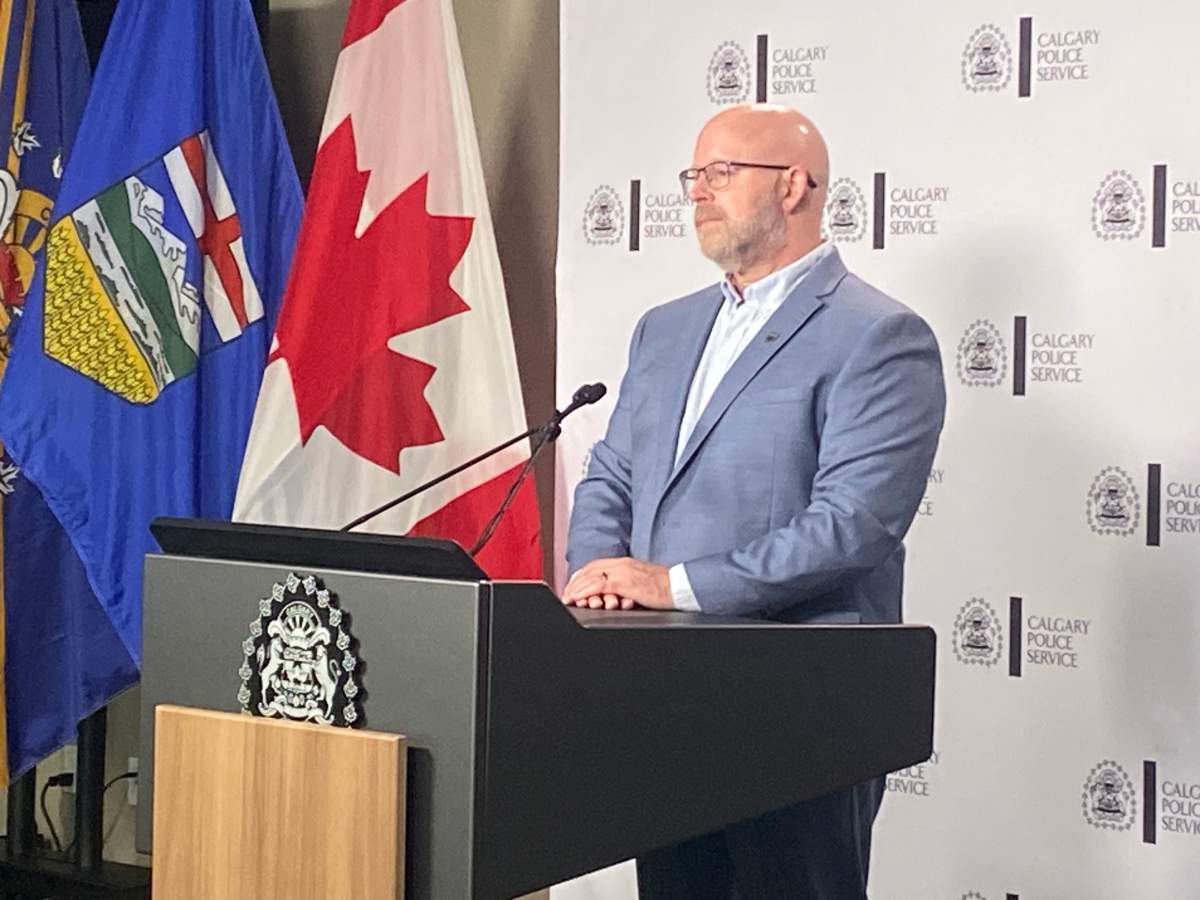
“Our biggest takeaway is that we need people to understand that this is not a joke, it’s not a prank, this is the most extreme form of bullying and a criminal offence,” added Auger. “We will take steps to stop this behavior.”
He said such actions can have a “horrible impact” on the victims.
“Teenagers are going through probably the most changes in their life with self-image, body image, social networks, and this is, as I said, the most extreme weaponized version of bullying to a young developing adult child. That is why we are very supportive on the onset and at the back end. Our investigators are now in touch with all the identified persons and their families to offer that support.”
The accused, who appeared in court Wednesday morning, has been released on numerous court-ordered conditions, including no contact with persons under the age of 16 unless incidental through work or school, and not to have any electronics capable of accessing the internet other than for work or school.
His next scheduled court appearance is Jan. 8.
Police are also asking members of the community to help support the victims by not sharing such images, refusing to condone such behaviour and reporting these types of images or this type of behaviour to police.

Provinces including British Columbia, Manitoba and Quebec have laws in place that criminalize AI-generated deep-fake pornographic or intimate images from being posted or shared online without consent.
Alberta’s legislation that prohibits non-consensual posting and sharing of intimate images, passed in 2017, does not mention AI-generated or altered images.
Rising warnings of AI crimes
The Alberta case comes amid increasing warnings from law enforcement about the dangers posed by artificial intelligence.
The RCMP said last year that a “wave of AI-generated child sexual abuse material is coming” as the technology swiftly improves and criminals gain access to AI-generating tools.
After a 12-year-old boy in B.C. who fell victim to online sextortion died by suicide in 2023, experts told Global News that AI was further compounding a mental health “epidemic” caused by similar cases involving minors.
That same year, the U.K.-based Internet Watch Foundation warned that AI-generated deepfake images will overwhelm child exploitation investigators without government action.
In 2023, a 61-year-old Quebec man was jailed for using artificial intelligence to produce deepfake videos of child pornography. No actual children were depicted, but Steven Larouche had broken the law banning any visual representation of someone depicted as being under the age of 18 engaged in explicit sexual activity.
Provincial court judge Benoit Gagnon wrote in his ruling that he believed it was the first case in the country involving deepfakes of child sexual exploitation.
This past summer, a junior girl’s football coach in Lethbridge was accused by ALERT of using AI to create child pornography.

Both the RCMP’s National Cyber Crime Coordination Centre and the Canadian Centre for Cyber Security, in its latest national threat assessment, have reported a sharp rise in AI-facilitated crimes that have caused harm or “near-harm” since the technology exploded into the mainstream in 2022.
Evan Solomon, Canada’s first minister responsible for artificial intelligence, is expected to introduce a new bill dealing in part with online harms.
Solomon said in late October his upcoming privacy bill could include age restrictions on access to AI chatbots to protect children. His spokesperson said the bill will be introduced in early December.
U.S. lawmakers have also been seeking to crack down on AI-caused harms on children after cases involving minors who were allegedly encouraged by chatbots to commit suicide, or did so after engaging in sexually charged conversations with so-called “companion” apps like Character.AI.
U.S. President Donald Trump this spring signed legislation into law that criminalizes non-consensual deep-fake pornography and requires online platforms to remove such material within 48 hours of a report. Several states have enacted similar laws.
===========================================================
