Everyday thousands of children are being sexually abused. You can stop the abuse of at least one child by simply praying. You can possibly stop the abuse of thousands of children by forwarding the link in First Time Visitor? by email, Twitter or Facebook to every Christian you know. Save a child or lots of children!!!! Do Something, please!

3:15 PM prayer in brief:
Pray for God to stop 1 child from being molested today.
Pray for God to stop 1 child molestation happening now.
Pray for God to rescue 1 child from sexual slavery.
Pray for God to save 1 girl from genital circumcision.
Pray for God to stop 1 girl from becoming a child-bride.
If you have the faith pray for 100 children rather than one.
Give Thanks. There is more to this prayer here

Please note: All my writings and comments appear in bold italics in this colour

Showing posts with label Buhari. Show all posts

Tuesday, 3 September 2019

Abducted Nigerian, Christian, Teen, Leah Sharibu, Alive: Reports

By Brandon Showalter, CP Reporter


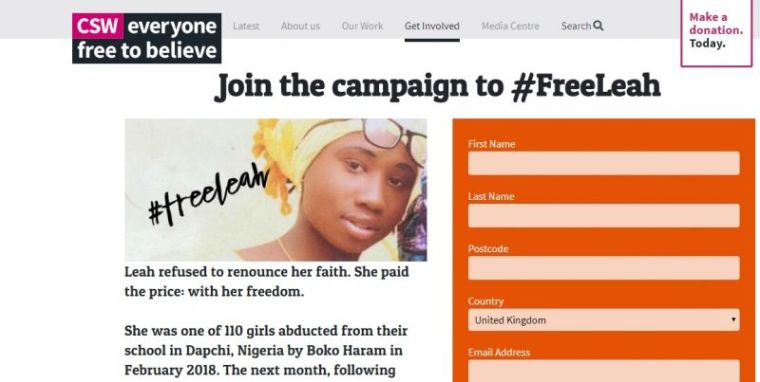
Leah Sharibu campaign by Christian Solidarity Worldwide in July 2018 calling for the Christian girl's freedom. | (Screenshot: Christian Solidarity Worldwide)

The Nigerian government is now indicating that Christian teenager Leah Sharibu, who was captured by Boko Haram in February 2018, is alive and not dead.

Several Nigerian and global media outlets reported Saturday that the kidnapped Christian 16-year-old schoolgirl is indeed alive. Reports surfaced this summer that she had been killed in captivity.

Save the Persecuted Christians, which advocates on behalf persecuted Christians around the world, is noting that Nigerian contacts say the Nigerian government is dismissing speculation that she is dead and is continuing to negotiate for her release.

“Leah needs to come home,” said Dede Laugesen, executive director of Save the Persecuted Christians, in a press statement emailed to The Christian Post.

“We are delighted the Nigerian federal government has confirmed Leah lives!”

In July, reports had surfaced that the Boko Haram splinter group ISWAP — a group that has ties to Islamic State terrorists — released a disturbing three-minute video of six Christian aid workers begging for their lives after being kidnapped by the group in a raid earlier this month. ISWAP is the Islamic extremist group that also kidnapped Sharibu along with more than 100 other schoolgirls in the town of Dapchi on Feb. 19, 2018. 

This is not the same kidnapping as the 218 Chibok girls in 2014. Hundreds, if not thousands more have been kidnapped since Chibok. 

In the video, Grace Taku, an aid worker with Action Against Hunger, pleads for her life and references Sharibu and the kidnapped Christian aid worker and mother, Alice Ngaddah.

Persecution watchdog group Open Doors USA, which has worked closely with Sharibu’s family since her abduction, cautioned against buying into reports of her death. But it urged Nigeria’s government to immediately launch an investigation into the reports.

Garba Shehu, the senior special assistant to Nigerian President Muhammadu Buhari on media and publicity, said on Saturday that the government's efforts would continue in hopes of Sharibu's release.

Earlier this summer, Sharibu's mother, Rebecca, visited the United States and pleaded with government officials to help free her daughter.

Laugesen said of the plea, “STPC and our coalition of NGO and faith leaders insist they keep their word and move quickly to secure her release.”

“The Nigerian government is eager to placate Vice President Mike Pence, USAID Admin. Mark Green and others in the U.S. administration pressing for her release after Rebecca Sharibu’s visit to Washington, D.C. in June where, with our coalition’s assistance, she made many tearful pleas for help for her daughter. This cannot be another photo-op backed up by empty promises.”

Leah, alone, refuses to convert to Islam

Sharibu was kidnapped last February along with 109 other girls. Five of those girls died while in captivity. The government negotiated the release of all the others except for Leah, who is a Christian and refused to convert to Islam.

The terror group had threatened to kill her but then said in October that they would keep her and another captive as slaves for life for refusing to convert.

“Women and girls are going through hell. Please pressure our government,” said Gloria Puldu, who was Rebecca Sharibu's translator when she spoke in Washington, D.C., at the Heritage Foundation, a conservative think tank, in June.

"Help us. We are out here. [Rebecca] is crying, just wanting her daughter to be set free.”

Nigeria ranks as the 12th worst nation in the world when it comes to Christian persecution, according to the Open Doors 2019 World Watch List.

As CP reported previously, in October 2018, Sharibu held a press conference calling on the Nigerian government to do their best to ensure that Leah is released. The press conference was held because there had not been any government official that visited the parents to tell them the information they had on their daughter’s kidnapping.

Reports at the time suggested that the militants were demanding a ransom of approximately $275 million to release Sharibu.

Another press conference was held in February, where they demanded answers again but received no response.

Save the Persecuted Christians is an educational charity and a grassroots movement that educates the public on anti-Christian violence, seeks to support those harmed for their faith in Jesus, holds those responsible accountable, and secures significant penalties on state and non-state persecutors of Christians, their website states.

Family Research Council President Tony Perkins, currently a commissioner on the United States Commission on International Religious Freedom, is Shairbu's advocate within that government entity.

Please pray for Leah Sharibu and the other unnamed Christian being held by this insane Muslim gang.


Thursday, 11 May 2017

Chibok Girls Rescued From Boko Haram But Far From Free

82 Chibok girls are free of kidnappers
but still not home

One girl's refusal to leave reveals Boko Haram's control as Nigerian government counsels freed girls

Chibok girls recently freed from Boko Haram captivity gather Monday in Abuja, Nigeria.
One who was kidnapped in 2014 chose to stay with her husband, a government spokesman said.
(Sunday Alamba/Associated Press)
Anna Cunningham
Lagos, Nigeria

It took three years, three weeks and one day for 82 Chibok schoolgirls to regain their freedom after a kidnapping at the hands of Boko Haram that stunned the world.

But it should have been 83 girls.

According to Garba Shehu, the Nigerian president's spokesman, one girl refused to leave.

"One said, 'No, I have a husband, I'm happy where I am,'" Shehu told local television after the release on Saturday.

It's among the first real indications of the level of control Boko Haram has exerted on these girls and young women.

​"It is not at all surprising," Mausi Segun, a senior Nigerian researcher with Human Rights Watch, told CBC News.

"People in long-term captivity, as these girls, will develop some sympathy for their captors — Stockholm Syndrome."

Segun says the trauma the mainly Christian girls have witnessed, "including constantly dealing with deaths, deliberate killings and other crimes," along with their exposure to Boko Haram's Islamic ideology, "could leave them confused about issues of faith."

Nigerian President Muhammadu Buhari, left, meets recently captives in Abuja on Sunday. The government carefully stage-managed their release. (Nigeria State House via Associated Press)

On April 14, 2014, Boko Haram kidnapped 276 girls, mostly aged between 16 and 18. Since then, 57 have escaped, three were found over the course of the last year, 21 released last October and 82 released on Saturday. That leaves 113 missing. 


Girls rescued in October are still not home with their families

For the latest group to be released, a transition back to normalcy will not be easy.

Many questions are being raised in Nigeria about the way in which the government is handling the released hostages. 

Those released in October have not been able to return to their homes and families. Instead, they have been kept in government-run facilities in the capital Abuja, where they have taken lessons and have received counselling.

The newly released 82 have also yet to be reunited with their families. The government says it is still verifying their identities.

Osai Ojigho, Amnesty International's Nigeria director, has called for the government to "respect their privacy and ensure they are reunited with their families … and not be kept in lengthy detention and security screening."

With some released hostages being held for months on end, such processes can "only add to their suffering and plight."


Freed captives sit in a hall as they are welcomed by officials in Abuja on Sunday.
A Nigerian researcher says they suffered trauma, 'including constantly dealing with deaths,
deliberate killings and other crimes.' (Reuters)

The Chibok schoolgirls spawned a global Twitter hashtag #bringbackourgirls, which shed light on the horrors of the Nigerian conflict, which began in 2009 and has killed at least 20,000.

Thousands of women and young girls like these have suffered a similar fate, forced to become Boko Haram wives, raped, trained to fight or become suicide bombers.

'They are probably different people, due to their experiences.'
— Elizabeth Pearson, specialist on Boko Haram

"They are probably different people, due to their experiences, than the young women preparing for their exams in 2014," says Elizabeth Pearson, a Boko Haram specialist who studies woman and conflict.

The world might never know the story of why at least one schoolgirl converted to being an apparently "happy" Boko Haram wife.

The release of the 82 was carefully stage-managed. The actual handover happened in a forest near the Cameroon border — the girls in exchange for an undisclosed number of Chadian prisoners, believed to be senior Boko Haram commanders.

Was money involved? What else was in the deal?

Yan St. Pierre, a counterterrorism specialist and head of Modern Security Consulting Group based in Berlin, says we might never know.

"Boko Haram will always try to get the best deal. And the reality is that most of what went down and was agreed upon will never be made public."

But he says the deal was done because "both sides felt they were maximizing the opportunity."

Campaigners observe a minute of silence for the remaining hostages during a daily meeting in Abuja on Tuesday. On April 14, 2014, Boko Haram kidnapped 276 girls, mostly between 16 and 18, and 113 are still missing. (Associated Press)

The first pictures of the girls came from the International Committee of the Red Cross (ICRC), which was not involved in negotiations but facilitated the release.  

The girls, dressed in ICRC bibs, were walking toward a military plane. This was probably their first flight anywhere, and it took them directly to meet Nigeria's President Muhammadu Buhari.

Nigerian President Muhammadu Buhari speaks in Abuja in 2016. Buhari, 74, is in ill health and being treated in London. It's not clear when he'll return. (Afolabi Sotunde/Reuters)

Images emerged of them having blood pressure checks and then it was all smiles, as they were greeted by the president.

An unrealistic transition maybe, but one the Nigerian authorities were ready to present to the world.

"The government's practice of parading the young women in front of the cameras doesn't appear to put their psychological needs first," says Pearson.

The government has promised that all will be done to provide the girls with an education and the counselling they need. 

"Without a doubt," says Segun, "Nigerian authorities need support in scaling up and improving the quality services."

The group released last October has also been kept in Abuja, in a government-run centre where they are attending lessons and having counselling.

Some parents have been angered, particularly at Christmas when the girls were taken to Chibok to meet family, but only allowed to do so in a local politician's house, before being returned to Abuja.

The 82 captives wait to be released in exchange for several militant commanders, near Kumshe,
Nigeria on Saturday. (Zanah Mustapha/Reuters)

There remain, of course, continued security risks for the girls.

Buhari was elected president in 2015 on a promise to end the Boko Haram insurgency. The release or discovery of 106 girls is a major political triumph for his government.

But Buhari, 74, is in ill health and being treated in London.

Within seconds of the release of the photo of his meeting the girls, the government issued a statement saying the president was flying to London.

In January he went on 10 days' leave for routine medical checks, but his stay turned into nearly two months.

Now it's not clear when he'll return, raising questions about whether he's well enough to lead.

But experts say talks for the release of the remaining Chibok girls will carry on regardless.


Friday, 14 April 2017

Nigeria Pledges to Find Chibok Schoolgirls on Third Anniversary of Abduction

Of the 276 girls taken in 2014 from a boarding school,
196 remain missing.
By Ed Adamczyk  

The 2014 abduction of 276 Nigerian schoolgirls by the Boko Haram insurgent group brought
international outrage. Nigeria noted the third anniversary of the kidnappings Friday with a 
pledge to rescue the remaining 196 captives. File Photo by SnapShot Photos/Shutterstock

UPI -- Nigeria's president restated his pledge to rescue the Chibok schoolgirls taken by Boko Haram insurgents on the third anniversary of their abduction Friday.

In a message to families of 196 girls still captive after the April 15, 2014, attack on their secondary school, President Muhammudu Buhari said that as a parent, "I feel what you feel." He said his government is in continuous negotiations through international intermediaries with the captors.

"On this solemn occasion, my appeal is that we must not lose hope on the return of our remaining schoolgirls. Our intelligence and security forces, who have aptly demonstrated their competence, are very much equal to the task and absolutely committed to the efforts to find and return the schoolgirls and others abducted by Boko Haram," Buhari's message read in part.

The government has been known to exaggerate its successes against the Islamist group with Islamic State links in the past, and offered a similar message of hope several months ago, The New York Times reported Friday.

Rampant corruption and a complete disregard for the truth causes one to not take seriously anything that comes from the government or military in Nigeria. Buhari, however, has at least accomplished some weakening of Boko Haram and the release of some girls, which is considerably more than his useless predecessor, Jonathon, ever accomplished. Please keep these girls in your prayers.

A group of 21 girls was released in October after negotiations involving the Swiss government and the International Red Cross, and one was located wandering in a Nigerian forest. The government said at the time of the abductions that 276 students were captured by Boko Haram; 57 escaped within two days of the incident, and two more escaped separately.

The kidnappings sparked global outrage, particularly on social media. Celebrities involved themselves in the campaign to demand action through the #BringBackOurGirls hashtag.