Everyday thousands of children are being sexually abused. You can stop the abuse of at least one child by simply praying. You can possibly stop the abuse of thousands of children by forwarding the link in First Time Visitor? by email, Twitter or Facebook to every Christian you know. Save a child or lots of children!!!! Do Something, please!

3:15 PM prayer in brief:
Pray for God to stop 1 child from being molested today.
Pray for God to stop 1 child molestation happening now.
Pray for God to rescue 1 child from sexual slavery.
Pray for God to save 1 girl from genital circumcision.
Pray for God to stop 1 girl from becoming a child-bride.
If you have the faith pray for 100 children rather than one.
Give Thanks. There is more to this prayer here

Please note: All my writings and comments appear in bold italics in this colour

Showing posts with label Alice Munro. Show all posts

Sunday, 20 October 2024

Inspired by Alice Munro's Daughter > One Survivor's Story of Child Sexual Abuse


Sexual abuse creates a circle of shame.

The courage shown by Alice Munro’s daughter

inspired me to speak up here for the first time


This is an essay I never thought I’d write on a topic I’d never imagined I’d discuss in public. My closest friends knew about my family’s deep dysfunction, but not its root cause. But, this summer, when Andrea Robin Skinner came forward in the Star to recount both her stepfather Gerald Fremlin’s sexual abuse and the refusal of her mother, Alice Munro, to support her, silence no longer felt like an option. My grandmother responded in exactly the same way Munro did when my mother told her about her own abuse. My mother’s family lined up to support the predator, an uncle who was in his twenties at the time of the abuse. My mother was seven.

Childhood sexual abuse is a crime against our most vulnerable, those who have zero defences in the one place they should feel most protected. In my experience, those who can turn away from the crime, do. But the level of detail in Skinner’s essay forced many to confront the horrific reality of abuse and its aftermath: the indelible images made imagination unnecessary and denial impossible.

“In the car, he asked me to play a game called ‘show me,’” Skinner wrote. “When I said no, he made me tell him about my ‘sex life,’ prying me for details of innocent games I played with other children.” At the time of the abuse, Skinner was nine; she’d only just realized she “couldn’t grow up to be a sheep-herding dog.” By the time she was 25, she had dropped out of university due to deteriorating mental health. She wrote that she “couldn’t picture a future” for herself.

I know the emotional wreckage of that crime intimately. My mother’s family never reported her assault; instead, she was forced to be civil with her abuser at family gatherings. The predator was free to slip from the frame and live in peace while my mother, and later, my father, sister and I, were left to try to heal from trauma we hadn’t caused and that no one wanted to know about.

That collective denial caused my mother a lifetime of insecurity that made our home life deeply dysfunctional, and which metastasized into a personality disorder that got worse as she got older. She alienated most of our extended family, swiftly terminated new friendships if she felt slightly threatened and recounted her stories of triumph over those who wronged her around the dinner table. She believed someone was always plotting against her; she quit her community theatre group when she didn’t receive the award she felt she deserved. I learned to walk on eggshells. Before I was out of my teens, she told me about the abuse. From me, she sought the emotional sanctuary my grandmother refused to provide.

When my younger sister was assaulted at 13 by a trusted adult in the community, she became the sexually abused child of a sexually abused child, and the damage compounded. We believed my sister, but my mother didn’t have the emotional tools to support a child through the same trauma. My parents reported the assault to police, who did nothing. In the 1980s, “he said/she said” was the acceptable response from law enforcement, even when it came to the sexual assault of a child. It was too difficult to prove, they shrugged. Couldn’t she just get over it? How bad could it be? I was 16 and still believed that adults knew best.

Within a year, my sister and I both developed eating disorders. I became anorexic, anxious and quiet: I withdrew to the world of books and buried myself in academic achievement. Intrusive thoughts and panic attacks hunted me for more than a decade. My sister’s bulimia flew under the radar, but her acting out didn’t. Police brought her home in a cruiser after she was caught stealing an eye shadow, a pack of gum. Now they cared.

fischer.JPG

Christine Fischer Guy’s sister, Cathrine, at the beach. Cathrine was sexually assaulted as a young teen, an event that shattered her.

Courtesy Christine Fischer Guy

The damage festered through my sister’s adult life. She wrestled with addiction, starting with alcohol, when she was still a teen. For decades, I tried to help her in every way I could. Nothing worked, or worked for long, because the damage was too old and too deep. Around 2010, she started going to AA. I celebrated her one-year milestone with her, naively believing that was the end of her struggle, but her mental health continued to decline. In August 2023, I found her collapsed on the floor of her apartment. As I walked home from the hospital, I dreamed of a future in which we could watch “Barbie,” laugh at the patriarchy and finally form an unbreakable bond. That time never came. My sister died a month later at age 53 and left no diary and no note. The official cause of death was advanced liver disease and severe malnutrition, but her actual cause of death was shame, and it had occurred decades earlier. It broke my heart when I discovered that since childhood, she had always slept with the light on.

Because of the letters Fremlin wrote brazenly admitting to his crime, the Ontario court charged and sentenced him in 2005 for sexually assaulting Skinner in 1976. This kind of proof is rare and didn’t exist in my family. The only record of what happened to my sister was the tattoo on her forearm that read nevertheless she persisted.

It should be astonishing that Fremlin felt that his words and those photographs would exonerate him, that everyone would see that he was powerless against the temptations of a child. But for anyone raised in the patriarchal system that made his thought process possible, it isn’t. He knew the system was rigged and it made him bold. My mother’s uncle and my sister’s predator knew that too. Those men were raised to understand that their desires would always supersede those of women, that they were not responsible for their own actions, and that the girls — children! — were to blame for bringing shame on the family.

I always believed my mother and my sister, but I know now that I was too young to help them find healing. Tending to their untreated trauma led to anxiety-related issues that I carry to this day because I didn’t have the training to protect myself: crushing insomnia, chronic stomach problems and generalized anxiety that I’ve tried and failed to outrun. At 57, I finally understand that yoga and meditation and medication will only keep it at bay. It feels petty, listing symptoms of my own pain in light of the life-changing trauma they endured, but I know I’m not an outlier. The circle of damage is wide.

My mother now has midstage Alzheimer’s and requires long-term care; alcohol use was a contributing factor. She can’t remember that my sister has died. If she dies of that terrible disease, her death will be recorded as a dementia tragedy, but it will only be a partial truth. Her brain was marked with trauma long before Alzheimer’s arrived.

For a long time, I felt that I shouldn’t lay my heavy truths on others, that this was a shameful family matter I should shoulder in isolation. Skinner’s essay gave me courage. Though my mother and sister tried, again and again, they can no longer can tell their stories.

====================================================================================

Monday, 8 July 2024

The Perverted Lives of the Rich and Famous > Nobel and Booker Prize winner, Alice Munro, chose paedo husband over abused daughter


Alice Munro stayed with husband who

sexually abused her daughter: essay


The daughter of celebrated Canadian writer Alice Munro has come forward with a dark secret about her family that is rocking the literary world and re-contextualizing the author’s legacy weeks after her death.

Andrea Robin Skinner, the youngest of Munro’s children, penned a first-person essay in the Toronto Star on Sunday that sheds light on the sexual abuse she suffered at the hands of her stepfather, Gerald Fremlin, Munro’s second husband. Skinner, who was nine years old when the abuse began, writes that her mother knew about it for decades and stayed silent.

Fremlin’s abuse was swept under the rug, Skinner writes. Even when he was eventually charged with indecent assault against her and pleaded guilty in a 2005 trial, her mother remained loyal to her abuser. Munro stayed married to Fremlin until his death in 2013.

Munro died on May 13 at the age of 92. Headlines of her death dominated Canadian news, with outlets hailing her mastery of the short story and praising her intimate portrayals of the lives of women and girls. Now, conversations are taking place about whether the Nobel laureate’s novels deserve space in the bookshelves of the nation.

Skinner’s story

Skinner is the youngest daughter of Munro and her first husband Jim Munro. The pair divorced in 1972 and each went on to remarry: Munro to Fremlin, and Jim to Carole Sabiston, a textile artist.

Skinner mainly lived with her father and stepmother in British Columbia, but spent summers with her mother in Ontario. In 1976, the year Munro and Fremlin were married, Skinner was sexually assaulted by her mother’s new husband.

Munro was away and Skinner, who was nine years old, had asked if she could sleep in Munro’s bed, next to Fremlin’s in the bedroom the couple shared. Fremlin crawled into the bed and molested her as she tried to fall asleep.

Then, Fremlin “tried to get me to hold his penis. My hand kept going limp though as I was pretending very hard that I was asleep,” Skinner told the Star.

Skinner, afraid of the fallout, didn’t tell her mother what happened. When it was time for her to return to British Columbia, Fremlin drove her to the airport by himself and asked the nine-year-old to expose herself to him — she said no — and tell him details about her “sex life.”

Back at home, Skinner told her stepbrother Andrew what happened and he urged her to go to his mother Carole. Skinner told Carole who then told Skinner’s father Jim. In the end, Jim decided to not tell Munro about Fremlin’s abuse.

“I was relieved at first that my father didn’t tell her what had happened to me… As relieved as I was, my father’s inability to take swift and decisive action to protect me also left me feeling that I no longer truly belonged in either home. I was alone,” Skinner writes in her essay.

Abused children desperately need a hero who will take their side and fight for them. Andrea's dad unfortunately failed miserably. He not only didn't report the creep to Alice or to the police, but he continued to send Andrea back east every summer.

Over the next several years, Skinner would return to Ontario each summer. Fremlin made inappropriate jokes, she wrote, “exposed himself during car rides” and talked about his sex life with Munro when he was alone with his stepdaughter. She tried to ignore him.

The abuse stopped when Skinner reached her teenage years and Fremlin lost interest, the Star reports. 

This is a typical sign of a genuine paedophile, they prefer prepubescent kids.

Munro seemingly remained in the dark until her daughter exposed the truth in a 1992 letter.

Skinner was 25 at the time and struggling with the trauma of her abuse. She had developed an eating disorder and battled insomnia and migraines. She had dropped out of the University of Toronto as a result.

Again, this is typical behaviour of adult survivors of child sexual abuse.

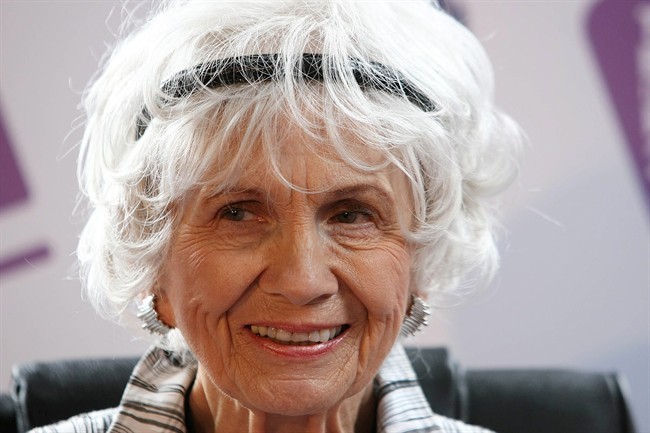
This June 25, 2009 file photo shows Canadian author Alice Munro at a press conference at Trinity College, Dublin, Ireland.

She decided to come clean to her mother about what happened.

“I have been carrying a secret for sixteen years. Gerry abused me sexually when I was 9 years old… I have been afraid all my life that you would blame me for what happened,” she wrote in a letter to her mom.

Skinner’s fears were realized. Instead of being met with sympathy and compassion, Munro painted herself as a victim of infidelity.

“She called my sister Sheila, told her she was leaving Fremlin, and flew to her condo in Comox, B.C. I visited her there and was overwhelmed by her sense of injury to herself. She believed my father had made us keep the secret in order to humiliate her. She then told me about other children Fremlin had ‘friendships’ with, emphasizing her own sense that she, personally, had been betrayed,” Skinner writes.

Rarely do paedophiles restrict themselves to a single victim. If there is one victim, there are most likely others.

When Fremlin learned of the letter, he began a campaign to discredit Skinner. In the end, his writings served to expose his crimes, and later helped in prosecuting him for indecent assault.

Of course, this is what liars do, and paedophiles are liars. They tell you as much truth as they think you can handle without turning on them, but they never tell the whole truth.

In a letter written to Jim and Carole, Fremlin wrote: “It is my contention that Andrea invaded my bedroom for sexual adventure. If she were in fact afraid, she could have left at any time. She was sexually receptive and mildly aggressive. While the scene is degenerate, this is indeed Lolita and Humbert. For Andrea to say she was ‘scared’ is simply a lie or latter day invention.”

He referred to her numerous times as a Lolita, and himself as a Humbert Humbert, referring to characters from Vladimir Nabokov’s Lolita. Fremlin seemed to believe that Skinner, at nine years old, was not a “blameless victim” but a seductress.

Despite Fremlin’s letters, Munro went back to him and for years the family skirted around the topic of abuse. No one in the family spoke of it. No one wanted to tarnish Munro’s rising fame and reputation as a writer.

But in 2002, Skinner became pregant with twins and the issue could no longer be ignored. She told her mother that Fremlin would never be allowed near her children and confronted Munro with some of the horrible specifics of the abuse she faced as a child.

Three years later, still feeling betrayed and silenced, Skinner went to the police. On March 11, 2005, an 80-year-old Fremlin pleaded guilty to indecent assault for abusing Skinner in 1976. The letters Fremlin wrote were a key piece of evidence.

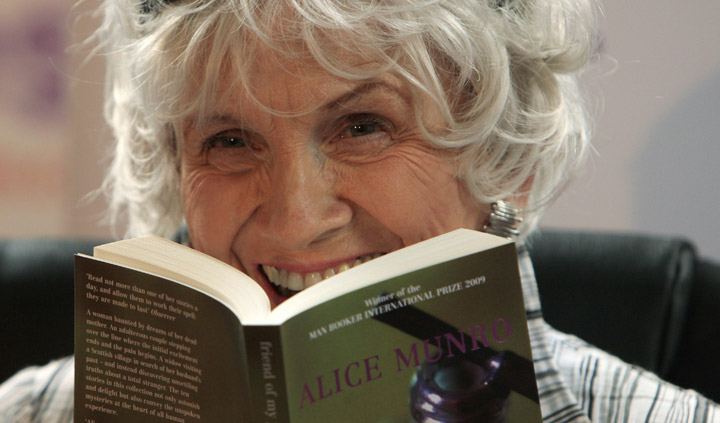
Alice Munro, pictured in 2009. Getty Images

Fremlin never served jail time. He was placed on probation for two years, ordered to not have contact with Skinner and prohibited from visiting parks or playgrounds. Still, Munro stayed and not much about the family dynamic changed, the Star reports.

“The family went back to socializing with the pedophile,” Skinner’s sister Jenny Munro told the Star. “My mother went on a book tour.”

Fremlin died in 2013, the same year that Munro received the Nobel Prize for Literature. Jenny accepted the award on her mother’s behalf.

Skinner never reconciled with her mother, who died in May this year.

Now, the siblings are standing together, in agreement that Skinner’s story must be told publicly. The Star reports they are worried about the fallout of this revelation, but hope “this might lead to a more robust understanding of her as a writer.”

Already, the impact is being felt — with many Canadians sharing their shock online. It remains to be seen how Munro’s legacy will be affected longterm.

In her essay, Skinner said she hoped that Fremlin’s 2005 conviction would ensure that she never saw “another interview, biography or event that didn’t wrestle with the reality of what had happened to me, and with the fact that my mother, confronted with the truth of what had happened, chose to stay with, and protect, my abuser.”

While that didn’t happen in the aftermath of the 2005 trial, it could certainly be the case now.

If you or someone you know is experiencing abuse or is involved in an abusive situation, please visit the Canadian Resource Centre for Victims of Crime for help. They are also reachable toll-free at 1-877-232-2610.

=====================================================================================