Everyday thousands of children are being sexually abused. You can stop the abuse of at least one child by simply praying. You can possibly stop the abuse of thousands of children by forwarding the link in First Time Visitor? by email, Twitter or Facebook to every Christian you know. Save a child or lots of children!!!! Do Something, please!

3:15 PM prayer in brief:
Pray for God to stop 1 child from being molested today.
Pray for God to stop 1 child molestation happening now.
Pray for God to rescue 1 child from sexual slavery.
Pray for God to save 1 girl from genital circumcision.
Pray for God to stop 1 girl from becoming a child-bride.
If you have the faith pray for 100 children rather than one.
Give Thanks. There is more to this prayer here

Please note: All my writings and comments appear in bold italics in this colour

Showing posts with label Ballarat. Show all posts

Sunday, 29 April 2018

Australian Mining Town Breaks Its Silence About Grim Past of Child Sexual Abuse

By JACQUELINE WILLIAMS

The ribbons tied to a fence outside St. Patrick’s cathedral in Ballarat, Australia, are in support of victims of child sexual abuse at the hands of the Catholic clergy. Credit Asanka Brendon Ratnayake for The New York Times

BALLARAT, Australia — Rob Walsh was outside Melbourne Magistrates’ Court recently awaiting a pretrial hearing for Cardinal George Pell, the Vatican’s third-highest-ranking official, when, he said, he unexpectedly walked into the cardinal himself.

The encounter wasn’t their first. They both were raised in the same old mining town, which could be why the cardinal extended his hand, inviting Mr. Walsh to shake it. Mr. Walsh declined — a gesture that signified the lasting impact of a decades-long sexual abuse scandal that has rocked this town, Ballarat, and sent shock waves around the world.

“The ripple is still on the lake and it’s still occurring,” Mr. Walsh said from his home in Ballarat, referring to the lingering effects from that scandal, in which priests preyed on children, including Mr. Walsh, during the 1960s and 1970s.

“It’s gone through families and generations.”

This town, officially a city of about 100,000 people, was once the center of Australia’s gold rush, but is now better known as the epicenter of that pedophile ring, in which Catholic clergy preyed on those who depended on them the most — children from Ballarat’s poor, blue-collar neighborhoods.

The scale of the abuse in Ballarat was staggering. Gerald Ridsdale, the former chaplain of St. Alipius Primary School in Ballarat, was imprisoned for sexually abusing 65 children from the early 1960s to late 1980s. He was only one of several priests convicted of abusing children.

An open-air museum depicting Ballarat in the 1850s, during the gold rush. Credit Asanka Brendon Ratnayake for The New York Times

About 45 victims were estimated to have committed suicide, prompting an outpouring of grief from once devout Catholic parents who said the church robbed them of their sons.

Today, survivors speak of broken marriages, children being raised without fathers, lives spent in a haze of drugs and alcohol or in and out of institutional care.

What happened here is often likened to a big black cloud hanging over the city that has never fully lifted.

“It’s a never-ending story,” said Mr. Walsh, whose two brothers and cousin were also abused at St. Alipius Primary School. In the years that followed, all three committed suicide.

“It just keeps going and going and going,” added Mr. Walsh, who has not alleged that Mr. Pell abused him.

Survivors in Ballarat remained silent for decades. The city has, until recently, prided itself on being a conservative community in which the Catholic Church was held in high regard. Some victims felt trapped — worried their families wouldn’t believe them. Others feared the church’s dominance here.

“It’s a never-ending story,” said Rob Walsh, an abuse survivor whose two brothers and cousin were also abused at St. Alipius Primary School. In the years that followed, all three committed suicide. Credit Asanka Brendon Ratnayake for The New York Times

On the road into the city from Melbourne, the state capital, the red brick Gothic-like presbytery of St. Alipius immediately stands out. Further into town, ornate churches have an imposing presence on many main streets.

The Ballarat Diocese, one of the largest Catholic dioceses in Australia, is a major power center. With its property and other assets, the Catholic Church’s holdings in and around Ballarat are estimated to be worth more than 175 million Australian dollars, or about $135 million, according to news reports.

Young George Pell

Many of the city’s Catholic families were descendants of poor Irish immigrants, most of whom were Catholic and came to Ballarat in the 1800s to work in its gold mines. Far from the mansions in other parts of town, they tended to gather in the working-class area of East Ballarat, seeking community in churches like St. Alipius after the mining industry slowed in the early 1900s.

East Ballarat “was really left over from the gold rush days,” said Maureen Hatcher, who has lived in Ballarat most of her life. “There would have been a lot of people that would have come here that were incredibly poor and never made any money but thought they would.”

Pubs have also played a major role in Ballarat life since the gold rush, say historians. And though they have dwindled in number, some residents said they have contributed to the malaise of alcoholism and depression that still lingers.

The abuse was particularly damaging because, without the basic social services prevalent today, residents of East Ballarat relied on the church for support, to serve as a bedrock for their community.

“This community has been ravaged by the Catholic Church,” said Stephen Woods, who was abused as a child starting in the 1970s at his old school, St. Alipius, above, and later at the nearby St. Patrick’s College. Credit Asanka Brendon Ratnayake for The New York Times

Ultimately, the priests betrayed those they were supposed to protect, say the victims.

“This community has been ravaged by the Catholic Church,” said Stephen Woods, who was abused as a child starting in the 1970s.

It wasn’t until the 1990s that the dam finally broke, said Mr. Woods, whose abuse took place at St. Alipius, and later at the nearby St. Patrick’s College, a Catholic day and boarding school.

He publicly revealed his abuse in 1994 and was among those who led the way for others to share their truths.

But he added that it was the Loud Fence movement, which began about three years ago, that finally gave this community a voice to speak about its dark past.

The movement began as thousands of residents and people from across Australia began hanging colorful ribbons on the fence outside St. Alipius and St. Patrick’s to show support for the victims.

Ms. Hatcher, the movement’s founder, said though ribbons had at times been stripped from the fences by parishioners, they tied people together and now served as a symbol of speaking out against abuse.

Some say the new willingness to speak out about the abuse scandal has turned Ballarat from a closed, conservative former mining town and industrial city into a more tolerant and inclusive community. Credit Asanka Brendon Ratnayake for The New York Times

“There are more ribbons on the fence now than there was before,” said Frank Sheehan, a former state lawmaker from Ballarat.

Finding its voice has helped Ballarat become something even more. Just as the rush to find gold transformed Ballarat from a small sheep station into a major mining settlement, the new willingness to speak out about the abuse scandal has turned Ballarat from a closed, conservative former mining town and industrial city into a more tolerant and inclusive community.

Belinda Coates, the city’s former deputy mayor, said she had seen a shift, with many major organizations here now choosing female leaders.

Ballarat is the first city in Australia to join the Council of Europe’s Intercultural Cities Network, a statement of intent to become a more culturally diverse and welcoming community, as also seen in Ballarat’s acceptance of a growing number of new immigrants from countries including Sudan and Afghanistan.

“There’s a bit of a quiet revolution going on in Ballarat,” Ms. Coates said.

“When you start to challenge the status quo, it ripples out into the community,” she added. “More people are finding their voices.”

But this transformation is in large part because of a great tragedy. Residents and former victims hope an impending court decision on whether Cardinal Pell should stand trial for “historical sexual offenses” will help Ballarat find some closure.

“We’re all waiting on a decision,” said Mr. Walsh, who refused to shake the cardinal’s hand on the street. “The Catholic Church has just really got to change. It’s as simple as that.”


Tuesday, 15 August 2017

A Few Good People and Some Really Horrific Ones on Global P&P List

Stories from Australia, New Zealand, North Marianas Islands, Wales, Nigeria, England, ans one shocking story from both Germany and Chile regarding ex-Nazi pedophiles

Awful Details of Ridsdale's Child Sex Abuse in George Pell's Ballarat
BY SOFIA LOTTO PERSIO 

An Australian court heard harrowing details of historic child abuse perpetrated by former priest Gerald Ridsdale, one of Australia’s most notorious pedophiles.

Ridsdale, 83, pleaded guilty to 23 charges Tuesday, including two counts of rape and one of buggery, for abusing 12 children, aged 6 to 13, between 1962 and 1988 in the Victoria state city of Ballarat and the surrounding area.

Young George Pell
Ballarat is considered one of Australia’s worst-affected areas for incidents of sexual abuse by Catholic priests. It is named in Vatican Cardinal George Pell’s charges of historic sexual abuse, as he served in the diocese first as an assistant parish priest in 1972 and later, between 1973 and 1984, as an episcopal vicar. Pell pleaded not guilty in a first hearing at a Melbourne magistrate’s court in July and will return to court in October.

One of Ridsdale’s victims was a girl whose father woke her up on two occasions to see the priest, who then sexually assaulted her, the court heard on Tuesday.

“[Her] father carried her to the confessional booth and took her clothes off her, then carried her to the altar and lay her down,” Crown Prosecutor Jeremy McWilliams said of the second occasion, in 1974, as quoted by the Australian Associated Press.

According to the prosecutor, Ridsdale indecently assaulted her, then told her, “Jesus died for our sins so we could be forgiven, and if I confess to this sin I might be forgiven,” before kissing her on the cheek.

You 'might' be, but I wouldn't count on it. 

Colorful ribbons were tied to the fence outside St. Patrick's Cathedral to remember victims of child abuse by priests, in the town of Ballarat, Australia, on July 23. The Victoria County Court recently heard harrowing accounts of child abuse that occurred in Ballarat and the surrounding area. BYRON KAYE/REUTERS

The survivor is still suffering from the abuse, experiencing “crippling” flashbacks. “I feel like a piece of meat handed around for anyone to take a bite of,” she said in a statement read to the court by the prosecutor, as quoted in local media.

McWilliams also recounted the story of a 9-year-old altar boy who was told “God will forgive all of your sins” as Ridsdale raped him.

The former priest has been in jail since 1994 after being convicted for sexually abusing 53 children over three decades, although he admitted the true number of victims could be in the hundreds.

His lawyer, Victoria Legal Aid Chief Counsel Tim Marsh, urged Victoria County Court Judge Irene Lawson to give Ridsdale a chance for parole, which would shorten his 28-year-long sentence and award him early release on April 8, 2019, according to local media.

Tuesday’s hearing saw a total of nine survivors facing Ridsdale. It came just a day after the publication of a report by the Royal Commission Into Institutional Responses to Child Sexual Abuse that controversially recommended priests should face criminal charges should they fail to report child abuse disclosed during confession.

The commission was set up in 2013 to investigate claims of child sex abuse in multiple Australian institutions, including the Boy Scouts, the Salvation Army and various churches and religious groups. Its findings have sparked outrage among the Australian clergy, who say they will oppose a recently proposed measure that would have priests face criminal charges if they fail to report allegations of child sex abuse disclosed during confession. The clergy insist that this goes against the Catholic Church’s rules on the confidentiality of confessions.

I wonder how many times Gerald Ridsdale confessed his sins to a priest or Bishop and was sent away with a few Hail Mary's to rape and destroy hundreds more children. You cannot forgive the sins of a serial child rapist, so why would you demand confidentiality. If he comes to you and confesses that he is a child rapist and you do nothing to stop him, you are no better than he is. 

I guess I know where I stand on that issue now.

Ridsdale himself gave evidence to the commission in 2015. He agreed the church should have notified the authorities about the abuse. “What I’ve done and the damage that I’ve done…I’d say definitely,” he said, according to Australian media reports at the time.


Dame Susan Devoy asks UN to push for
child abuse inquiry in N.Z.
NZ Herald

The Race Relations Commissioner has asked the United Nations to pressure New Zealand's Government to hold an inquiry into child abuse in state-run institutions.

Speaking to a United Nations human rights committee in Geneva, Dame Susan Devoy said it was "immoral" that successive governments had refused to hold an inquiry into the physical and sexual abuse of children and disabled people held in state institutions.

She said it was "heartbreaking" standing alongside abuse survivors at the steps of Parliament last month to present a petition calling for the inquiry.

"As children they suffered years of abuse at the hands of their own government and there they were asking for justice."

Between the 1950s and 1990s more than 100,000 children and vulnerable adults were taken from their families and placed in state-run institutions.

It is estimated up to 3.5 per cent of them suffered horrific physical, sexual and mental abuse while in care.

The vast majority of children taken were Maori, Dame Susan told the UN committee.

"These state homes were the beginning of the mass incarceration of Maori New Zealanders in our state institutions. And it is still going on.

"The refusal by successive governments to investigate is not only wrong, it is immoral. This is not my New Zealand and I urged the UN to tell our Government to do the right thing."

Prime Minister Bill English has effectively ruled out setting up an independent inquiry into the claims. He considers it more important to make changes to child welfare services to prevent a repeat of the abuse.

However after the petition was delivered in July he softened his stance, saying he was willing to listen to what the victims had to say - but suggesting he was yet to be convinced of the merits of a large-scale inquiry.

Dame Susan is representing the Human Rights Commission before the UN Committee on the Elimination of Racial Discrimination (CERD), which monitors whether countries are complying with anti-discrimination laws.

"We live in one of the most peaceful and ethnically diverse nations on earth and yet racism happens in New Zealand," she told the committee.

I think every country needs to examine the issue of institutionalized child sex abuse, and child sex abuse in general. It is easily the worst atrocity in the world today, far worse than climate change or anything else.


Judge grants motion to dismiss sexual-abuse-of-a-child case without prejudice; may sanction prosecutor
By Bryan Manabat - Variety News Staff 

Northern Marianas Islands (Saipan)
SUPERIOR Court Associate Judge Teresa Kim-Tenorio on Tuesday granted the government’s motion to dismiss without prejudice the case against a retired Army reservist who was charged with two sexual assault offenses involving minors.

On Aug. 25, 2016, Michael Barry Murphy was charged with sexual abuse of a minor in the first degree, and sexual abuse of a minor in the second degree. The alleged victim in the second charge is now an adult, and the abuse happened between 1994 and 2006, the prosecution said.

Following the denial of the government’s reconsideration motion to extend the discovery deadline last week, Assistant Attorney-General Betsy Weintraub on Aug. 10 filed a notice of voluntary dismissal without prejudice.

Teresa Kim-Tenorio

But Murphy, through his lawyer Janet King, opposed the government motion and accused the prosecution of bad faith and harassment.

In her ruling, the judge said to accommodate the prosecution and defense, the court entertained multiple requests for extensions and continuances.

She said the court denied the government’s motion to extend the discovery deadline on Aug. 2, after finding that the prosecutor had had adequate opportunity to prepare and meet the discovery deadline.

The judge said she also found that Weintraub failed to show excusable neglect for moving to change the deadline within the time stated in the court’s second amended pre-trial order.

Judge Kim-Tenorio also disagreed that late discovery of probative information will not affect the trial date as the defendant will need additional time to inspect the evidence and defend against it.

According to the judge, Weintraub’s “complete disregard of the trial court’s docket compromises the fair administration of justice, which is a matter of great public significance.”

The court likewise noted the prosecutor’s pattern in dismissing prosecutions only to re-file charges at a time more favorable to the prosecution.

The judge directed Weintraub to appear in court on Aug. 29 at 9 a.m. to show cause why she should not be sanctioned for lack of diligence and dilatory tactics.

But the court also found “that public interest requires a trial to vindicate the victim and/or defendant…. [D]ismissal of the charges would result in wasted taxpayer dollars and resources of already burdened agencies.”

The judge said the jury trial scheduled for Sept. 11, 2017 and the pretrial conference set for Aug. 15, 2017 are vacated.


Welsh woman who was sexually abused as a child didn't tell anyone about it until she was 27

May Baxter-Thornton has bravely relinquished her legal right to anonymity to talk about her experiences as she takes on a new role to help others

A woman who was sexually abused as a child has spoken about her experiences as she takes on a role to ensure victims and survivors’ voices are heard during The Independent Inquiry into Child Sexual Abuse.

The Independent Inquiry into Child Sexual Abuse today announces that two Welsh victims and survivors of child sex abuse will join the Victim and Survivors’ Consultative Panel.

May Baxter-Thornton, who was raised in Aberdare , and Emma Lewis, from Swansea , will join the panel. Both have relinquished their legal rights to anonymity to talk about their experiences ahead of working to ensure other victims are heard during the inquiry, which was set up in the wake of the Jimmy Savile scandal, to uncover the truth about child abuse in the UK.

May Baxter-Thornton was abused as a child. She can’t remember the exact age, but believes it could have been when she was around five years old.

She moved to Sunderland in 1997 to attend university and gained a degree in photography and video.

While a student she contacted a charity to make a video documentary about women living in a women’s refuge. From there, she was offered work, and she ended up working with them for around 16 years, supporting women and children fleeing domestic violence.

May was 27 before she told anyone about the abuse.

“There are people who just never tell anyone and they take it to their graves,” the 42-year-old said.

Now living in Newport , she moved back to Wales in 2015 and was interviewed for a role on the panel in June before being appointed.

Speaking about her decision to apply for a place on the panel, May said: “I think it’s a way of my having a voice but also to make people realise that you can actually go on and have careers, you can make a life for yourself even though it might feel like, right now, that you can’t for whatever reason.

“Childhood abuse impacts every aspect of your life, whether that’s your education, your communication with people, relationships, confidence. It can knock every part of your life.

“I can use my own experiences, and the experience of my working with people as well, to benefit victims and survivors so that when the inquiry does make any recommendations or come to any conclusions I know I’ve played a part in ensuring that victims and survivors are heard.”

Through their new role on the Victims and Survivors Consultative Panel, May and Emma will advise the inquiry on how best to reach and listen to victims and survivors in Wales.

Emma, from Swansea, grew up in care and has dedicated the last 20 years to helping young people make a smooth transition out of care. She was sexually abused aged six, and didn’t tell anyone until she was 12.

Emma, 37, said: “It is a privilege to be asked to champion the interests of Welsh victims and survivors to the inquiry.

“I want my role on the Victims and Survivors Consultative Panel to really count and to ensure that children in Wales are better protected in the future.”

The inquiry is using a novel way of gathering accounts from those who may have suffered at the hands of child sexual abuse.

The Truth Project gives individuals who experienced sexual abuse as a child the chance to privately describe what happened to them and how institutions failed to protect them. They are also welcome to make suggestions about what can be done to prevent the same abuse occurring in the future.

Anonymised information gathered in Truth Project sessions will be used to shape the inquiry’s recommendations to the government about how institutions can better protect children.

May added: “With regards to the Truth Project, that is a really strong and important piece of work around getting people’s experiences, real-life experiences, of people who have experienced childhood sexual abuse to input into the inquiry.

May Baxter-Thornton (left) from Newport, and Emma Lewis (right) from Swansea (Image: PA)

“They can tell their story in a safe environment. It’s a way for them to get their voices heard. Their experiences will be anonymised.

“What we’re trying to get across with this project is ‘this project will believe you’.”

The inquiry first opened in Wales in November 2016 and since then has met with victims, survivors, and experts in Swansea, Newport, Cardiff and Caernarfon.

Inquiry chair Professor Alexis Jay said: “May and Emma have demonstrated a proven commitment to reaching and supporting victims and survivors of child sexual abuse in Wales.

“The Welsh perspective May and Emma offer will provide a vital contribution to the work of the Victims and Survivors Consultative Panel.”


Katsina, Nigeria, CSOs endorse death penalty for
child sexual abuse
ByYunusa Ringim 

The Katsina State Government, in collaboration with a coalition of civil society groups campaigning for the domestication of the Child Rights Act, has proposed death sentence for any person confirmed by a competent court of law to have raped or sexually abused a child.

Apparently worried by increasing incidences of defilement of baby-girls and sodomy in parts of the state, the coalition, in the final draft of the document renamed “Katsina State Child Protection Bill,” defined a child as any male or female who is nine years or below, for the purpose of the proposed law.

Some of the agencies of government involved in the project included the ministries of Women Affairs, Justice and Information, along with the United Nations Children’s Fund (UNICEF), Save the Children International, the National Human Rights Commission, Child Protection Network, Da’wa Family Support, JIBWIS and Women’s Rights Advancement and Protection Alternative (WRAPA), among others.

Presenting a draft copy of the Bill to the Commissioner of Women Affairs, Dr. Badiyya Hassan Mashi, for onward transmission to Governor Aminu Bello Masari, the coalition’s Secretary, Hajiya Fatima Jibo, described the death sentence as applicable where the child abused is under the age of nine years and was “lured by a person or persons to commit unlawful, illicit sexual intercourse.”

According to the proposed Bill, “whoever sexually abuses a child commits an offence and shall be liable on conviction to be sentenced to death.”

The document also outlaws the use of children for soliciting for alms, hawking and slavery and recommended prison sentences and fines depending on the extent of violation of the law.

“Whoever procures a child for the purposes of begging for alms or guiding beggars thereby depriving the child the opportunity to to attend or remain in school, commits an offence and shall be liable on conviction to a fine of not less than N10,000 (that's €27.50) and community service,” according to the document.

Also speaking at the programme, Save the Children Area Manager, Nura Muhammad, noted that apart from Katsina, 10 other states in the north are yet to adopt the Child Rights Act.

The states, according to him, are Kaduna, Adamawa, Bauchi, Borno, Gombe, Kano, Kebbi, Sokoto, Yobe and Zamfara.


Black Country pervert admits child sex abuse
By John Scott | Dudley, UK | Crime |

A 51-year-old man is facing a long prison sentence after admitting a series of sex offences against children.

Ian Jones from Central Drive, Lower Gornal, Dudley pleaded guilty to six offences of penetrative sex with an under age boy when he appeared at Wolverhampton Crown Court yesterday.

He further admitted causing or inciting two teenagers under 18 years old to become involved in pornography on various dates.

Jones also pleaded guilty to sexually assaulting a youth and attempting to engage in sexual activity by trying to kiss a 15-year-old.

The defendant was placed on the Sex Offenders Register and remanded on bail for pre-sentence reports until September 15 when details of the case are expected to be outlined.

Judge Peter Barrie warned him: "The fact I am granting you bail does not have any bearing on the sentence you will face. It will almost certainly involve a significant custodial sentence."

Then why grant him bail at all?


Right-hand man of shockingly evil, cult leader to serve Chilean sentence in German prison 

The right-hand man of a one-eyed German Nazi who oversaw daily torture and abuse of child slaves over three decades in Chile has been given a five-year prison sentence in Germany. 

A court in Krefeld upheld a Chilean prison sentence of five years and one day for Hartmut Hopp - a German in his 70s - over abuses committed at the notorious Colonia Dignidad commune.

Pictured right: Hartmut Hopp with his wife. He has been jailed for five years and one day after being the right-hand man of notorious Nazi paedophile Paul Schaefer 

Hopp, a doctor, was a close associate of convicted paedophile Paul Schaefer, a former Wehrmacht soldier who in 1961 founded the commune where residents were indoctrinated and kept as virtual slaves over three decades.

A court in Chile convicted Hopp in 2011 of crimes including complicity in the sexual abuse of 16 minors but he fled to Germany before the final court ruling was imposed.

Pictured: Paul Schaefer, a one-eyed former Nazi soldier who founded the commune in 1961

But the latest German ruling is not yet final as his lawyer has announced plans to appeal.

As head of the Nazi paedophile sect, Schaefer collaborated with the dictatorship of Augusto Pinochet. His secret police used the colony, about 215 miles south of the capital Santiago, as a place to torture and 'disappear' his opponents. 

Germany last year said it was declassifying its files on the sect, and the foreign minister at the time, Frank-Walter Steinmeier, admitted that the diplomatic service had failed to stop the abuses.


Pictured: The Colonia Dignidad commune in Chile, which was the scene of child sex abuse for over thirty years 

The scale of the atrocities came to light only after the end of Pinochet's regime. 

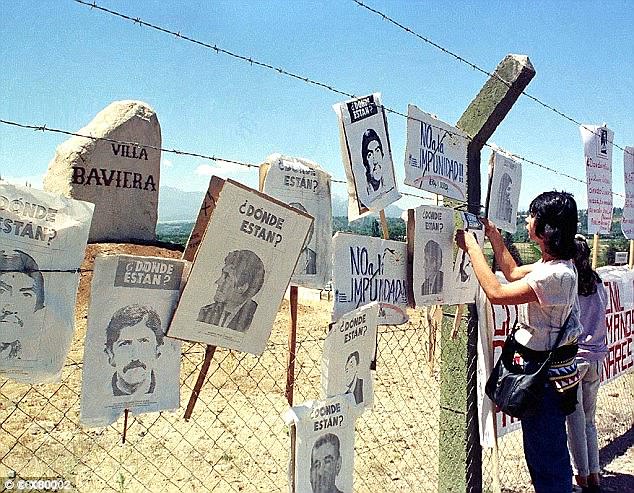
For decades, the residents of Villa Baviera, initially called Colonia Dignidad, submitted to the authoritarian whims of Schaefer, who banned almost all contact with the outside world at the commune 210 miles south of Santiago.

Under his rules, men and women lived separately, intimate contact was controlled and children were split from their parents.

In 2006, former members of the cult issued a public apology and asked for forgiveness for 40 years of sex and human rights abuses in their community, saying they were brainwashed by Schaefer, who many viewed as God.

Pictured: A woman hangs up posters of missing people on the fence surrounding the sect's compound 

Schaefer was born in Troisdorf, Weimar Germany, and joined the Hitler Youth movement at a young age.

He served as a medic in the German Army during World War II, where he reached the rank of corporal. 

Last year prosecutors in Krefeld requested that his right-hand man Hopp serve out the prison term in his country of origin, in line with a Chilean request, and the court has now agreed.

The European Center for Constitutional and Human Rights greeted the ruling, calling it a long-overdue first step 'in the resolution of the crimes of Colonia Dignidad, in particular rape and sexual abuse of minors'.

It warned that Hopp had already fled Chilean justice once and said that authorities 'must prevent a possible escape of Hartmut Hopp'. 

Schaefer disappeared on May 20, 1997, fleeing child sex abuse charges, filed by Chilean authorities after 26 children who went to the commune's free clinic and school reported abuse.

He was tried in Chile in his absence, and found guilty in late 2004.

He was discovered on March 10, 2005, nearly eight years after his disappearance, hiding in a suburb known as Las Acacias, 30 miles from Buenos Aires, Argentina.

Following two days of negotiations between Chilean and Argentine authorities, Schaefer was sent back to Chile to face a court hearing. There, he was charged with being involved in the 1976 disappearance of the political activist Juan Maino, and he remained in custody until his death.

On May 24, 2006, he was sentenced to 20 years in jail for sexually abusing 25 children and was ordered to pay £1million to 11 minors whose representatives established suits.

He died aged 89 in a Chilean jail in 2010 while serving his sentence.

Villa Baviera (Colonia Dignidad), Chile


Thursday, 27 October 2016

Cardinal Pell Questioned by Police on Child Sex Abuse Claims

The Vatican’s Treasurer Has Been Interviewed by Australian Police Over Child Sex Abuse Claims
TIME Staff  

Cardinal George Pell Testifies To Child Sex Abuse Royal Commission - Rome

There are allegations that Cardinal George Pell abused
young boys in the 1970s and 1980s

Police from the state of Victoria, Australia, have flown to Rome to interview Vatican treasurer Cardinal George Pell over allegations of sexual assault.

A spokeswoman for Pell confirmed Wednesday that the Australian-born Cardinal had been interviewed and would continue to co-operate with police but said that he “repeats his previous rejection of all and every allegation of sexual abuse,” the Guardian reports.

Victorian police had previously confirmed that they were considering charging Pell in July, when allegations that the Cardinal had abused young boys in the 1970’s and 1980’s surfaced in Australian media.

Among the allegations were those made by two men who claimed on Australia’s ABC News that, when they were high school students, Pell had repeatedly touched their genitals while swimming with them at a pool in Ballarat, Victoria. Pell was episcopal vicar for education at the time.

“It’s about time Australia’s most senior Catholic was interviewed by the police,” Leonie Sheedy, the chief executive officer of Care Leavers Australia Network, a support group for people who were raised in orphanages, told the Guardian.

Pell has described the allegations as “utterly false” and “nothing more than a scandalous smear campaign.”

And, of course, we know a Cardinal would never lie!

Earlier in 2016 Pell testified from Rome via video link to an Australian inquiry into child sex abuse, where he said the Catholic Church had made “enormous mistakes” in dealing with claims of sexual abuse.

                       Ballarat, Victoria, AU

Sunday, 18 September 2016

Catholicism Surviving in Ballarat Despite Astounding Historical Child Sex Abuse

Harrowing stories of child sex abuse
still reverberating in Ballarat
By Danny Tran

Father James Kerr
Father James Kerr is one of a few boys from Ballarat's St Patrick's College who joined the priesthood. (ABC Open: Marc Eiden)

It's the spiritual birthplace of the trade union movement, the gateway to Victoria's gold rush and Australia's source of Mars Bars.

However, in recent years, the intensely Catholic city of Ballarat in Victoria has been infamous for the gang of paedophile priests which operated with impunity.

Among them was Gerald Ridsdale, who conceded before the child abuse royal commission that even if he had been found out, he would have lied.

He used to be known as Father Gerry or Father Ridsdale — a man who could be trusted because of his devotion to God.

"He was a kind and gentle man, very kind," said Joanna, a former parishioner who did not want to use her full name.

"He visited, he did things around the parish. You would have no idea, none of us had any idea that there was anything going on and that's the sad part. He was a good priest."

It was decades before communities along Victoria's rosary belt would learn he had abused what is estimated to be more than 100 of their children.

'How could I not have protected my own son?'

Ridsdale's conviction blindsided and baffled the communities that had trusted him.

PHOTO: Gerald Ridsdale is estimated to have abused more than 100 children, mainly in Victoria. (Royal Commission into Institutional Responses to Child Abuse)

It was 15 years after he went behind bars before Joanna's son admitted that he had been molested.

"I screamed ... just up and down the passage ... absolutely screaming to think how could I not have protected my own son," she said.

Joanna's son has since died, but the gut-wrenching betrayal was not enough to shake her faith.

"I truly have forgiven him. I actually have pity for him. When I saw him on the television, I thought, you're to be pitied. You're to be pitied," she said.

'I think it's shaken everybody's faith'

For the Catholic Church and clergy, the Royal Commission into Institutional Responses to Child Abuse has brought a chill to Ballarat's air.

Father James Kerr, 29, is one of the few boys from Ballarat's St Patrick's College to go on to join the priesthood.

Father James Kerr at St Patrick's in Ballarat
Father James Kerr says it is only fair that priests cop anger from the community. (ABC Open: Marc Eiden)

He is one of fewer who have stayed in Ballarat as the royal commission raged.

"I've only been abused [by members of the public] twice," Fr Kerr said.

"It is hard because your integrity's questioned. But behind that is a pain and you've got to recognise that, too.

"If that means from time to time that I have to cop that kind of anger, then that's fair."

Father Justin Driscoll, the vicar-general of the Ballarat diocese, said the pressure was too much to bear for some parishioners.

"I think it's shaken everybody's faith," he said.

"Some to the point where they have walked away, others staying with the sense of, 'well, where else would I go?'"

Ballarat's Catholics keeping faith

Despite the difficult times for the church, baptism numbers are steady, according to Father Driscoll.

He said people had continued to seek out the church throughout the royal commission hearings.

"Sometimes I ask them, do you really know who you're coming to? Do you know who we are? And they're under no pretences," he said.

Joanna said her son found it intensely difficult to reconcile her religion.

"He would've liked to give up my faith, but he knew I couldn't. He knew that I had faith in Jesus and not in priests," she said.

"Jesus … said forgive them father, but he didn't say, 'hey, the crucifixion didn't hurt'.

"He said, 'Forgive them they know not what they do'."

He said that with regard to the people who were crucifying Him. I don't believe it is applicable to all sinners especially pedophile priests who bloody well knew what they were doing. Nevertheless, while it is up to us to forgive, Jesus wasn't praying for such heartless, hypocritical, perverted priests on the Cross. Pedophiles destroy innocence, and that may be their ruling compulsion, but it is also a direct act of violence against God.


Sunday, 28 August 2016

Anglican Dean ‘Gave Court Reference for Priest Accused of Child Sex Abuse’

A gay, a child sex abuser - why wouldn't he be
Dean of Newcastle’s Anglican cathedral? Good grief!
Is there absolutely no discernment in the church today?

   Defrocked former Anglican dean of Newcastle Graeme Lawrence arrives home with partner
   Greg Goyette at the weekend. Picture: Ryan Osland

The Australian
DAN BOX Crime reporter Sydney, AU

A former dean of Newcastle’s Anglican cathedral wrote a character reference for an alleged pedophile priest at the centre of a new police investigation, a royal commission has heard.

The reference was one of three provided by Graeme Lawrence for the criminal trials of alleged sex offenders within the NSW diocese, according to evidence before the Royal Commission into Instit­utional Responses to Child Sexual Abuse. Mr Lawrence was himself later defrocked after having group sex with a teenager.

The former cathedral dean prepared the reference in about 2001, although the charges were ultimately “no-billed”, meaning prosecutors decided not to pursue the case.

The Newcastle diocese subsequently released a media statement falsely claiming that the priest, who cannot be named, had been acquitted, the commission has heard.

The priest moved to the Victorian diocese of Ballarat.

Sure, seems like all pedophile priests ended up in Ballarat.

Newcastle’s bishop at the time, Roger Herft, now the Archbishop of Perth, has told the commission he has “no recollection” of contacting the church in Ballarat to warn them the priest was an ­alleged child-sex offender.

“I accept, however, it was entirely within my power” to contact the bishop of Ballarat “about the allegations ... either before or after (the priest’s) trial”, Archbishop Herft said in a statement to the commission. Both Mr Lawrence and Archbishop Herft are expected to face cross-examination ­before the commission, which ­resumes its public inquiry into the Newcastle diocese today.

The Australian revealed in 2014 that police had launched a strike force, codenamed Arinya-2, to investigate alleged abuse of multiple victims within the region’s Anglican Church during the 1970s.

The commission has since heard the priest in question allegedly abused two altar boys over several years between 1971 and 1975. The abuse took place at least fortnightly and escalated over time,” one of his victims has told the commission. The priest ­“abused me at our local church, the rectory where he lived, in his vehicle during travel, and at other churches in the parish”.

NSW police are now likely to lay fresh charges against the priest, the commission has heard, with lawyers for the state saying they expect he will face a second criminal trial.

As dean of the cathedral, Mr Lawrence worked closely with the priest and also provided character references for two other alleged abusers, Ian Barrack and Allan Kitchingman, the commission heard. Both were subsequently convicted of sexual offences.

Mr Lawrence was also a member of the “Gang of Three” senior church officials who protected another alleged pedophile priest, the commission has heard.

Both Mr Lawrence and former Newcastle archdeacon Bruce Hoare were defrocked, or ­removed from the priesthood, in 2012 after an internal investi­g­ation found they had taken part in a 1984 group sex session with a 19-year-old.

The teenage participant, who also cannot be named, has told the commission the incident was “the outcome of years of sexual grooming and abuse … by Lawrence”.

Evidence before the commission alleges Archbishop Herft was told at least three times that Mr Lawrence was sexually abusive, including of children, although he has told the commission he cannot recall this taking place.

A file note of a conversation last year between the current Newcastle bishop Greg Thompson and one of its former legal ­advisers, Keith Allan, has also been tendered to the commission.

“Allen advised that Graeme Lawrence would be a focus of the police and the royal commission and that Lawrence would ‘bring others down’,” this states.

Questioned about this during the commission, Mr Allen said: “I probably think words to that or similar to that may — would have been said.”

Wednesday, 27 July 2016

Cardinal Pell Being Investigated for Multiple Allegations of Child Sex Abuse

Pell is arguably, the second most powerful
man in the Catholic Church
ABC 7.30 By Louise Milligan and Andy Burns
George Pell subject of Victoria Police investigation into multiple allegations of sexual abuse

Police are investigating multiple child abuse allegations levelled directly against Australia's most senior Catholic cleric Cardinal George Pell, the ABC's 7.30 program has revealed.


Victoria Police's Taskforce SANO, which investigates complaints coming out of the Royal Commission into Institutional Responses to Child Sexual Abuse, has been examining the allegations by complainants from Ballarat, Torquay and Melbourne for more than a year.

They include allegations about incidents which allegedly happened during Cardinal Pell's time as Archbishop of Melbourne in the 1990s.

7.30 understands that the Pell case has been referred by Victoria Police to the Office of Public Prosecutions for advice.

7.30 has obtained eight police statements from complainants, witnesses and family members who are helping the taskforce with their investigation.

Victoria Police Chief Commissioner Graham Ashton confirmed last month that the taskforce was investigating multiple allegations against the Cardinal and, if necessary, detectives would fly to Rome to interview George Pell, although the Chief Commissioner said "it had not been put as necessary to me at this point in time".

Mr Ashton declined to comment to 7.30, although his spokesman has confirmed to the program it is "very much a live investigation".

In a statement to the ABC, Cardinal Pell's office said he "emphatically and unequivocally rejects any allegations of sexual abuse against him", and accused the ABC of mounting a smear campaign against him.

Alleged incidents occurred across two decades

The complaints include those by two men now in their forties, from George Pell's home town of Ballarat, who say he touched them inappropriately in the summer of 1978-79 when he was playing a throwing game with them at the town's Eureka pool.

In another complaint, Torquay businessman Les Tyack gave a statement to the royal commission last year relating to an incident at the Torquay Surf Life Saving Club in the summer of 1986-87.

He said he walked into the club change rooms to discover a naked George Pell behaving in a manner that caused him concern in front of three boys he estimated to be aged between 8 and 10 years old.

A further complaint about George Pell that 7.30 is aware of relates to the period in the 1990s when George Pell was setting up the Melbourne Response — the Australian Catholic Church's first attempt to seriously address child abuse.

It involves two teenage choirboys who asked their parents to leave the choir soon after the alleged abuse had occurred.

One of the boys died in tragic circumstances two years ago and the other is working with Taskforce SANO detectives.

7.30 has met that young man and the family of his former friend who died.

George Pell says claims are 'totally untrue and utterly wrong'

George Pell declined to be interviewed by 7.30 and did not address specific allegations, but said he had never abused anyone.

In a statement, his office said:

"The Cardinal does not wish to cause any distress to any victim of abuse. However, claims that he has sexually abused anyone, in any place, at any time in his life are totally untrue and completely wrong."

The Cardinal is entitled to the presumption of innocence and police and prosecutors will decide whether any of the allegations warrant charges.

George Pell has previously faced public allegations of sexual abuse.


PHOTO: Cardinal George Pell as a young man. (Supplied)

In 2002, when George Pell was Archbishop of Sydney, a man came forward to the Church to say that George Pell abused him in 1961 when he was 12 years old and George Pell was a trainee priest.

In a statement to an internal church inquiry headed by retired Supreme Court Justice Alec Southwell, the complainant alleged that on several occasions at a campsite on Phillip Island, the man known to him as "Big George" put his hands down his pants and "got a good handful of his penis and testicles".

He said George Pell molested him on several occasions in a tent and once, under his bathers, when they were in the water, jumping in the waves.

The then-Archbishop Pell stood aside in 2002 while Alec Southwell conducted the inquiry for the Catholic Church.

At the time, George Pell said the allegations were "lies" and said he denied them "utterly and totally".

Some time after the complaint was made a file was compiled on the complainant, who had been a wharfie, a convicted criminal and an alcoholic.

The details of the man's criminal history then appeared in a newspaper article.

Justice Southwell said in his findings that the "complainant's credibility was subjected to a forceful attack", however he found the complainant's evidence truthful.

He also found that George Pell's evidence was truthful.

George Pell returned to his role as Archbishop, saying "there's no mud to stick, I've been exonerated".

Complaints fall outside royal commission's terms of reference

In his statement, Cardinal Pell accused the ABC of a "scandalous smear campaign".

"If there was any credibility in any of these claims, they would have been pursued by the Royal Commission by now."

Cardinal Pell gives evidence by video to Royal Commission

However, the royal commission advises that these sorts of allegations are outside its terms of reference, because it only investigates institutional responses to child abuse, and it refers any new complaints of clergy abuse to police.

It is expected to make findings on the Cardinal's evidence about his role in the Church's response to allegations of abuse by clergy in coming months.

Some of the behaviour alleged in the Taskforce SANO statements seen by 7.30 may not justify criminal charges, but does seem unusual and inappropriate for a senior priest.

The alleged behaviour raises serious questions about whether George Pell was ever an appropriate person to drive the Church's response to child sexual abuse.

Forensic psychologist and former priest, Terry Laidler, says it also raises questions over whether he should stand aside from his position at the centre of Church power in the Vatican.

"I think, like everyone, he's entitled to presumptions of innocence on criminal matters, to an assumption of goodwill on other matters," Mr Laidler said.

"But I think once something gets to the level of allegations that, on any reasonable standard, are worth giving some credit to, no, I think he's got to stand aside."

Wednesday, 2 March 2016

Several Takes on Cardinal Pell's Last Day of Testimony to Commission

'I hope that my appearance here has contributed a bit to healing,' says Pell at the conclusion of questioning – as it happened

Cardinal George Pell tells the royal commission he regrets his choice of words when he described offending by the paedophile priest Gerald Ridsdale as a ‘sad story’ that ‘wasn’t of much interest to me’.


Melissa Davey

A recap of one of the most telling exchanges between Justice Peter McClellan and Cardinal George Pell

Melissa Davey here closing off our live coverage of Cardinal George Pell’s evidence before Australia’s royal commission into institutional responses into child sexual abuse.

A recap of the key evidence from today:

Pell gave a brief press confidence following the close of his evidence before the royal commission, saying: “I hope that my appearance here has contributed a bit to healing, to improving the situation”.

At 9.30pm Australian eastern daylight time, survivors will meet with Pell in Rome. They have largely expressed disappointment at his evidence, saying it at times lacked empathy and transparency.

A lawyer for abuse victims has put it to Pell today that the death of at least one child abuse victim could have been prevented had Pell gone to police so an investigation could have been launched. The statement was met by applause from survivors watching from Ballarat town hall.

Pell sais when a young schoolboy came to him to say Brother Edward Dowlan was abusing children, he “didn’t do anything about it” aside from tell a chaplain because he believed then that was all he had to do. He was strongly challenged on this point by Justice Peter McClellan.

Pell said investigating pedophile priest Peter Searson was not his responsibility and he believed the Catholic Education Office and the Bishop of Ballarat, Ronald Mulkearns, was handling the allegations.

Pell said that he regrets what child sexual abuse within the church does to the Catholic faith of the survivors, their families and society.

Pell was questioned by his own lawyer, Sam Duggan, who tried to demonstrate that Pell had limited contact with notorious paedophile priest Gerald Ridsdale during some of the period in which he was abusing children across several parishes.

However, Ridsdale was convicted for abusing more than 50 children over a period of 30 years. For a time, he lived in a parish with Pell.

Duggan said it was Pell who handed pedophile priest Peter Searson a letter requesting that he resign in 1998, a move not supported by the Vatican in Rome.

However, the commission also heard the Catholic Education Office handed Pell a list of grievances against Searson long before that, in 1989. Pell believed the list, which included reports Searson had abused animals in front of children and was using children’s toilets, did not contain enough information about the situation for him to act.


The ABC Australia writes:

The ABC has filed this report on the response of survivors today. 

Sex abuse survivors say they are looking forward to the royal commission handing down its findings in relation to Cardinal George Pell’s testimony, saying they believe he has not been truthful.

Cardinal Pell fronted the child abuse royal commission for a fourth day and final day via videolink from a Rome hotel on Thursday, saying he believed it was a “disastrous coincidence” that a series of pedophile priests had been sent to the Ballarat East parish during the 1970s.

Speaking outside the Hotel Quirinale, survivors said they doubted Cardinal Pell was telling the truth.

“The Ballarat survivors came to Rome to hear truth and honesty from George. We feel we have been deceived and lied to,” survivor Philip Nagle said.

“The royal commission at some stage in the future will give a recommendation on the evidence given by George.”

In several hours – at 9.30pm Australian eastern daylight time and 11.30am Rome time – abuse survivors will meet with Cardinal George Pell.

On the possibility of meeting with the Pope
They hope to also meet with Pope Francis before they leave Rome on Saturday, but no word yet on whether the Vatican has responded to that request. They want a commitment that no child will be abused within the Catholic church ever again, and that everything will be done to prevent abuse in a transparent and rigorous way.

Survivors have said at a press conference in Rome earlier that Pell’s evidence has not left them hopeful that the church is open to transparency, or that it understands the serious and devastating implications abuse has had on their lives.


Australian Parliament

The opposition leader, Bill Shorten, has brought up the royal commission in parliamentary question time. He says to the prime minister, Malcolm Turnbull:

Australians have been shocked and angered by evidence revealed at the royal commission into child sexual abuse. In September last year the royal commission’s final report on redress and litigation recommended a single national redress scheme for survivors of child sexual abuse. Labor committed to a single national redress scheme in October last year. Will the prime minister join with Labor and commit to a single national redress scheme for survivors of child sexual abuse?

Turnbull responded:

The government has carefully considered the royal commission’s recommendations and will lead the development of a national approach to redress for victims of institutional child sexual abuse. We recognise the importance of developing such a national approach to redress as quickly as possible. Survivors want redress, they deserve redress to assist with the healing process. Now we’ve commenced discussions with the states and territories to carefully work through these many complex issues.


Kristina Keneally's take

The former premier of NSW Kristina Keneally, who also has a masters in theology, has been closely following Pell’s evidence to the royal commission. She has written some analysis for Guardian Australia. Keneally writes Cardinal Pell has thrown his men to the wolves – it’s everyone’s fault but his:

Cardinal George Pell’s evidence this week to the royal commission on institutional responses to child sexual abuse is – to many – shocking. Audible gasps can sometimes be heard from the public gallery in Sydney.

Most of the criticism of Pell is sparked by this one stark statement, given in response to questions about what the younger Pell knew about convicted serial paedophile Gerald Ridsdale: “It was a sad story and it wasn’t of much interest to me ... I had no reason to turn my mind to the evils Ridsdale had perpetrated.”

Let’s set aside that perhaps any priest – indeed, any human with a functioning conscience – might have shown some interest once stories and rumours started to swirl in Ballarat. Pell shared a house with Ridsdale, Pell sat on a committee of priests who made decisions to move Ridsdale from parish to parish, Pell was vicar for education when Ridsdale was a school chaplain at St Alipius, and Pell accompanied Ridsdale to court when he was finally charged.

Pell had more reasons than most to turn his mind to what Ridsdale was perpetrating.


Melissa Davey

A recap of one of the most telling exchanges between Justice Peter McClellan and Cardinal George Pell

With Pell’s evidence now over, this exchange is worth going over in full:

McClellan asked Pell about how he responded to a young schoolboy who came to him to say Brother Edward Dowlan was abusing children. In 2015, Dowlan was convicted of 16 counts of indecent assault against 11 boys at four different Christian Brothers’ schools and was sentenced to six years and six months in prison, with a four-year non-parole period.

McClellan: “What did that boy say to you?”

Pell: “Um, he said something like ‘Dowlan is misbehaving with boys’.”

McClellan: “That was a very serious matter to be raised with you, wasn’t it?”

Pell: “Um, yes, that is the case.”

McClellan: “What did you do about it?”

Pell: “Um, I didn’t do anything about it.”

McClellan: “Would you have done something about it?”

Pell: “Well, I eventually did. I eventually inquired with the school chaplain.”

McClellan: “You didn’t go straight to the school and say ‘I’ve got this allegation, what’s going on’?”

Pell: “No, I didn’t.”

McClellan: “Should you have?”

Pell: “Um, with the experience of 40 years later, certainly I would agree that I should have done more.”

McClellan: “Why do you need the experience of 40 years later? Wasn’t it a serious matter then?”

Pell: “Yes, but people had a different attitude then. There was no specifics about the activity, how serious it was and the boy wasn’t asking me to do anything about it but just lamenting and mentioning.”

McClellan: “You and I have had this discussion on more than one occasion: Why was it necessary for people to ask you to do something rather than for you to accept the information and initiate your own response?”

Pell: “Um, obviously that is not the case and my responsibilities as an auxiliary bishop and director of an educational institute and archbishop, obviously I was more aware of those obligations in those situations than I was as a young cleric. But I ... don’t excuse my comparative lack of activity.”