So far in the 21st century nearly a third of a billion children have been sexually abused, most of them multiple times, some thousands of times. 6 out of 7 are girls. Anything you can do to get this message to as many people as possible will help save abused children all over the world, and maybe even some of the abusers. Please read "Save A Child from Sexual Abuse by 3:15 PM" under "First Time Visitor?" May God bless you and anoint this ministry.
Everyday thousands of children are being sexually abused. You can stop the abuse of at least one child by simply praying. You can possibly stop the abuse of thousands of children by forwarding the link in First Time Visitor? by email, Twitter or Facebook to every Christian you know. Save a child or lots of children!!!! Do Something, please!
3:15 PM prayer in brief:
Pray for God to stop 1 child from being molested today.
Pray for God to stop 1 child molestation happening now.
Pray for God to rescue 1 child from sexual slavery.
Pray for God to save 1 girl from genital circumcision.
Pray for God to stop 1 girl from becoming a child-bride.
If you have the faith pray for 100 children rather than one.
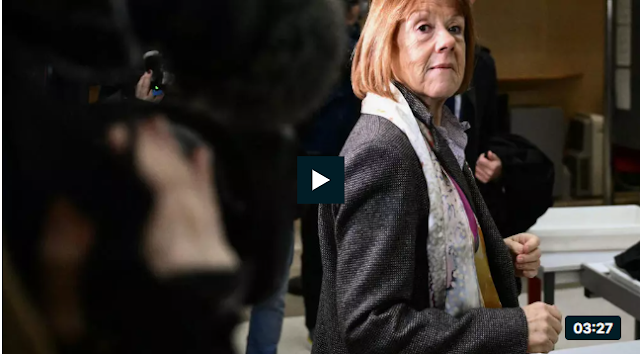
European authorities on Thursday said cases such as that of Gisele Pelicot (C) are not rare, with an international operation disrupting four online networks of men sharing videos, photos and information about during and sexually assaulting women, often their own partners. File Photo by Guillaume Horcajuelo/EPA
July 3 (UPI) --Authorities have uncovered international networks of men accused of drugging and sexually assaulting women, most often their own partners, then sharing videos and photos of the crimes with one another online.
Announced Thursday, the coordinated law enforcement efforts disrupted four online communities that authorities said played a significant role in enabling and normalizing what Europol called "drug-facilitated sexual assaults."
According to authorities, the international investigation targeted drug-facilitated sexual assaults in intimate partner relationships.
The victims, almost exclusively women, are sedated with drugs or alcohol before they are sexually assaulted, sometimes by multiple offenders, without their knowledge.
Identifying information about those arrested was not made public, but the authorities said they were in long-term relationships with their victims, who were often unaware of the crimes, which were sometimes committed for decades.
Project Medusa, launched in April and led by British and German authorities, resulted in the identification of 156 perpetrators and victims and 274 investigative leads, as well as 57 arrests and 113 investigations launched.
Separately, Britain's National Crime Agency said an investigation launched in October 2025 identified more than 270 individuals linked to one particular online forum and its successors, with more than 210 packages of intelligence sent to law enforcement partners in Britain and overseas.
"This is a deeply distressing form of sexual offending and domestic abuse, and we recognize the enormity of the impact on victims, particularly where the person responsible is someone known and trusted," Deputy Assistant Commissioner Helen Millichap, director of the National Center for Violence Against Women and Girls and Public Protection, said in a statement.
"In many cases, victims may not realize what has happened to them at the time. They may only become aware through police contact or emerging evidence, which can be extremely confusing and difficult to process."
The investigations come after the case of Gisele Pelicot gained international attention last year.
Pelicot was a victim of mass rape. Her ex-husband, Dominique Pelicot, was convicted of drugging and raping her and inviting dozens of other men to participate, all without her knowledge.
The international authorities said Thursday that the networks they disrupted show that Pelicot is not the only victim of this type of crime.
"The abuse we're discussing is some of the most horrifying I have ever seen in my career," Siobhan Blake, National CPS lead for Rape and Serious Sexual Offenses, said in a statement.
"This offending thrives in secrecy online and behind closed doors. It is the job of the criminal justice system to bring it out into the open to deliver for victims and survivors."
These are seriously sick men, and apparently, there are a lot of them.
Men film themselves sexually abusing sedated women and share it with other men online. Why?
The world watched on in horror in 2024 as Dominque Pelicot and 50 other men were tried in a French court for repeatedly drugging and raping Gisele Pelicot over almost a decade. All of them were found guilty.
While such horrific abuse can feel far away and rare, it’s more widespread than many realise. There are private online communities with thousands of members all over the world, including in Australia, trading in video and photos of sedated women being abused.
A recent investigation by CNN revealed there are thousands-strong groups on messaging app Telegram who share tactics and videos assaulting and raping their girlfriends and wives.
In April, France launched an investigation into the website Pelicot used to recruit dozens of strangers to rape his wife. During the trial, police uncovered 20,000 videos and photos of his wife’s abuse, recorded by Pelicot himself.
These reports show how widespread this issue is, underscoring that these are not isolated episodes. They are organised crimes committed by dedicated communities that support such violence, hosted on platforms that provide the essential infrastructure.
One report from the New York Times reported China-based group chats with as many as 100,000 members. A study of Telegram networks across Italy and Spain showed groups with nearly 25,000 users.
The Telegram group CNN reported on had more than 1,000 members with some videos posted in the group amassing over 50,000 views.
The groups identified in these stories and reports are part of a broader digital ecosystem often referred to as the manosphere, an online network of group chats, influencers and communities that perpetuate misogynistic ideas.
As the CNN report puts it “while the platforms vary, inside such groups, video is king”. The more perverse, humiliating and risky the visual material, the higher the engagement and the greater the reward.
Telegram, like other platforms, provides financial incentives for engagement. Members can earn points through their activity and earn a place on leader boards. Telegram has its own internal crypto system, which members can spend through affiliate links.
Research from Australia shows men who non-consensually share images and videos online are motivated by more than revenge. What these men crave is the chance to prove their manliness to other men.
from women they want devotion, service and sex. Heterosexual male culture is homoerotic; it is man-loving.
While the men in these groups are sharing images and videos of women, commenting on women’s bodies, degrading women and objectifying women, it is men who are at the centre of the exchange. They seek the validation and praise of other men. One way this is achieved is by getting comments and likes on their videos.
Another popular form of bonding is the solicitation of comments from other members. One study described how users requested descriptions of what others would do, such as “describe how you would rape this bitch”.
Others commission sexualised deepfakes – realistic but fake sexually explicit images – using nudify apps and other artificial intelligence (AI) platforms.
In these groups, the practices and the language are meant to degrade women, to reduce them
from women they want devotion, service and sex. Heterosexual male culture is homoerotic; it is man-loving.
While the men in these groups are sharing images and videos of women, commenting on women’s bodies, degrading women and objectifying women, it is men who are at the centre of the exchange. They seek the validation and praise of other men. One way this is achieved is by getting comments and likes on their videos.
Another popular form of bonding is the solicitation of comments from other members. One study described how users requested descriptions of what others would do, such as “describe how you would rape this bitch”.
Others commission sexualised deepfakes – realistic but fake sexually explicit images – using nudify apps and other artificial intelligence (AI) platforms.
In these groups, the practices and the language are meant to degrade women, to reduce them to raw material, objects to be consumed to satiate men’s desire, and to reinforce the bonds between men. Misogyny is the “social glue” that holds these communities together.
What can we do about it?
Traditional approaches and responses to gender-based violence still tend to individualise the problem, focusing on single perpetrators. What this approach fails to do is address the social, structural and technological enablers of this abuse.
Take the Telegram platform: why has this become the safe haven for perpetrators?
Groups can have up to 200,000 members. End-to-end data encryption allows for anonymity, and its content moderation regulations are weak. Telegram allows users to share visual and audio material (including large files). And perhaps most importantly, it has interactive features: likes, comments and disappearing messages.
Telegram allows up to 200,000 people in a group and offers very little content moderation.Dimitri Karastelev/Unsplash
All of these features collide to create the perfect storm for perpetrators. They are large, private, largely unregulated and allow them to anonymously share non-consensual sexual material.
There are efforts to stop this abuse, with emerging legislation such as the Take It Down Law in the United States that came into effect in May, and regulatory bodies such as the eSafety Commissioner in Australia, that aim to tackle the creation of image-based sexual abuse (including using sexualised deepfakes).
While these laws are aimed at individual perpetrators, the Pelicot case in France prompted the arrest of the creators of the website Dominique used to recruit others to assault his wife. In 2024, Telegram’s founder was arrested and charged in France for allowing illicit behaviour on the platform, including the distribution of child sexual abuse material. The case is still before the courts.
These arrests represent a welcome shift in how we tackle this issue by holding tech executives, not just their companies, responsible for providing the infrastructure that allows this abusive and degrading behaviour to proliferate and thrive.
All of these features collide to create the perfect storm for perpetrators. They are large, private, largely unregulated and allow them to anonymously share non-consensual sexual material.
There are efforts to stop this abuse, with emerging legislation such as the Take It Down Law in the United States that came into effect in May, and regulatory bodies such as the eSafety Commissioner in Australia, that aim to tackle the creation of image-based sexual abuse (including using sexualised deepfakes).
While these laws are aimed at individual perpetrators, the Pelicot case in France prompted the arrest of the creators of the website Dominique used to recruit others to assault his wife. In 2024, Telegram’s founder was arrested and charged in France for allowing illicit behaviour on the platform, including the distribution of child sexual abuse material. The case is still before the courts.
These arrests represent a welcome shift in how we tackle this issue by holding tech executives, not just their companies, responsible for providing the infrastructure that allows this abusive and degrading behaviour to proliferate and thrive.
Prosecutors have requested sentences of up to 15 years in jail for 49 co-defendants in the trial of Dominique Pelicot, who is accused of drugging his former wife Gisèle for a decade and inviting dozens of men recruited online to rape her.
On Monday, prosecutors requested a maximum 20-year jail term for Dominique Pelicot, 71, who has been on trial in the southern city of Avignon since September with 49 other men for organising the repeated rape and sexual abuse of Gisèle Pelicot, now his former wife.
One man is being tried in absentia. As in all previous hearings, Gisèle Pelicot was present in court.
The case has sparked horror, protests and a debate about male violence in France, with tens of thousands of protesters staging demonstrations across the country on Saturday against violence targeting women.
The decade-long abuse of Gisèle Pelicot by Dominique Pelicot was only uncovered when he was arrested for a separate offence of filming up women's skirts, leading investigators to discover his meticulously-kept records of the visitors to the family home in the town Mazan.
Prosecutors since Monday have outlined their sentencing demands for the defendants who responded to Pelicot's invitation, men aged between 26 and 74, most of whom come from ordinary professions ranging from the fire brigade to the media.
Sentencing requests were made for 20 of the defendants on Monday, with those for the remaining 30 set to be wrapped up on Tuesday, paving the way for Dominique Pelicot's lawyer Beatrice Zavarro to set out her closing argument from Wednesday.
Over the two days, excluding Dominique Pelicot himself, the lowest sentence demanded was four years and the highest was 17 years.
'From another era'
On Tuesday, public prosecutor Laure Chabaud asked for a 14-year sentence for Karim S., 38, who was one of the few defendants whose messaging with Dominique Pelicot was discovered by investigators.
For Florian R., 32, who did not admit "intent" and Gregory S., 31, who was "aware of Gisèle Pelicot's altered state", Chabaud demanded 13 years in prison.
Some defence lawyers have described the sentencing demands as "staggering" and "out of proportion", alleging that the public prosecutor's office was under pressure from "public opinion".
"I fear what will happen next," said Louis-Alain Lemaire, a lawyer for four defendants.
But public prosecutors say the trial should herald a fundamental change in society.
"In 2024, we can no longer say 'she didn't say anything, she agreed', that's from another era," Chabaud said on Monday.
'Did not obtain consent'
A 14-year sentence was demanded for Christian L., 56, who was filmed forcibly penetrating Gisèle Pelicot wearing his local fire brigade T-shirt. Joan K. who went to Pelicot's home twice, should get a 15-year sentence, prosecutors said.
Prosecutors asked for Boris M., 37, who claimed during the hearings that he, too, was a victim, to be sentenced to 12 years.
"He says he was a victim of Dominique Pelicot, like Gisèle Pelicot," prosecutor Jean-Francois Mayet said.
But "at no time did he seek or obtain Gisèle Pelicot's consent", he said, adding that "in reality, he was pleased with the situation presented to him" by the main defendant.
Chabaud also asked for 12-years for Lionel R., 44, who said he was taking "part in a couple's fantasy".
Many of the accused argued in court that they believed Pelicot's claim that they were participating in a libertine fantasy, in which his wife had consented to sexual contact and was only pretending to be asleep.
Among them, 33 have also claimed they were not in their right minds when they abused or raped Gisèle Pelicot, a defence not backed up by any of the psychological reports compiled by court-appointed experts.
'Courage and dignity'
On Monday, prosecutors requested a 17-year prison sentence for one defendant, Jean-Pierre M., 63, who applied Pelicot's practices against his own wife to rape her a dozen times, sometimes in Pelicot's presence.
The trial has made Gisèle Pelicot, who insisted the hearings be held in public, a feminist icon in the fight of women against sexual abuse.
Prosecutor Mayet praised her "courage" and "dignity", thanking her for allowing the hearings to be held in public.
On Monday, Prime Minister Michel Barnier said the trial was a watershed moment for the country's efforts to combat violence against women, saying it would "mark a before and after".
The verdicts and sentencing are expected by December 20.
France unveils new measures to protect women in wake of Pelicot affair
Analysis
France
France announced on Monday a new campaign to combat violence against women, including raising awareness about the use of drugs to commit sexual abuse, as the country reckons with a mass rape trial that has shocked the public.
The French government announced on Monday, November 25 new measures to combat violence against women, including state-funded test kits, the ability to file complaints at more hospitals and increased emergency aid.
“These last months the French have been deeply moved by the incredible courage of Gisèle Pelicot,” said Barnier, referring to the mass rape trial that has sent shockwaves across France and beyond. Dominique Pelicot is on trial for raping and recruiting dozens of strangers to rape his heavily sedated, now ex-wife Gisèle for almost a decade in the southeastern French village of Mazan, where the couple lived and where most of the events took place.
‘Raising awareness’ for chemical submission
To combat the “as yet little-known issue of chemical submission”, Barnier announced that the French national health insurance programme will be providing state-funded test kits in several regions on a trial basis. No timetable has yet been defined for this initiative.
A campaign to raise awareness of chemical submission will also be spearheaded by the M'endors pas (Don't sedate me) association co-founded by Gisèle Pelicot's daughter and the helpline of France's Reference centre for substance-facilitated aggression (Centre de référence sur les agressions facilitées par les substances) in partnership with the French Order of Pharmacists.
In October, the government entrusted a similar mission to Senator Véronique Guillotin, of the centrist Radical Movement party, and MP Sandrine Josso, of the centre-right Democratic Movement party. The latter recommended that pharmacies be allowed to issue a “morning-after" test kit via medical prescription to women who think they may have been drugged. Contained in the kit would be urine sample bottles, useful addresses and full instructions on how to access the results, to be used as evidence.
“We feel that the [Pelicot] trial has raised awareness of this type of violence,” said Mine Günbay, director general of the national federation Solidarité Femmes(Women’s Solidarity), who has noted a significant increase in women calling 3919, the national number dedicated to female victims of violence. “Women are speaking out,” said Günbay. “It's very important that a parliamentary report be written up and that resources also be made available to deal with this issue.”
The security services recorded 271,000 victims of domestic violence in 2023, according to the French interior ministry. This type of violence accounted for 93% of the calls handled by 3919.
Expanded system for filing complaints in hospitals
The French government also announced the expansion of the system enabling female victims of violence to file a complaint in a hospital with an emergency or gynaecology department.
While this system, whereby the hospital itself contacts the police or the public prosecutor's office to lodge a complaint, is already available in many French hospitals, it will be extended to 377 facilities by the end of 2025.
“Hospitals and doctors are often the first professionals that women go to, sometimes even before the police ... It is therefore essential that the police come directly to the hospital so that a complaint can be lodged,” added Gunbay, who advocates these systems that “effectively facilitate the victim's journey” and calls for “continued training of police, justice and health professionals”.
Increased universal emergency aid
Günbay also welcomed the increase in universal emergency aid to help victims of domestic violence and support them when they leave their homes.
The budget for this aid will increase from €13 million in the 2024 finance bill (projet de loi sur les finances, or PLF) to €20 million in the 2025 PLF, according to the government. This measure has benefitted 33,000 people, who have received an average of €800, since it was launched at the end of 2023.
“It's a one-off helping hand that's much in demand by the women we support in their dealings with the CAF [Caisses d'Allocations Familiales, the French government agencies responsible for distributing various social benefits and allowances to families], but it doesn't get them out of the violent situation,” said Günbay. The director of Solidarité Femmes nonetheless welcomed the announcement of these measures, “which are nothing new to the associations, but which are more in line with what has been thought out and undertaken as part of the Grenelle [governmental-level consultations] and ministerial plans”.
The government's plan also calls for every French regional department to have a specialised women's centre by the end of 2025.
‘€2.6 billion are needed for a real plan to combat discrimination’
In total, “we have managed to obtain a 10 percent increase in the budget” devoted to gender equality, which has risen to €85.1 million (€+7.7 million) in the PLF 2025, Secretary of State Salima Saa said during an interview on French public radio network Franceinfo on Monday morning.
But the budget increase still falls far short of what is needed for the associations, which are calling for a total budget of €2.6 billion per year and a “comprehensive framework law” to replace the current legislation, which they deem “fragmented and incomplete”.
“We, the feminist associations, are asking for [this total sum] to combat all forms of violence against women. This includes the issue of prevention from a young age, training for professionals, psycho-trauma centres and shelters for women and their children. The €85 million will not be enough. We need €2.6 billion to be able to really combat the problem,” said Günbay.
And nowhere in here is there any mention of educating children regarding paedophiles and child sexual abuse. This is a far more urgent problem than anything else.
The director of Solidarités Femmes said she is very worried about the drop in funding for local authorities, which also finance associations in their area. “In addition to this budgetary ‘women's rights’ envelope, our associations receive funding from local authorities on a departmental and regional level as well as from the local authorities, municipalities, etc. As a result, we have several associations in our network that are in a very precarious economic situation. I just learned this very morning [Monday] that a post funded by the Pays de la Loire region [in western France] had been cut. It was an essential post, because it enabled us to coordinate with a large number of associations across the region.”
“We'll only consider the fight against violence against women to be a major national cause once we have €2.6 billion designated to combat violence against women,” said Günbay, who is now waiting for the "welcomed" but "insufficient" governmental measures to be implemented.