ELIZABETH EISENSTADT-EVANS
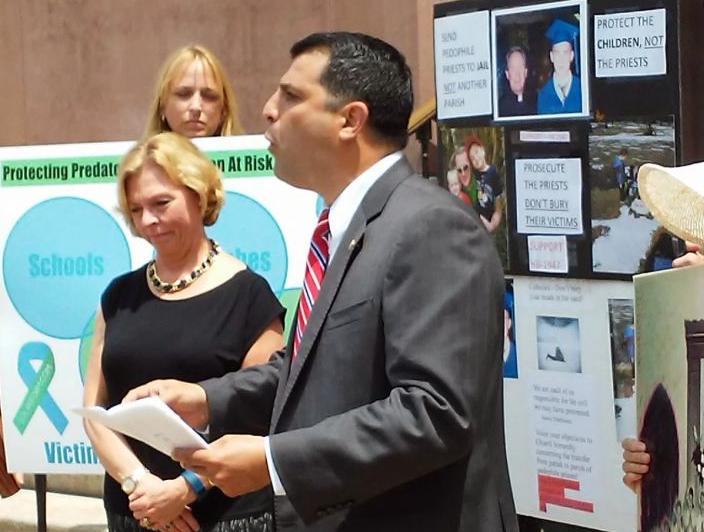
State Re. Mark Rozzi speaks at a press conference in Philadelphia. To his right is attorney Marci Hamilton.
“It’s not over,” said state Rep. Mark Rozzi on Monday, moments after throwing the grand jury reports on sexual abuse of children on the steps of the Cathedral Basilica of Saints Peter and Paul in Philadelphia.
The Berks County lawmaker, himself a victim of abuse, was most likely referring to his ongoing battle to retroactively extend the period in which victims of decades-old childhood abuse could sue those who molested them, dropping the statute of limitations in criminal cases and extending the window for civil ones from age 30 to 50.
HB 1947, which overwhelmingly passed the House this past spring, was stripped of the retroactivity language when it arrived in the state Senate after lobbying by the Pennsylvania Catholic Conference and other groups.
They argued that the provision was unconstitutional, unfairly targeted private institutions like churches and would result in the closure of parishes and ministries. Both the Diocese of Harrisburg and the Archdiocese of Philadelphia, which opposed the House legislation, sent out letters to be read from the pulpit and included in parish newsletters.
What an abomination! Children were, and still are, unfairly targeted by perverts in private institutions, probably for as long as they have existed, and there was little or nothing done to save the children until their atrocities began showing up in the media and law-suits started. Then, and only then, was there action. These private institutions should not be protected from the consequences of their extreme failures. If it means some churches have to close, how can that be a bad thing given their history.
“The constitutionality defense is an issue that bishops typically raise when they find themselves between a rock and a hard place,” says Marci Hamilton, an attorney specializing in the constitutional separation of church and state and a resident senior fellow in the Robert A. Fox Leadership Program at the University of Pennsylvania.
“They typically lose in court. In Pennsylvania the (state) senators were willing to be swayed by a bishop. It is essentially a made-up theory that would have had life in the 19th century but it doesn’t prevail anymore. They are grasping at straws; it’s just politics,” said Hamilton, who added that a number of other states, including California and Delaware, had passed similar provisions.
Clear message
“Today,” thundered Rozzi, flanked by a small group of abuse survivors and victim advocates in Philadelphia, “I want my message to be clear. I don’t care who you are. I don’t care what institution it is. I don’t care when the abuse took place. If you abused children, we are coming for you. If you’re an institution that protected and actively managed predators, we are coming for you. If you’re a legislator who decides its more important to protect pedophiles and the institution that protected them, we are coming for you.”
I’ve been covering sex abuse stories in faith communities for decades, including those that occurred or are linked in some way to clergy or laypeople in my own denomination, the Episcopal Church. For more than a decade, the Diocese of Pennsylvania (in which I reside) was in a virtual state of civil war, due in part to allegations that the (now-retired) bishop, Charles Bennison, had participated in hiding the abuse perpetrated by his brother.
Nagging at me was the question of why, after all these years, the spotlight remains focused on ecclesiastical institutions and the pain of survivors.
After all, while such stories of horrific, institutionalized violence against minors and subsequent coverups were once frequently reported, they aren’t surfacing with the shocking frequency of 10 or 20 years ago.
Help for victims
Many denominations, most notably the dioceses of the Roman Catholic Church, have instituted parish- and diocese-based programs, both to help victims and to clarify and facilitate the mandate to report suspected harm to children.
“If the Archdiocese receives an allegation of sexual abuse of a minor by any priest, deacon, lay employee, or volunteer, it is immediately reported to the appropriate law enforcement agency. That is a long-standing policy,” said Ken Gavin, spokesman for the Archdiocese of Philadelphia. “The required canonical (Church) investigation of such an allegation does not take place until law enforcement has concluded its work. The work of law enforcement and any criminal investigation always take precedence, and we cooperate fully. “
In addition to informing parishes if there is a credible allegation of abuse against a priest, and publishing information on its website, the archdiocese pays for treatment for victims, no matter when the abuse happened, added Gavin. Since 2002, it has disbursed over $13 million in victim assistance, he said.
The Roman Catholic Diocese of Harrisburg also has a victim assistance program.
Nor is sexual abuse of children a problem unique to churches — the majority of cases happen inside the home. According to statistics cited by the Rape, Abuse & Incest National Network, 80 percent of perpetrators were a parent, 6 percent were other relatives, 5 percent were “other” (from siblings to strangers) and 4 percent were unmarried partners of a parent.
Faith communities
Sexual abuse of children by clergy or laypeople associated with faith communities continues to draw our gaze and elicit outrage for a number of reasons.
Stories of abuse and organized efforts to conceal continue to surface, as they did this past spring in the Diocese of Altoona-Johnstown, where a grand jury report documented not only abuse perpetrated by as many as 50 church officials, but a cover-up that involved not only local bishops but judges, police and the district attorneys’ office.
Abuse in faith communities also attracts attention because it occurs in an environment that is supposed to protect the vulnerable, not leave them more open to harm.
Survivors
Then there is the unspeakable pain of survivors.
At the Cathedral press conference, which became more of a rally, I had the opportunity to speak with a survivor, Jim Money. The retired detective, who spent most of his professional life helping abused children, is an alcoholic in long-term recovery who says he is doing well.
Many survivors go on to lead long, healthy lives. Often they find support in the witness of men and women like Rosalind Merritts, who traveled across the state to raise a sign and show her support for victims.
But others have struggled — and some have succumbed — to the pain of their traumatic wounds. In June, Brian Gergely, an abuse victim who counseled other survivors in Western Pennsylvania, took his own life. “He basically gave up” said Hamilton, pointing a finger at the state Senate, which she accused of having “arrogantly stripped out the provision that would have given him justice.”
Abuse victims are four times as likely to abuse drugs and suffer from Post-Traumatic Stress Disorder, and three times more likely to suffer a major episode of depression, according to statistics. Childhood sexual abuse seems also to raise the risk for other psychological disorders, including thoughts of suicide.
Press conference
Given a choice, Hamilton said she’d rather have had the Monday press conference held outside the Capitol in Harrisburg. Hamilton believes that the root of the problem lies in a society that privileges the needs of adults over the welfare of children.
You mean like abortion?
“Pennsylvania has failed to act over the years,” Hamilton said. “It has become a predator-friendly state, which is directly attributable to the Pennsylvania State Senate.”
The Senate is out of step with the public, argues Hamilton — and she suggests, as did Rozzi, that the remedy may lie with Pennsylvania citizens. “It’s going to take some political heat” she says. “For survivors and children to win, members need to be identified as pro-child … or pro-predator.”
Elizabeth Eisenstadt-Evans is a freelance writer and nonparochial Episcopalian priest.
Remember in November


