So far in the 21st century nearly a third of a billion children have been sexually abused, most of them multiple times, some thousands of times. 6 out of 7 are girls. Anything you can do to get this message to as many people as possible will help save abused children all over the world, and maybe even some of the abusers. Please read "Save A Child from Sexual Abuse by 3:15 PM" under "First Time Visitor?" May God bless you and anoint this ministry.
Everyday thousands of children are being sexually abused. You can stop the abuse of at least one child by simply praying. You can possibly stop the abuse of thousands of children by forwarding the link in First Time Visitor? by email, Twitter or Facebook to every Christian you know. Save a child or lots of children!!!! Do Something, please!
3:15 PM prayer in brief:
Pray for God to stop 1 child from being molested today.
Pray for God to stop 1 child molestation happening now.
Pray for God to rescue 1 child from sexual slavery.
Pray for God to save 1 girl from genital circumcision.
Pray for God to stop 1 girl from becoming a child-bride.
If you have the faith pray for 100 children rather than one.
Martyna Ogonowska has lost her appeal. This is atrocious. Martyna was just 18 when she was sexually assaulted by a man named Filip Jaskiewicz. A rape survivor, she was carrying a knife, and she stabbed Jaskiewicz once, killing him.
At her trial, the judge accepted that Martyna had been violently and sexually assaulted, but because she was carrying a knife, her actions were considered unlawful, and she was sentenced to 17 years in prison.
Worse, she’s still behind bars, while Banaras Hussein, leader of the Rotherham rape gang, is already free on licence. This is the UK in 2026: a country where a man who doused a little girl in gasoline and threatened to set her on fire spends less time in prison than a woman who killed in admitted self-defense.
According to Grok:
Martyna Ogonowska was convicted of murder in 2019 at age 18 for stabbing Filip Jaskiewicz once in the heart in his car after he sexually assaulted and assaulted her in Peterborough; the judge accepted the assault happened but rejected self-defense because she brought a knife for protection.
Her conviction appeal was denied in 2023 and sentence appeal (arguing for 12-13 years minimum instead of 17) lost in May 2025, with the Court of Appeal calling the term heavy but not manifestly excessive given her youth, PTSD from prior rape, and the single fatal stab.
The post by radfem account
@sappholives83
uses the case and an accompanying news headline image to criticize UK justice, contrasting Ogonowska still imprisoned with Rotherham grooming gang rapist Banaras Hussain's 2024 release on licence after serving ~9 years of 19.
I can understand the court's reluctance to overturn her guilty finding; however, there, in any sane world, has to be some room for mercy for a rape survivor. What was she supposed to do, hide in her room for the next ten years?
British Columbia Premier David Eby is calling the decision that allowed a convicted child predator to attend an equestrian centre that subsequently led to the sexual assault of an 11-year-old girl a “massive failure of judgment.”
Mr. Eby and his NDP government faced repeated questions from the B.C. United (BCU) Party about why known sex offender Taylor Dueck was released in Kelowna last month without the public being notified.
Mr. Dueck was permitted to attend riding lessons Feb. 9 at an equestrian centre that runs after-school programs for children.
B.C. United Leader Kevin Falcon called the incident “nothing short of horrific,” during question period, saying a “pedophile with a history of violent sexual assault” should never have been allowed to attend such a facility.
For that matter, he should never have been released from prison, ever! But Canadian judges are far more concerned about murderers and rapists than about their victims.
BCU MLA Renee Merrifield, who represents Kelowna-Mission, told the legislature March 5 that a subcontractor arranged by Community Living B.C., who was charged with monitoring Mr. Dueck, sat in his car for more than two hours during which time an 11-year-old girl was allegedly assaulted in a bathroom at the centre.
Ms. Merrifield, who was near tears during her recounting of the events, laid blame on the NDP government for failing to notify the public about Mr. Dueck’s release into the community.
“Who is going to take responsibility for this complete and utter failure so it never happens again?” she asked.
Mr. Falcon also called on the government to take action.
“This NDP government apparently thought that not only was it a good idea to give this pedophile free horseback riding lessons, they decided to book those lessons at a riding camp that was easily identifiable as a venue for children,” he said during question period March 6.
“The premier needs to take accountability for this latest catastrophic failure of his government. Who is going to be fired for this utterly despicable failure to keep our children safe?”
Premier Eby acknowledged there had been a “profound lack of judgement” by Community Living B.C. (CLBC) in allowing Mr. Dueck to go to the equestrian school. He said a government investigation will “hold accountable” the individuals responsible.
“For CLBC to take on responsibility for someone with a criminal record like this, for them to subcontract that responsibility to an obviously negligent and incompetent subcontractor, for that person who had one job to do—to make sure that this individual was not in contact with any children—to fail at that job, to decide that a horse barn was the right place to take this person, it is outrageous,” Mr. Eby said. “It is the absolute most unbelievable string of incompetent decision-making that one could even imagine.”
Public Safety Minister Mike Farnworth assured the legislature March 5 an investigation had been launched and would demand an accounting from all provincial and federal agencies “to find out exactly what happened.”
“Was it a systemic failure or was it a failure of an individual? That work is underway to ensure that this never happens again,” Mr. Farnworth said.
Ms. Merrifield’s response was emotional, saying the victim and the community “deserve better.”
“Our communities are not going to be protected by some investigation and analysis and report,” she said. “People are sick and tired of the premier and this minister’s feigned indignation in the face of horrific failures that leave innocent people victimized.”
‘Special Needs’ Arrangement
Ms. Merrifield told CityNews Mr. Dueck was at the equestrian centre as part of “an arrangement between the social worker and the farm owner.”
“Having said that, at no point when the farm owner had asked about that particular individual and what sort of special needs he had — because that was the premise she was given — when that was asked, the response from the social worker was ‘he needs emotional support,'” she said.
“At no time was there ever disclosure that there was a criminal record, that there was supervisory necessity that they were not to be around children. If so, he would have never been anywhere near that farm.”
Mr. Dueck, 29, was arrested Feb. 9 on charges of sexual interference, invitation to sexual touching and breach of probation in connection with the equestrian centre incident, the Kelowna RCMP said. He remains in custody at the Okanagan Correctional Centre.
The alleged incident occurred less than two months after Mr. Dueck was released on parole after serving four-and-a-half years in jail for sexually assaulting four teenage girls in 2014.One of the victims was threatened with a knife.
Mr. Dueck’s history of sexual offences with minors has made him the subject of past public warnings before his release into a community.
Sergeant Laura Pollock said in a statement Kelowna RCMP had requested a public disclosure order (PID) prior to Mr. Dueck’s release in Kelowna.
“While we understand the commentary surrounding this case, there are multiple factors in the decision-making process for a PID,” she said in an email to The Epoch Times. “I can confirm that a PID was sought prior to his release in Kelowna, however the threshold was not met in this case based on the totality of the circumstances.”
The RCMP referred all further questions to B.C. Corrections.
B.C. Corrections and Community Living B.C. did not respond to requests for comment by publication time.
Delays in civil justice system forcing one woman to go one-on-one against the man she says raped her
Jane Skrypnek
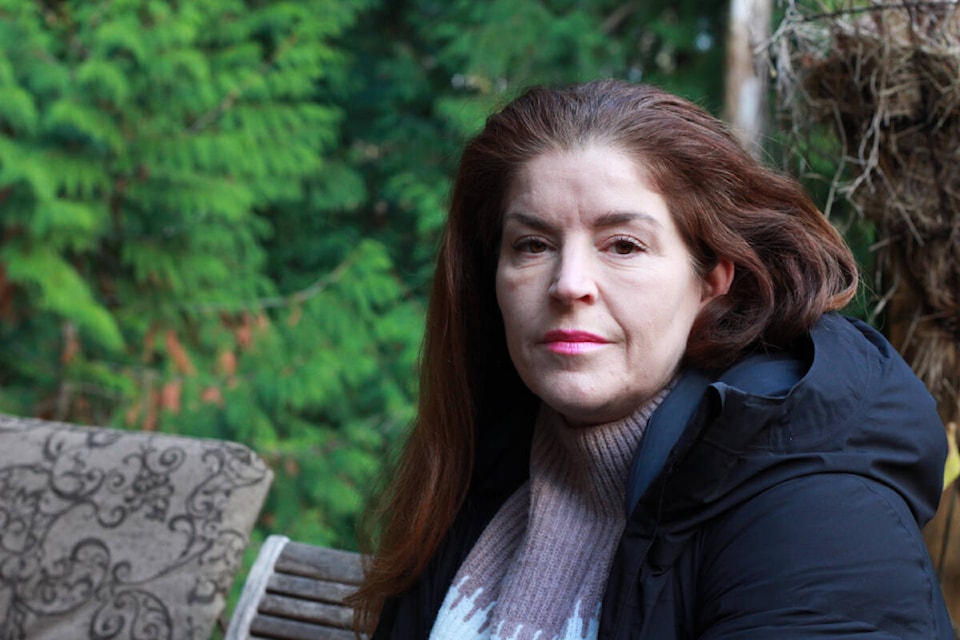
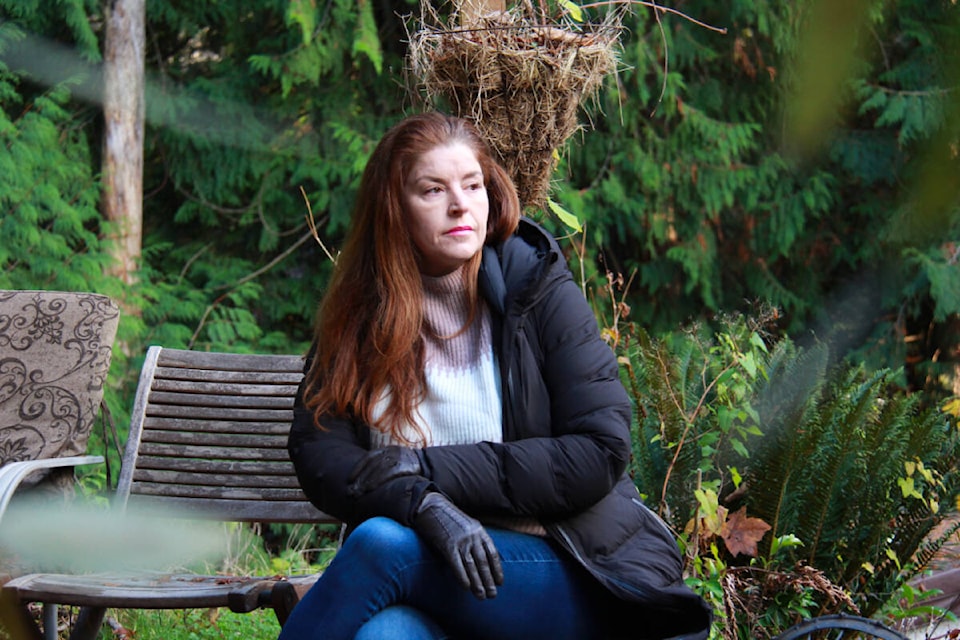
Elisha Bonnis sits in a treed area on her sister’s property on the Sunshine Coast on Nov. 29, 2023. She says it is one spot where she is able to find some peace. (Jane Skrypnek/Black Press Media)
When Elisha Bonnis woke up on a Monday morning in mid-November last year, she thought it was the beginning of the end. Not in the usual sense that implies impending disaster, she had already faced almost every kind of nightmare she could imagine. No, that morning Bonnis believed she would finally be standing up in court to face the man she says raped her on her birthday some nine years earlier.
Monday, Nov. 20 was supposed to mark the end of her fight, the end of devoting her life to gaining validation for herself and ensuring repercussions for him.
Her healing, she believed, was about to begin.
The single 52-year-old mother went about the morning as planned. She put on a long black dress and a grey blazer, an outfit she had picked out to make herself feel strong and professional. Strong, so she could hold herself together; professional, because she had learned over the last four-and-a-half years of pursuing civil action that her appearance and demeanour mattered. Credibility is crucial in a courtroom and she knew the judicial system’s history of holding sexual assault survivors to a higher standard than their assailants.
Bonnis spoke very little to her loved ones as she got ready to leave, her mind busy running over her testimony and her hands occupied packing one bag with water and snacks and a second with items that bring her comfort – a bottle of vanilla essential oil, a few beach rocks inscribed with the words of loved ones, and a bandana her boyfriend gifted her.
On the drive to the Vancouver courthouse, nausea and nerves twisted through her gut. She felt prepared and confident in many ways, but was terrified for the process. Taking deep, long breaths, she put on a playlist she had curated for that moment. Rise Up by Andra Day and Til it Happens to You by Lady Gaga flowed in through Bonnis’ ears and carved out a small safe place in her brain.
Elisha Bonnis sits in a treed area on her sister’s property on the Sunshine Coast on Nov. 29, 2023. She says it is one spot where she is able to find some peace. (Jane Skrypnek/Black Press Media)
She met her lawyer outside the courthouse and they made their way into the scheduling area to wait to be assigned a judge. Bonnis perched on a padded wooden chair and faced away from the entrance so she wouldn’t have to see the defendant enter.
She knew something had gone wrong when their scheduled 10 a.m. start time came and went. The clock kept ticking and others who were waiting on their own trials began to talk amongst themselves, voicing their concerns. Then, a courthouse staff member came out and told them the chief justice of the supreme court wanted to see them all.
The various groups filed into an upstairs courtroom and slid onto hard, wooden pews. Bonnis took a seat in a row just in front and to the side of the defendant, so she could see him in the periphery of her vision. Her heart beating uncontrollably as she heard the chief justice enter and speak: There were no judges, and everyone’s trials had been cancelled. This, he said, was the direct result of the federal government underfunding the judicial system.
Bonnis’ stomach dropped.
“It felt like just being let down one more gigantic, profound time.”
‘Crisis point’: Civil trial delays increasing across the country
Stories like Bonnis’ are becoming more common in B.C. and throughout Canada as delays that have been mounting for years in the civil justice system worsen.
It’s an issue legal professionals have long been sounding the alarm on, but they say little is being done at the government level and the average person is rarely aware of just how bad things can be unless they are battling through the system firsthand.
Civil trials can be heard at the provincial or supreme court level, but in B.C. civil sexual assault cases are always at the latter. There, one of the clearest measures of decline is in the per cent of trials being suddenly cancelled. Known as being “bumped” in legal terms, the cancellations occur when there aren’t enough judges available. Like Bonnis, people often don’t find out until the day of. And, once bumped, it could be months or years until they receive a new trial date, for which there is no guarantee it will occur either.
This means everything they’ve done to prepare – bringing in people from out of town, paying for expert reports, preparing witnesses to take the stand — will likely have to be done all over again.
“All of the exact fears I had, all of them have totally played themselves out in even a worse way than I imagined,” Bonnis says.
A few days before Christmas, she heard from her lawyer, who said they could get a new trial date but needed another $50,000 to move forward. It’s an amount Bonnis simply cannot afford.
That means she’s on her own now. She will have to represent herself, navigate the justice system, request medical and financial reports from experts to support her case, and learn how to question witnesses. When a trial does eventually happen, she will also be the one cross-examining her alleged rapist.
“It’s just the most inhumane, surreal possibility,” Bonnis says. “I know it’s not insurmountable, because I’ll do it. But oh my god, what’s that going to do to me?”
In 2009, about 5.3 per cent of civil trials at the B.C. Supreme Court were bumped, according to the court’s annual report. In 2014, that number increased to 10.2 per cent. Another five years later, in 2019, it reached 19 per cent. At that time, the B.C. Supreme Court described the situation as having hit “critical proportions.”
Yet the issue is still growing. The latest annual report, published in March 2023, shows almost 25 per cent of civil cases were bumped during the year prior.
Raji Mangat, the executive director of West Coast Women’s Legal Education and Action Fund, says she believes things have reached a crisis point.
The longer a trial takes, Mangat says, the more trauma a person endures, the more money they are forced to spend and the longer they have to wait to move on and heal.
“I can see why a lot of people just give up, because it’s so much to take on.”
Last summer, a national not-for-profit of legal professionals known as The Advocates’ Society released a report on the delays, calling on all levels of government to take urgent action.
The society pointed to a series of issues fuelling the problem, including the federal government’s failure to fill judicial vacancies, general understaffing and underfunding of the civil system, and outdated technology and procedures.Things were further exacerbated last year in B.C. when the provincial committee responsible for screening applicants for the federal justice minister went inactive for five months.
The Canadian Bar Association’s B.C. branch voiced concern about this as well in a letter directly to Minister Arif Virani in August.
“We’re not really getting any answers from government,” Scott Morishita, the branch’s president, says.
Black Press Media requested an interview with the B.C. Supreme Court, but was declined, andthe office of the federal justice minister did not respond to multiple requests prior to publication.
In a phone interview with Black Press Media, B.C. Attorney General Niki Sharma called Bonnis’ experience unacceptable. She said while it is important to take time to choose the right people to fill judicial positions, the process needs to speed up.
As of the end of January 2024, the B.C. Supreme Court is short 11 of its intended 95 judges. Assuming they carry an equal caseload, that amounts to about 12 per cent of the court’s capacity.
Vancouver-based litigation lawyer and The Advocates Society director Craig Ferris says newer and younger judges tend to take on more work than older ones, though, so the level of capacity lost is likely even higher.
Ferris says even if B.C. had its full complement of judges, delays would persist, however. He notes that while B.C.’s population has grown exponentially over the years, the number of judicial vacancies has not kept up.
Since 2002, the oldest year the Government of Canada was able to provide, the number of judicial positions at the B.C. Supreme Court has increased by seven, from 88 to 95. During the same period, the province’s population jumped from 4.1 million to 5.5 million people.
If every position were filled, B.C. would have 1.72 supreme court judges per 100,000 British Columbians right now compared to 2.15 judges per 100,000 people in 2002.
“They just keep trying to do more work with the same number of people. It is simply not working,” Ferris says.
Delays only exacerbate the burden survivors already bear
For Bonnis, the cost of such shortages is the difference between having a lawyer cross-examining the defendant and having to do it herself. But the sacrifice survivors of sexual assault make to enter the justice system begins long before they actually face anyone in the courtroom.
Few people choose to go that route at all. In Canada, just six per cent of sexual assault survivors made a report to police in 2019, according to Statistics Canada’s latest General Social Survey. Bonnis was hesitant to be a part of that small fraction, plagued by the shame and fear that most survivors report feeling, but she eventually decided to go the Vancouver Police Department.
She told officers that she was sexually assaulted on the night of her birthday in 2014.
According to her civil claim, she held a stand-up comedy night for friends and family on that day, headlined by herself. The defendant, who Bonnis knew from the comedy community, offered to get her home in a cab at the end of the night. Bonnis says in her claim that she told the friend multiple times that she didn’t want anything to happen between them and that he told her he would get her safely inside and then leave. Once there though, Bonnis says she passed out and woke up to him sexually assaulting her.
None of these allegations have been proven in court. Police investigated Bonnis’ case in 2018 and recommended sexual assault charges against the defendant to Crown Counsel, but the prosecution service said they didn’t believe they could prove Bonnis’ case “beyond a reasonable doubt” – the standard required for criminal offences.
Because sexual violence cases can lack physical evidence or witnesses, and rely primarily on the testimony of the survivor and assailant, they often don’t meet the Crown’s threshold for prosecution. A 2012 book called “Sexual Assault in Canada” by Elizabeth Sheehy found just 18.5 per cent of cases reported to police by women against men result in prosecution.
“It would take dramatic changes in women’s willingness to report these assaults to the police, or a concerted effort to alter current police and prosecutor policies, to improve this dismal rate of attrition and address what amounts to impunity for sexually violent men in Canada,” she wrote.
Bonnis believes her case is strong enough that it should have been taken on in the criminal system. She remembers calling the Crown prosecutor and begging him over and over again to reconsider.
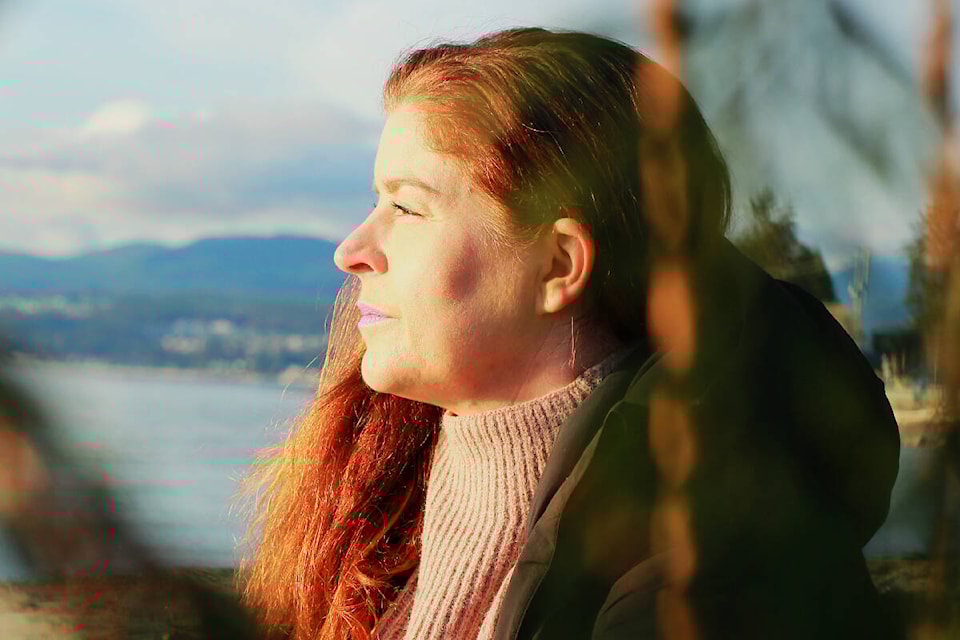
Elisha Bonnis looks out at the ocean off the Sunshine Coast, during a trip to the beach with her two dogs on Nov. 29, 2023. (Jane Skrypnek/Black Press Media)
Through all of this, her mental and physical health improve and plunge as her hope rises and falls.
She was diagnosed with Post-Traumatic Stress Disorder in the aftermath of the assault and now suffers from long episodes of anxiety and depression. Sometimes she shuts herself off from the world for weeks or months at a time. Even when she is around others, Bonnis says nightmares will shake her from her sleep and worm their way into her waking life in the form of intrusive thoughts. There are days when everything will be going perfectly well until the smallest of inconveniences send her spiralling for hours.
On two occasions, Bonnis says her blood pressure spiked so high she had to be rushed to the emergency room.
The retraumatization survivors endure while seeking justice is further magnified by the fact that they can’t always receive proper mental-health care when a trial is ongoing. Therapists will often caution patients against sharing the specifics of their sexual assault, in case counselling notes are introduced into the trial, says Community Legal Assistance Society lawyer Jennifer Khor. Any discrepancy between those records and what a survivor testifies could then be used against them.
This has been the case for Bonnis, who says she has received counselling for her trauma, but has yet to tell a health professional the specifics of the assault. Discussing this piece feels critical to her.
Her decline in mental health means she can no longer handle working full-time and has had to cut her job as an elementary school teacher in half. Other places she used to find joy and purpose are too overwhelming now.
Many areas of the stand-up comedy world no longer feel safe.
“My world has been devastated professionally, emotionally, physically, in every possible way.”
The let down of the criminal system sunk Bonnis into a state of despair until she learned about the possibility of justice through civil means. It’s a route some sexual assault survivors end up pursuing, not just in hopes of recovering financial damages, but as a means of having their story and trauma recognized in a formal capacity. The bar for a winning judgement is also more achievable, with a complainant having to prove their case “on a balance of probabilities,” rather than “beyond a reasonable doubt.”
The barrier here, though, is cost. A lawyer will often work on contingency if they believe there is a strong likelihood of a payout at the end, but if the defendant doesn’t have any assets, they will require payment up front. Bonnis says this is what her lawyer told her. Not only does it mean she has sunk tens of thousands of dollars into her case so far, it also means she is unlikely to see a dime from the proceedings if she wins.
But the result of a civil suit still holds weight for her.
“This legal validation is everything.”
Without it, Bonnis says, people perceive her as “just one more woman running around and saying ‘Oh, he raped me.’” Despite progress over the years, Bonnis says her experience is that society at large, and even some people close to her, are reluctant to believe survivors.
A civil ruling isn’t a conviction, but if Bonnis wins it will give her something official that says she was wronged and another person’s actions altered her life forever. And, although she likely won’t get paid, a ruling in her favour would still put a number value on how much she should be compensated – how much being sexually assaulted costs in the eyes of the court.
Defendant countersuing, denies wrongdoing
The defendant, who is now a permanent resident of the United States, is countersuing Bonnis for defamation and breaching the terms of a non-disparagement agreement. Black Press Media has chosen not to name him while that trial remains before the court.
In response to Bonnis’ claim, the defendant denies any wrongdoing. He claims in legal documents that while getting out of the taxi in front of Bonnis’ then-apartment, she asked him to come inside her home for a drink and that any sexual contact that occurred between them was consensual.
Black Press Media reached out to the defendant for comment. This included leaving a voicemail to a phone number listed on court documents, as well as sending two emails and additional messages to a social media account connected to his professional website. As of deadline, he had not responded to these requests.
‘It completely consumes your whole life’
For Bonnis, freeing up the money for the trial has meant selling her home in Vancouver, taking out lines of credit, borrowing from family members and allowing a friend to set up an online fundraiser, something Bonnis says she struggled not to feel shame over. It’s also meant she hasn’t had money available for other things, like paying for her son’s post-secondary education.
“It’s destroyed me financially,” she says. “There’s a ton of guilt.”
Just before her trial was supposed to start, Bonnis took one more step to come up with some last-minute money. She traded in the electric vehicle she was so proud of owning for the cheapest used car she could find.
“It was the last thing I had left from my life in Vancouver. It was the last thing I really owned that was of great value. That day I felt like I had lost everything I had built.”
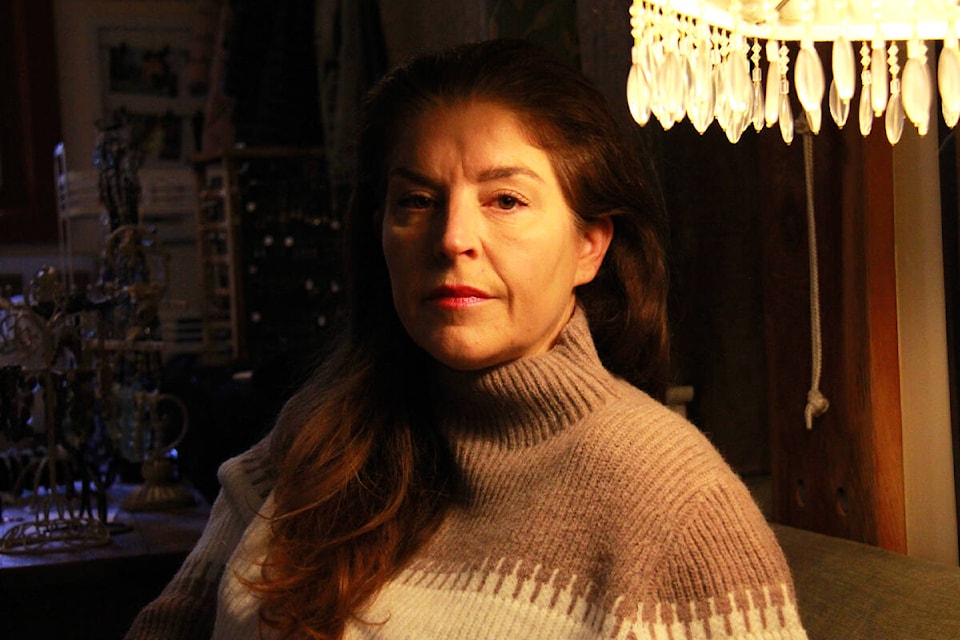
Elisha Bonnis sits in the living room of her home on the Sunshine Coast on Nov. 29, 2023. (Jane Skrypnek/Black Press Media)
Bonnis lives in a compact one-bedroom home on her sister’s property along the Sunshine Coast now.
She’s seated there in an armchair on a Wednesday at the end of November as her two Brussels Griffons, Honey and Boo, ask for attention at her feet. When she reaches down to pet them, the sleeve of her brown and cream knit sweater slides up and reveals part of a series of coloured floral tattoos she recently got done on her left arm.
The poinsettia, dahlia, peony, morning glory, stephanotis and forget-me-nots each represent a person in her life, but Bonnis got the tattoos for a very practical reason. One symptom of her PTSD is the urge to obsessively pick away at her skin, and the disorder has left raw spots and scars over much of her body. Planning for the tattoos forced her to let one area heal, so the ink could be safely applied. Now, she says, the artwork itself stops her from scraping at that arm. Her plan is to do the same for more of her body.
It’s the same kind of slow healing she hopes to be able to achieve for her mind as well. For now, though, she feels incapable of moving forward in that way. The irony of pursuing justice, she says, is that it retraumatizes a person for years on end and leaves them in a state of limbo.
“It completely consumes your whole life.”
The civil process is also intensely intrusive. While Bonnis works to prove that she was sexually assaulted and how she has suffered since then, the defendant does everything in his power to discredit her and write off her injuries to other incidents in her life. This means digging through her past.
Bonnis says the defendant has every document on her from birth to present. He knows where she has lived, where she has gone to school, anytime she has visited a doctor or hospital, whether she’s ever had a driving violation, what she’s filed in her tax returns and who she has ever had a sexual relationship with. Now that she has no lawyer as a go-between, Bonnis says he also knows her personal email and home address.
Civil sexual assault lawyer Janelle O’Connor says while many survivors of sexual violence enter the justice system to try to take back control after being violated, the level of disclosure demanded of them can sometimes leave them feeling even more powerless.
“In an ideal world we have a method that takes into account the trauma that has already been endured by survivors,” she says. In reality, O’Connor says the system likely contributes to underreporting and causes some of those who do come forward to withdraw. Worsening delays are only increasing those barriers to justice.
Advocates are concerned by how this impacts current survivors, as well as future ones and the progression of sexual assault law in general. The fewer cases that make it into the system, the less chance there is for precedents to be set and enduring sexual assault myths and stereotypes to be dispelled.
Bonnis is spending much of her time now preparing to face the defendant in court, on her own, with a new trial tentatively scheduled for March 2024. She’s applied to receive the three free hours of legal advice B.C. recently introduced for sexual assault survivors, but is otherwise alone, googling how to make legal applications and question witnesses.
In many ways she says it feels surreal, but in others it is what she is used to now. She’s sunk countless hours into this process over the years and says she’s lost faith that people who hold the power to create change for sexual assault survivors truly care to do so.
“We’re on our own. We have to do it ourselves. And the cost is way too great.”
Elisha Bonnis looks out at the ocean off the Sunshine Coast, during a trip to the beach with her two dogs on Nov. 29, 2023. (Jane Skrypnek/Black Press Media)
2-years in jail for Abbotsford masseur who sexually assaulted
12 women multiple times
Reinhard ‘Bud’ Loewen’s actions were those of ‘long-term, committed
serial sex predator,’ says judge
Jessica Peters
Nov 2, 2023 3:57 PM
Reinhard “Bud” Loewen has been sentenced to two years in prison for sexually assaulting 12 women while massaging them. (Facebook photo)
A former Abbotsford masseur has been sentenced to two years in prison for sexually assaulting 12 women while providing services to them.
Reinhard ‘Bud’ Loewen, 59, will also have to submit his DNA to the National Sex Offender Registry. He had at one point been facing a total of 24 charges, but it had been reduced to six counts that affected 12 women, many of whom were pregnant.
In B.C. Supreme Court Thursday (Nov. 2), Justice Ian Caldwell explained why a conditional sentence (house arrest) would not have been sufficient to deter Loewen from offending again.
That such a thing was even considered is just disgraceful.
Loewen advertised his services for free or very low-cost on Facebook pages, sometimes in the form of contests, specifically targeting pregnant women. Caldwell read the detailed accounts of how those massages turned into sexual assaults for 12 different women on multiple occasions over about two years.
“These are the actions of a long-term, committed, serial sex predator,” Caldwell said.
Caldwell also read from victim impact statements from several of the women, who are not to be identified under a publication ban.
“It was hard to have to tell my mom that her baby was hurt,” one woman’s statement read.
“I felt like he violated my baby,” another had said.
Some of his victims have suffered anxiety, anxiety attacks, required anti-depressants, and have had significant impacts on their lives and relationships due to the nature of the assault. One victim lost her job because she was unable to leave her bedroom.
“It’s robbed my children of their mother,” that one had said.
“I almost booked my 16-year-old daughter with him,” one explained. “The devastation sits very deep in me. What if it was her?”
In explaining his decision, Caldwell read portions from similar case law that dealt with sexual assaults during massage treatments in Canada. In each case, a decision had to be made between incarceration or a conditional sentence that would allow the offender to serve his time in the community.
Massage therapy falls under a position of trust or authority, which Caldwell ruled that “Mr. Loewen clearly abused.”
“He relied on the trust bestowed to (him) to attack his victims,” he said, with significant impact to them.
He planned and deliberated the attacks, rather than “simply happening on victims.” He also offered them financial incentives, by way of free or deeply discounted massage therapy.
“He targeted financially and physically vulnerable victims,” Caldwell said, and further isolated them in order to assault them.
And, he added, this was not a one-time event, but a pattern over a course of about two years.
There were some mitigating factors, but a doctor who assessed Loewen found that while he showed some remorse, he was also concerned that nobody was listening to his side of the story. The doctor also felt he was not being fully candid about his actions.
But Loewen had fully complied with bail conditions, has no criminal record, and a strong family and church base that continues to support him.
Some of those supports were in the Abbotsford courtroom for the sentencing, as were a large number of his victims.
One woman clapped when Loewen was handcuffed, while his family members clasped hands. Loewen looked to his family before being taken away for processing.
He was charged with a series of six consecutive charges ranging from three to five months each, adding up to the two years of incarceration.Following his release, he will serve 36 months of probation, with a list of conditions and ancillary orders, including providing a DNA sample, a 10-year firearms prohibition, and strict orders to not contact or be near any of his 12 victims.
“If you see them, you must leave immediately,” Caldwell underlined.
He may not provide massage services, and must remove any information from the internet that offers such services within 24 hours of his release from prison. If he wants massage services during that time, the practitioner must be informed of his history, and a male supervisor must be present who is also aware.
Loewen will also be required to inform his parole officer of any address or name changes, and his employment, for the course of his three-year probation.
He was also ordered to pay a victim surcharge of $200 per count, totalling $1,200 payable within 60 days of his sentencing.
$200 per count - Good grief! That should make the victims feel so much better as Loewen walks out of jail next year.
2 years for dozens of assaults on vulnerable women is surely a bad joke. Where is the justice? For a woman who may have been abused several times, this means a sentence of a few weeks for each crime. In fact, he will certainly be released next year, reducing the sentence to a matter of days per crime. The "Justice" in "Canadian Justice" is a complete farce.
Loewen formerly operated Bud’s Massage Therapy. He started that business in 2017 out of a basement of a home in the 35400 block of Munroe Avenue in Abbotsford that also had an unrelated hair salon.
Loewen was first charged in December 2020. He was not certified as a massage therapist and had taken only a one-week course in late 2016 through “Brandon Raynor’s School of Natural Therapies.” That course is designed to train someone to give massages to friends and family.
‘Bail system is failing’: Calls grow for answers after N.S. mother killed
By Rebecca Lau Global News
Posted November 2, 2023 10:17 am
pdated November 2, 2023 2:21 pm
WATCH: A Nova Scotia family is seeking answers and accountability after a woman was killed this week in a hit and run. Hollie Boland was allegedly struck by a car driven by her ex-partner. As Ella MacDonald reports, the incident is being called a horrific act of domestic violence.
Friends and family of a Nova Scotia woman who was killed this week say her death was preventable, and are calling for accountability in the judicial system that failed her.
Hollie Marie Boland of Dartmouth, N.S., died from her injuries on Monday in the Halifax suburb of Cole Harbour after she was hit by a car, police say.
The man accused of killing her is her former partner, court records show, and was out on bail while facing previous charges for allegedly assaulting her.
“We feel at this moment the system failed Hollie, and if they hadn’t, she would still be here with all of us and her babies,” a statement from the Boland family read.
A memorial of flowers and cards at the intersection in Cole Harbour, N.S. where Hollie Boland was struck by a vehicle. Ella MacDonald/Global News
On social media, her aunt Madeline Rhodenizer called Boland a beautiful, soft-hearted, funny, hard-working, mom of three children who had gone back to school to “make a life for her and her kids.”
“The children now have no Mom,” she wrote. “But it could have been prevented. Someone needs to be held accountable for this. So many mistakes made by the system that was supposed to protect her.”
Accused was facing previous charges
Aaron Daniel Crawley, 33, has been charged with first-degree murder in the death and is scheduled back in court Nov. 29.
The hit-and-run Monday prompted an emergency alert at the time, after Crawley allegedly fled the scene.
Aaron Daniel Crawley, 33, was identified as the hit-and-run suspect. Provided/NS RCMP
According to a police news release, a “Good Samaritan” tried to help Boland, who was being held against her will by a man on Shrewsbury Road, in Cole Harbour. Investigators say that when the Good Samaritan intervened, she and Boland were knocked to the ground by the suspect.
Police allege the driver used his car to strike the woman he had been detaining and fled the scene.
Boland died of her injuries in hospital, while the woman who had intervened suffered non-life-threatening injuries.
Court documents show Crawley was facing previous charges for allegedly assaulting Boland, including one incident involving a car.
Provincial court Judge Brad Sarson nonetheless permitted Crawley’s release on conditions he stay away from Boland and four other people, not drive and remain at home except when going to his job or travelling for appointments.
Brian Cox, the president of the Nova Scotia Crown Attorneys’ Association, says the prosecution had opposed Crawley’s release.
The public prosecution service has said Crawley was charged with dangerous operation of a car and assault with a weapon against Boland on May 24, and had been released on an undertaking to appear in court at a future date.
Despite being ordered not to have further contact, Crawley was charged with assaulting and choking Boland on June 8, as well as with breaching his release conditions.
And why was he not incarcerated at that time, since it was apparent he had no compulsion to abide by his bail conditions? Criminals who don't take their bail conditions seriously should not get a second chance to prove that.
“Recent amendments to the bail system were meant to modernize and streamline the system while also protecting the safety and rights of victims of intimate partner violence,” Cox told Global News.
“But when we have intimate partners who are killed while offenders are out on release that says to me that the bail system is failing and that the justice system is failing.”
Linda MacDonald, the co-founder of Persons Against Non-state Torture, goes further. The activist wants Boland’s death to be recognized not as a case of intimate partner violence, but as femicide.
“When you see women that are killed in femicide it’s a war — one house, one street at a time,” said MacDonald.
“It’s a very serious crime. It’s still minimized. It’s not a private matter.”
Boland’s friends and family echo that sentiment and say there needs to be accountability.
“My heart is broken,” her mother, Carol Boland, wrote on social media. “My beautiful daughter was murdered and left everyone who loved her.”
— with files from The Canadian Press and Global News’ Ella MacDonald