Everyday thousands of children are being sexually abused. You can stop the abuse of at least one child by simply praying. You can possibly stop the abuse of thousands of children by forwarding the link in First Time Visitor? by email, Twitter or Facebook to every Christian you know. Save a child or lots of children!!!! Do Something, please!

3:15 PM prayer in brief:
Pray for God to stop 1 child from being molested today.
Pray for God to stop 1 child molestation happening now.
Pray for God to rescue 1 child from sexual slavery.
Pray for God to save 1 girl from genital circumcision.
Pray for God to stop 1 girl from becoming a child-bride.
If you have the faith pray for 100 children rather than one.
Give Thanks. There is more to this prayer here

Please note: All my writings and comments appear in bold italics in this colour

Showing posts with label village councils. Show all posts

Sunday, 15 May 2016

A Couple More Horror Stories of Girls Being Raped in India

16-yr-old girl complains of rape by 113, including policemen, over 2 years

Mubarak Ansari | Pune Mirror
Pune, India: A 16-year-old girl, who was brought here from West Bengal on the pretext of a job, has allegedly been tortured and forced into prostitution for the last two years.

The minor victim has alleged that she was raped by over 100 persons, including cops.The girl escaped to Delhi last month and lodged a complaint there. On Saturday, the case was transferred to Pune police and accordingly, an FIR has been registered against 113 persons.

Vimantal police station arrested a 26-year-old woman in this regard on Sunday.

Incidentally, this case is connected to the recent revelation of the attempt to rape and torture a model from Delhi, who had escaped with the minor girl to the capital last month. In this case, four more accused have already been nabbed by officials of Chandan Nagar police station.

The arrested accused has been identified as Swikriti Kharel (26), a native of Nepal, who lives in Viman Nagar. Those arrested by Chandan Nagar cops are Rohit Bhandari (35), Harish Shaha (25), Tapendra Sahi (23), and Ramesh Thakula (25), all Nepal natives, who live in Kalyani Nagar.

The other accused named in the complaint include Shakti, Anna, Bharat, and others, all part of the sex racket in the city. Cops said the minor girl hails from the Nepal-India border region in Siliguri. Her father had left her mother, who later became mentally unstable. Her grandmother ran a tea stall, where Bhandari used to come to buy cigarettes and saw the victim. He promised to get her a job at a beauty parlour in Pune and brought her here in January 2014. The first few days went smoothly, but later, she was forced into prostitution. The accused raped her, also drugging her and making her engage in sex with multiple persons.She was kept at locations like Sanjay Park, Viman Nagar, Kharadi, etc. As per the survivor's complaint, Swikriti took her to Hyderabad, Ahmedabad and Bhopal for this racket, too.

Later, the girl was brought to Pune again and kept in a flat at Nyati Empire society in Kharadi, where she was forced to have sex with more `customers'. She was also beaten and forced to undergo an abortion when she became pregnant. It was from this flat that she fled to Delhi last month, along with another 24-year-old model, who was allegedly given cigarette burns after she refused to perform sexual favours in exchange of helping her become an actress. They came out of the flat on the pretext of going to a beauty parlour and fled the city.

The incident had come to light in March when the 24-year-old was admitted in a Delhi hospital for burns treatment and hospital authorities informed cops. Delhi police registered a zero FIR and sent the case to Pune, where it was taken up by the Chandan Nagar police.

Assistant police inspector P B Kolte from Viman Nagar police chowky is investigating the case.


An Indian teen was raped by her father.
Village elders had her whipped

Annie Gowen, The Washington Post


In a scene captured on a cellphone video, one of the men wags his finger angrily at her. He rages: This girl must be punished.

A villager ties her waist with rope, holding the other end, and lifts a tree branch into the air. She bows her head. The first lash comes, then another, then another. Ten in all. She lets out a wail.

Eventually the crowd starts murmuring, "Enough, enough," although nobody moves to stop the beating. Finally, the man throws down his stick. It's over.

She is 13 years old. Or maybe 15. Her family doesn't know for sure. She has never set foot in a school and has spent most of her life doing chores at home, occasionally begging for food and performing in her father's acrobatic show, for which she is given 20 rupees, about 30 cents.

Her crime? Being too scared to tell anyone her father raped her.

India rape victim beaten
Seven men from an informal village council were arrested and charged after they beat a 13-year-old victim for not speaking up when her father raped her. The man who gave the beating, Arun Jadhav, right, is shown here with his wife, Leela. 
 (Annie Gowen / The Washington Post)
Victimized twice

In early March, a farmer (the girl's father) and local labor activist named Sachin Tukaram Bhise was headed to a nearby village to find day laborers for his wheat and sugar cane farm when he heard a village council was to be called by members of the local Gopal community, near Mauje Jawalwadi. Shivram Chavan's sons did not know the whole story but feared the worst and had ostracized their father; he was ready to confess.

The Gopals are a largely illiterate, impoverished group who were once nomads making their living as cow herders and itinerant street performers. Many have since settled down to menial jobs in the fertile farming region in the shadow of the basalt crags of the Sahyadri mountain range.

As Bhise watched, villagers from around the area gathered in the main square of the village amid tin-roofed sheds. The teenager and her father were brought to kneel before the member council.

Chavan bowed his head and admitted what he had done, Bhise recalled, and said he was ready for whatever punishment the council would give him. Then the elders turned to the teenager and began to berate her.

"They said it was the girl's fault. That the father was drunk and he was not in his senses," Bhise said. "I got angered at the whole thing. How could a girl invite such an act? The 'panch' said, 'You're useless,' 'You're the culprit.' She was crying."

Bhise took out his cellphone camera and surreptitiously began to film as the council issued its verdict - a fine of about $67 and a whipping of 15 "sticks" for the father, five "sticks" for the girl. They would be whipped until each of the thin tree branches broke.

Bhise took his evidence to the police, who later arrested all seven members of the council, charging them with conspiracy, extortion and assault. The father was held on child abuse charges.


The tyranny of village councils

India is a country of 1.2 billion people, with a growing economy, a young population and an energetic prime minister eager to sell the country on the world stage. A generation of women are taking stronger roles in the workforce, in colleges and online who aren't afraid to push against outdated misogyny - be it acid attacks, rape and sexual harassment, or the portrayal of women in movies and advertisements.

Yet patriarchal prejudices ingrained for centuries have been tough to shake loose despite a growing clamor for change - and continue to affect life from the village water pump to the judicial system and beyond.

Male-dominated village councils have existed in India for centuries to resolve disputes between neighbors and serve as enforcers of social mores in the country's stratified caste system. Although elected village bodies were established by the Indian government in 1992, unelected clan councils continue to operate with impunity throughout rural India, issuing their own edicts in the name of preserving harmony.

Five years after the Supreme Court said such councils should be illegal, the central government and some states are only beginning to pass or contemplate laws that would limit their behavior.

These councils often prevent or break up marriages and love affairs between couples from different castes, and they have instigated honor killings. Women typically receive the harshest punishments.

They also intervene in cases of sexual assault - mediating resolutions between two families, attempting to smooth over devastating wounds with a few hundred rupees and even in some cases forcing a victim to marry her rapist. Amid international outrage about the 2012 fatal gang rape of a Delhi student, laws were passed to make it easier for rape victims to file charges. But the road to the police station is still a long one.


"In rape cases, their role is underground and not officially or publicly acknowledged," said Jagmati Sangwan of the All India Democratic Women's Association, a longtime critic. "They will ask the family of the victim to go for a compromise, go for mediation, and that suppresses the interests of the victim."

Saturday, 25 April 2015

Villages Lead the Way to Stopping Child Marriage

Village councils in the northern Indian state of Rajasthan have taken it upon themselves to rid the region of the menace of marrying off girls way before the legal age

Urmul Trust - You are my heroes of the week

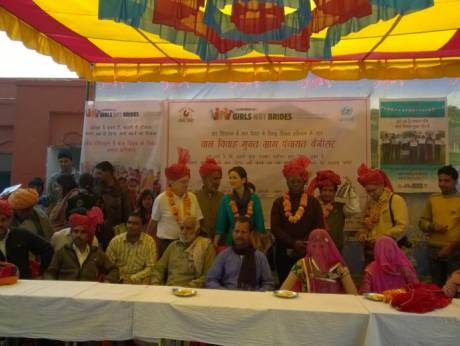
Girls not brides A woman signs a pledge against child marriage in the presence
of Urmul Trust volunteers, officials of Zila Parishad
and people from Unicef Rajasthan
In September 2010, Jimmy Carter and Fernando H. Cardoso wrote in “The Guardian” that child marriage has been a major brake on progress towards six of the eight millennium development goals. They argued that it was time to recognise that we cannot improve the lives of the poorest and most marginalised women and girls until the impact of child marriage was addressed directly and openly.

The same year The Elders, an independent group of global leaders brought together in 2007 by Nelson Mandela to work together for peace and human rights, began to forge a global civil society alliance for a world without child marriage. Girls Not Brides: The Global Partnership to End Child Marriage brought together non-government organisations working all over the world to end this harmful practice. The Urmul Trust based out of Bikaner in the Indian state of Rajasthan is one of them. Its managing trustee Arvind Ojha was one of the four Indians who participated in The Elders global strategy meeting in Ethiopia to end child marriage.

Five years later, at a function on February 17, 2015, he smiled with satisfaction when a “gram panchayat” (village council) in Bikaner in northern Rajasthan declared itself child marriage free. He marvelled at his trust’s work when people of the “gram panchayat”, including girls, took a pledge to never allow child marriage in their milieu.

It was a pleasant morning when Benisar, 61 kilometres from Bikaner district headquarters, became Rajasthan’s first child marriage free “gram panchayat”. Its sarpanch (village council head) Shravan Kumar was later quoted by “The Times of India”, an Indian English daily, as saying, “Child marriage is a social evil. We gathered to fight against it. Still, some child marriages are solemnised secretly in the villages. Now, we have taken a pledge not to allow child marriages any more in our “gram panchayat”.” A member of Bikaner district council Parvati Devi said, “We lost our freedom; we will not let our daughters lose theirs.”


A few hours later, Surjansar, 34 kilometres from Benisar, became the second child marriage free “gram panchayat”. A prominent villager, Om Prakash Tarar, addressing the gathering, said: “We assure you that we will work for making other villages in our neighbourhood child marriage free. We take a pledge to rid our block of this social evil. We want to make Sri Dungargarh Rajasthan’s first child marriage free block.”

Urmul Trust volunteers, officials of Zila Parishad, people from Unicef Rajasthan were present when villagers in both the “gram panchayats” signed a banner pledging against child marriage. Adriano Sofri, a well-known Italian intellectual, writer and journalist, who was in India to deepen child protection issues and the root causes of related social problems, regarding the condition of the girl child, child marriage, trafficking and more in general the lack of opportunities of vulnerable girls and groups, was also witness to the two functions. Sofri collaborates with “La Repubblica”, an Italian daily. He has written about the two “gram panchayats” in the newspaper on his return.

On October 11, 2012, the world celebrated the first-ever International Day of the Girl Child. The day was embraced globally as a moment to celebrate the girl child and to call for greater action to protect her rights, dignity and enable her to fulfil her potential. As a principal barrier to the development of girls and their wider communities, organisations around the world emphasised that it is high time to tackle child marriage. The United Nations chose to mark the occasion by focusing on the issue of child marriage, led by Secretary General Ban Ki-Moon’s call for all of us “to do our part to let girls be girls, not brides”.

Ojha was also present at the first ever girl summit on 22 July 2014 in London. The summit built on growing recognition that child marriage and female genital mutilation hold back millions of girls. The need for urgent action was emphasised by the launch of new data from Unicef which showed that worldwide more than 700 million women alive today were married or entered into union before their 18th birthday. This is equivalent to 10 per cent of the world’s population. An October 2014 Girls Not Brides publication titled “Understanding The Scale of Child Marriage: A User Guide”, predicts that if there is no reduction in child marriage, 1.2 billion girls will marry as children by 2050 — equivalent to India’s population.

India is at top of the 10 countries with the highest absolute numbers (in thousands) of child marriage (“Vogelstein, R, Ending Child Marriage, How elevating the status of girls advances US foreign policy objectives, Council on Foreign Relations, 2013”). India, the report mentions, has 10,063,000 women between 20 and 24 years of age who were married before they were 15. According to the “UNICEF State of the World’s Children: In Numbers: Every Child Counts, 2014”, India is eighth among the 10 countries with the highest rates of marriage before 15.

It was in the backdrop of these stark statistics that Urmul Trust, named after Uttar Rajasthan Milk Union Limited (Urmul), took up a special project in tribal village Chundhi in Jaisalmer district in February 2014 — one year before Benisar and Surjansar in Bikaner became child marriage free panchayats. The trust told the community that a child bride was neither physically nor emotionally ready to become a wife or a mother; that girls married before the legal age (18 years) were at far greater risk of experiencing dangerous complications in pregnancy and childbirth, becoming infected with HIV/AIDS and suffering domestic violence. The community was sensitised on the issue with the help of opinion leaders, including religious gurus. The trust understood that dropping out of school increased a girl’s vulnerability to child marriage and hence worked with school management committees to ensure girls dropout rates fell. It worked with the youth groups to develop them as pressure groups.

Chundhi soon became the first village in the state to declare itself child marriage-free.

Chundhi, India
So far, the trust has managed to get 54 villages declared as child marriage free — 24 in Bikaner’s Sri Dungargarh and 30 in Jaisalmer’s blocks. In November 2014, the trust took up some villages in the Phalodi block of Jodhpur. The trust is working on 150 villages in three blocks: 60 each in Sri Dungargarh and Jaisalmer, and 30 in Phalodi.

The initial strategy was to focus on villages. With Benisar and Surjansar, the focus has shifted to “gram panchayats” (which have more than one village). “We realised with a little more effort, we could declare an entire “gram panchayat” child marriage free,” says Ojha.

Recalling the ground work, Ojha says, “In the initial few meetings with the villagers, we identified people who were pro the issue. We prepared them for leadership, felicitated them time and again, called them to Bikaner meetings, and built their capacity to take ownership of the movement. The idea was to build a mechanism that will sustain the movement against child marriage.”

The result is people like 19-year-old Poonam Sankhla in Benisar and 20-year-old Manoj Meghwal in Dhirdesar Purohitan. A second year student of Bachelor’s course in Arts, Poonam is now a full-time volunteer with Urmul Trust. “Child marriage takes away our childhood, forces us to drop out of school,” she says as she recounts how girls of the village got together on February 9 this year for beating “thali” (a utensil) to announce birth of a girl in the village. Traditionally, “thali”-beating is done to announce a boy’s birth. Benisar girls led by Poonam broke the convention.

On January 26, 2012, 28-year-old Osho Jigyasu Siddh, leader of a village youth group in Benisar, made the tradition compulsory for birth of a girl child. Three days later, when a girl was born in village health worker Neetu Kanwar’s family, she beat “thali”.

Manoj’s elder sister didn’t study beyond class 10, but she wants to study “at least till graduation level”. An elected panchayat representative Puja Kanwar, 23, says she was married at 17. “I know what child marriage does to a woman so I won’t let my daughters get married before the legal age,” she says.

It is people such as Poonam, Jigyasu and Puja Kanwar who will act as internal pressure against child marriage in these villages. “If we can rotate the wheel for five years, the static energy will keep it moving forever,” says Ojha as he shows me around the Urmul Trust office near the bus stand in Bikaner.

“Ownership by a panchayat is a sustainable model since panchayats are constitutional bodies. If we can run this model successfully in the target population of 150 villages, we can showcase it to government and get it replicated elsewhere,” he adds.

In Rajasthan, the present percentage of married women aged between 20 and 24 years who were married before the legal age of 18 years is 51.2 per cent (54.7 per cent in rural and 36.9 per cent in urban areas) according to marriage data in the Annual Health Survey 2012-2013. 

The reasons are many. Trade of girls due to poor sex ratio, poverty and fear of infamy (following affairs) are some of them.

Rakesh Kumar is a writer based in Jaipur, India