So far in the 21st century nearly a third of a billion children have been sexually abused, most of them multiple times, some thousands of times. 6 out of 7 are girls. Anything you can do to get this message to as many people as possible will help save abused children all over the world, and maybe even some of the abusers. Please read "Save A Child from Sexual Abuse by 3:15 PM" under "First Time Visitor?" May God bless you and anoint this ministry.
Everyday thousands of children are being sexually abused. You can stop the abuse of at least one child by simply praying. You can possibly stop the abuse of thousands of children by forwarding the link in First Time Visitor? by email, Twitter or Facebook to every Christian you know. Save a child or lots of children!!!! Do Something, please!
3:15 PM prayer in brief:
Pray for God to stop 1 child from being molested today.
Pray for God to stop 1 child molestation happening now.
Pray for God to rescue 1 child from sexual slavery.
Pray for God to save 1 girl from genital circumcision.
Pray for God to stop 1 girl from becoming a child-bride.
If you have the faith pray for 100 children rather than one.
The STOP FGM Act of 2020 strengthened a 1995 original law. The revamped law increased the maximum jail sentence to up to 10 years. Yet as the report points out below, there have been no prosecutions in the high Somali-populated Minnesota. This proves that a two-tier legal system is still operational in America; it must be stopped. No region anywhere in the U.S. should reflect Islamic norms, despite high Muslim populations in some areas and fierce efforts to expand the hegemony of the Sharia — while leftist crazies either deny the nature of Sharia or aid its expansion.
In Somalia, 99 percent of women between 15 and 49 years have undergone FGM. And yes, it is Islamic.
It is not strictly Islamic, as it also occurs in some non-Muslim countries, and it is not taught in the Quran or the Hadiths. But the majority of girls and women who undergo this madness are Islamic.
Minnesota FGM prosecutions remain zero despite state felony law
More than half a million women and girls in the United States are living with the physical and psychological scars of female genital mutilation — including many in Minnesota, home to a large Somali community from a country where roughly 98% of women have undergone the procedure, according to United Nations data.
Yet despite a state law that makes performing the procedures a felony, Minnesota has never secured a single criminal prosecution under its law — raising questions about enforcement, and whether cases could be going on undetected.
Female genital mutilation, or FGM, involves the cutting or removal of parts of a female’s genital organs, typically for cultural rather than medical reasons. The practice is irreversible.
“It’s hidden — it’s a cultural practice, and who is doing the cutting could be a family member or a doctor who is also in that same culture,” Minnesota Republican state Rep. Mary Franson told Fox News Digital, noting it may be carried out within tight-knit communities. She said the secrecy surrounding the practice makes it exceptionally difficult to detect and confront…
But the UN claims that female mutilation is a Christian, Jewish and European practice.
A staggering number.
The UN recently commemorated its ‘International Day of Zero Tolerance for FGM’ by not mentioning Islam in any way, but by mentioning that 230 million, almost a quarter of a billion women and girls, were mutilated by the traditional practice that is especially prevalent in the Muslim world of ‘female genital mutilation’ whose purpose is to prevent women from having normal sex lives and can lead to serious injury and major risks during pregnancy.
The UN frenetically dances around the Islamic factor in all this. Its official FAQ claims that “although female genital mutilation is not endorsed by either Islam or Christianity, supposed religious doctrine is often used to justify it” implying that FGM is a Christian practice.
Then it even more feebly tries to link FGM to Jews. “Although often perceived as being connected to Islam, perhaps because it is practised among some Muslim groups, not all Islamic groups practise it, and many non-Islamic groups do, including some Christians, Ethiopian Jews and followers of certain traditional African religions.”
Not all Muslims. Look that way, the UN urges, at Christians and Jews.
Then the UN promotes a list of where FGM is practiced that focuses on Europe and Western nations.
Europe: Austria, Azerbaijan, Belgium, Bulgaria, Croatia, Cyprus, Czechia, Denmark, Estonia, Finland, France, Georgia, Germany, Greece, Hungary, Ireland, Italy, Latvia, Luxembourg, Malta, the Netherlands, Norway, Poland, Portugal, Romania, Russia, Slovakia, Slovenia, Spain, Sweden, Switzerland, and the United Kingdom of Great Britain and Northern Ireland.
Oceania: Australia, New Zealand.
The Americas: Canada, Colombia, United States of America.
Who exactly is practicing FGM in Belgium, Norway and Switzerland? If FGM a traditional Polish or British practice?
A Somali woman from canton Neuchâtel has been sentenced to eight months’ prison over the genital mutilation of her two daughters, in the first Swiss case of its kind after a law change.
Rights activists in The Gambia are calling for justice after a one-month-old baby’s death was linked to female genital mutilation, a widely practised but illegal procedure up for review before the country’s Supreme Court.
The Gambia has one of the highest rates of FGM in the world, with 73 percent of women and girls aged 15 to 49 having undergone the procedure, according to 2024 figures from UNICEF.
The baby girl was pronounced dead upon arrival at a hospital in the capital Banjul after being “allegedly subjected to circumcision” and developing severe bleeding, The Gambia Police Force said in a statement Sunday.
The death has sparked outrage among women’s rights defenders working to combat the deeply rooted cultural and religious practice that they say is a harmful violation against women and girls.
“FGM is not a cultural tradition to be defended — it is a form of gender-based violence that can kill,” Santana Simiyu, a human rights lawyer with rights group Equality Now, said in a statement sent to AFP Tuesday.
Two women allegedly involved in the case are in custody, police said, as an investigation is carried out in the western town of Wellingara, where the incident occurred.
Researchers at Britain’s University of Birmingham estimated in a study published in 2023 that approximately 44,320 girls and young women die each year due to FGM in the countries where it is practised.
Former Gambian dictator Yahya Jammeh, now in exile, outlawed FGM in 2015, branding it outdated and not a requirement of Islam.
Parliament later that year adopted the first law specifically banning the practice, which is now punishable by up to three years in prison but is rarely enforced.
In July 2024, lawmakers revisited the matter, upholding the 2015 law despite pressure from religious traditionalists.
But the ban was immediately challenged before the Gambian Supreme Court, where the petition remains pending….
Note how carefully AFP dances around the fact that FGM is Islamic, as it is always Job One for the establishment media, in all stories involving Muslims, to make Islam look as good as possible. First, we hear that “FGM is not a cultural tradition to be defended — it is a form of gender-based violence that can kill,” which establishes at the outset that some people think it is a cultural tradition worth defending, while telling us that those people are wrong. The idea that it is a religious tradition doesn’t even come in for a mention until farther down in the article, when we are told that “former Gambian dictator Yahya Jammeh, now in exile, outlawed FGM in 2015, branding it outdated and not a requirement of Islam.” Great, but “in July 2024, lawmakers revisited the matter, upholding the 2015 law despite pressure from religious traditionalists.”
So AFP tells us, without telling us, that some traditionalist Muslims consider female genital mutilation to be part of the Islamic faith. This is the main reason why it is still prevalent in many areas today, but the establishment media does its best to obfuscate any connection between FGM and Islam.
“It is a religious thing. Do you want to change religion?” said one Egyptian in response to a campaign to eradicate female genital mutilation. “You only listen to what the West is saying.”
The establishment media ignores the fact that FGM is mandated in Islamic law: “Circumcision is obligatory (for every male and female) (by cutting off the piece of skin on the glans of the penis of the male, but circumcision of the female is by cutting out the bazr ‘clitoris’ [this is called khufaadh ‘female circumcision’]).” — Umdat al-Salik e4.3, translated by Mark Durie, The Third Choice, p. 64
Why is it obligatory? Because Muhammad is held to have said so: “Abu al- Malih ibn Usama’s father relates that the Prophet said: ‘Circumcision is a law for men and a preservation of honour for women.’” — Ahmad Ibn Hanbal 5:75
“Narrated Umm Atiyyah al-Ansariyyah: A woman used to perform circumcision in Medina. The Prophet (peace be upon him) said to her: ‘Do not cut severely as that is better for a woman and more desirable for a husband.’” — Abu Dawud 41:5251
That hadith is classified as weak, but this one is classified as sahih (reliable): “Aishah narrated: ‘When the circumcised meets the circumcised, then indeed Ghusl is required. Myself and Allah’s Messenger did that, so we performed Ghusl.’” — Jami` at-Tirmidhi 108
If Muhammad had the genitals of his favorite wife, Aisha, mutilated, that is a strong endorsement of the practice from the man who is an “excellent example” (Qur’an 33:21) for Muslims.
Why does it matter whether or not FGM is Islamic? Because the practice will never be eradicated if its root causes are not confronted. As long as those Muslims continue to believe that Allah and Muhammad want it done, for some that will override all other considerations, in the United States and everywhere else.
The advisory issued by Japan’s embassy in Laos shows grass-roots activism against transnational exploitation can force institutional action
Japan’s embassy in Laos and its Ministry of Foreign Affairs have issued a rare and unusually direct advisory, warning Japanese men against “buying sex from children” in the Southeast Asian country.
The move was prompted by Ayako Iwatake, a restaurant owner in Vientiane, who allegedly saw social media posts of Japanese men bragging about child prostitution. In response, she launched a petition calling for government action.
The Japanese-language bulletin makes clear such conduct is prosecutable under both Laotian law and Japan’s child prostitution and pornography law, which applies extraterritorially.
This diplomatic statement was not just a legal warning. It was a rare public acknowledgement of Japanese men’s alleged entanglement in transnational child sex tourism, particularly inSoutheast Asia.
It is also a moment that demands we look beyond individual criminal acts or any one nation and consider the historical, racial and structural inequalities that make such mobility and exploitation possible.
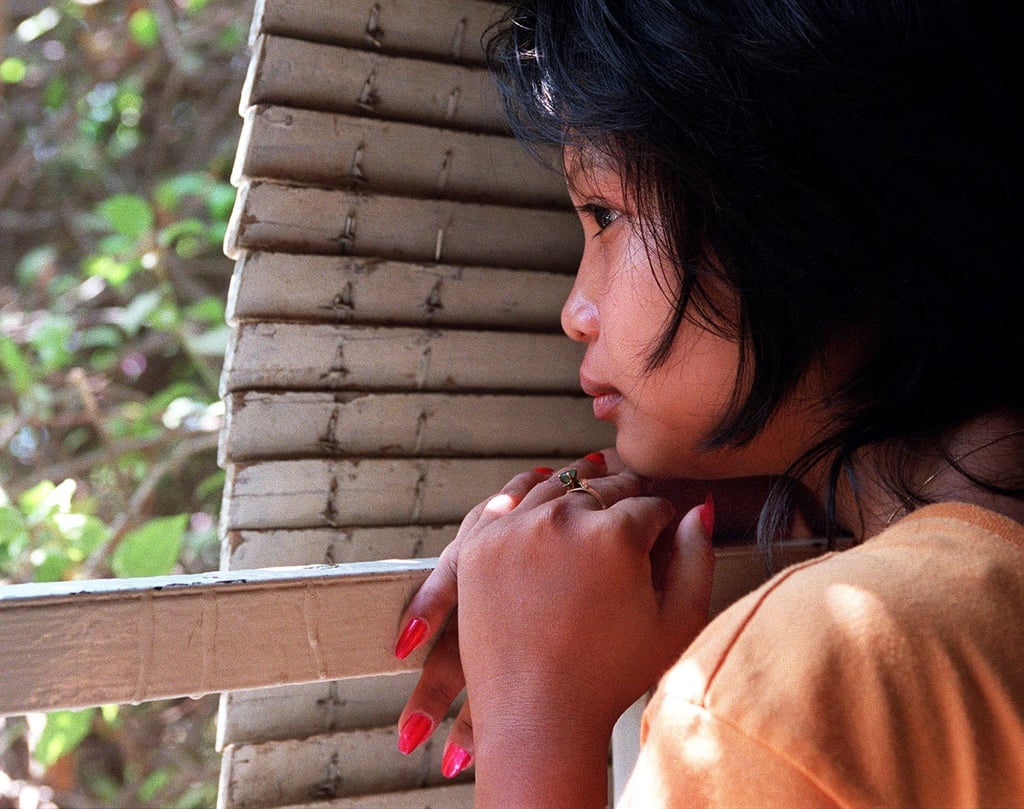
A 16-year-old girl peers out into the streets of Phnom Penh after being rescued from a brothel where she was forced to work. Photo: AFP
A changing map of exploitation
Selling and buying sex in Asia is nothing new. The contours have shifted over time but the underlying sentiment has remained constant: some lives are cheap and commodified, and some wallets are deep and entitled.
Japan’s involvement in overseas prostitution stretches back to the Meiji period (1868-1912). Young women from impoverished rural regions (known as karayuki-san) migrated abroad, often to Southeast Asia, to work in the sex industry, from port towns in Malaya to brothels in China and the Pacific islands.
If poverty once pushed Japanese women abroad to sell their bodies, by the second half of the 20th century – fuelled by Japan’s postwar economic boom – it was wealthy Japanese men who began travelling overseas to buy sex.
Around the 2000s, the dynamic flipped again. In South Korea, now a developed economy, men travelled to Southeast Asia – and later to countries such as Russia and Uzbekistan – following routes once taken by Japanese men.
Later in the same period, the flow took an even darker turn.
Japanese and South Korean men began to emerge as major buyers of child sex abroad, particularly across Southeast Asia, the Pacific islands and even Mongolia.
According to the US Department of State, Japanese men continued to be “a significant source of demand for sex tourism”, while South Korean men remained “a source of demand for child sex tourism”.
The UN Office on Drugs and Crime and other organisations have also flagged both countries as key contributors to child sexual exploitation in the region.
Meanwhile, a more recent and troubling shift appears to be unfolding within Japan.
Amid ongoing economic stagnation and the depreciation of the yen, Tokyo has reportedly become a destination for inbound sex tourism. Youth protection organisations have observed a notable rise in foreign male clients, particularly Chinese, frequenting areas where teenage girls and young women engage in survival sex.
What ties these movements together is not just culturally specific beliefs, such as the fetishisation of virginity or the superstition that sex with young girls brings good luck in business, but power.
The battle to protect children
The global campaign to end child sex tourism began in earnest with the founding of ECPAT – a global network of organisations that seeks to end the sexual exploitation of children – in 1990 to confront the rising exploitation of children in Southeast Asia.
Despite legal frameworks and international scrutiny, the abuse of children remains disturbingly common.
Several factors converge here: endemic poverty, weak law enforcement and a constant influx of wealthier foreign men. Add to that the digital age of information and communication technologies, where child sex can be advertised, arranged and commodified through encrypted platforms and invitation-only forums and the crisis deepens.
While local governments often pledge reform, implementation is inconsistent.
Buyers, especially foreign buyers, often manage to evade consequences. However, earlier this year, Japan’s National Police Agency arrested 111 people – including high school teachers and tutors – in a nationwide crackdown on online child sexual exploitation, conducted in coordination with international partners.
Why this moment matters
The shock surrounding the Laos revelations and the unusually direct response from Japanese authorities offers a rare opportunity to confront the deeper systems at work.
Sex tourism doesn’t happen in a vacuum. It is enabled by uneven development, transnational mobility, weak regulation and social silence. But this moment also shows grass-roots activism can force institutional action.
Japan’s official warning was not triggered by a government audit or diplomatic scandal. It came because Ayako Iwatake saw social media posts of Japanese men boasting about buying sex from children and refused to look away.
When she delivered the petition to the embassy, it responded quickly. Less than 10 days later, the foreign ministry issued a public warning, clearly outlining the legal consequences of child sex crimes committed abroad.
Iwatake’s action is a reminder: it doesn’t take a government to expose a system. It takes someone willing to speak out – even when it is uncomfortable. As she told the Japanese Mainichi Shimbun newspaper: “It was just too blatant. I couldn’t look the other way.”
It is commendable that Japan acted swiftly. But a warning alone isn’t enough. Japan should strengthen and expand its international cooperation to combat these heinous crimes.
A more decisive model can be seen in a recent case in Vietnam, where US authorities infiltrated a livestream child sex abuse network there for the first time. Working undercover for months, they coordinated with Vietnamese officials to arrest a mother who had been sexually abusing her daughter on demand for paying viewers abroad.
The rescue of the nine-year-old victim showed what serious cross-border intervention looks like.
But for every headline-grabbing scandal, there are hundreds of untold stories.
The Laos case should be the beginning of a broader reckoning with how sex, money and power move across borders – and who pays the price.
Dr Ming Gao is a research scholar of East Asia studies at Lund University. This article was first published byThe Conversation