Everyday thousands of children are being sexually abused. You can stop the abuse of at least one child by simply praying. You can possibly stop the abuse of thousands of children by forwarding the link in First Time Visitor? by email, Twitter or Facebook to every Christian you know. Save a child or lots of children!!!! Do Something, please!

3:15 PM prayer in brief:
Pray for God to stop 1 child from being molested today.
Pray for God to stop 1 child molestation happening now.
Pray for God to rescue 1 child from sexual slavery.
Pray for God to save 1 girl from genital circumcision.
Pray for God to stop 1 girl from becoming a child-bride.
If you have the faith pray for 100 children rather than one.
Give Thanks. There is more to this prayer here

Please note: All my writings and comments appear in bold italics in this colour

Showing posts with label Virginia. Show all posts

Wednesday, 20 February 2019

Perverted Lifestyles of the Rich and Famous Episode IX

Virginia power crisis escalates with 2nd woman accusing Democrat Lt. Governor of rape


A second woman has accused embattled Virginia Lt. Governor Justin Fairfax of sexual assault, with his office still reeling from last week’s claims he’d assaulted a female professor at the 2004 Democratic National Convention.

Meredith Watson claims she was raped by Fairfax in a “premeditated and aggressive assault” while both were students at Duke University back in 2000. Watson told multiple friends and classmates about the assault after it happened – both verbally and in Facebook messages and emails, she has revealed through her attorney. At least one of those friends has publicly corroborated her account, while others have reportedly provided statements.

The two undergrads were “friends” at Duke but did not date or see each other romantically, according to Watson’s lawyer, Nancy Erika Smith.

“At this time, Ms. Watson is reluctantly coming forward out of a strong sense of civic duty and her belief that those seeking or serving in public office should be of the highest character,” said Smith, who claims the details of the attack on Watson are similar to the details shared by Vanessa Tyson, the professor who accused Fairfax last week.

I have that same ridiculous trait - a belief that those seeking or serving in public office should be of the highest character. How utterly naive!

Fairfax has denied Watson’s allegations, claiming there is a “smear campaign” targeting him. “I will not resign,” he said in a statement, calling for a full investigation and noting he has already passed FBI background checks.

The Lieutenant Governor also insisted there was nothing non-consensual about his encounter with Tyson, who released a statement claiming she initially suppressed memories of the assault - in which the Democratic politician allegedly forced her to perform oral sex - out of shame until the news he was running for office “hit [her] like a ton of bricks.”

As the reports of Fairfax’s second accuser filtered through Congress, multiple Democratic lawmakers called for his resignation. Sen. Mazie Hirono (D-Hawaii), Rep. Jennifer Wexton (D-Virginia), Sen. Cory Booker (D-New Jersey), and former Virginia governor Terry McAuliffe were among the first.

Fairfax isn’t the only VA Democrat in hot water, as the entire state leadership is crumbling under allegations of racism and sexual assault. After first admitting, then denying he had appeared in a photo from his high school yearbook depicting a man in blackface next to a man in a KKK costume, Governor Ralph Northam has refused to step down despite calls for his resignation. Meanwhile, Attorney General Mark Herring has admitted that he too wore blackface at a college party.


National Enquirer publisher to investigate
Bezos extortion claims

Tabloid said it 'acted lawfully' while reporting story on Amazon CEO

The Associated Press 

The publisher of the National Enquirer said Friday it will look into claims of extortion and blackmail made by Amazon CEO Jeff Bezos, who said the tabloid threatened to publish intimate photos of him unless he stopped investigating how the Enquirer obtained his private communication with his mistress.

American Media Inc. said it "acted lawfully" while reporting the story.

The company's statement is the latest twist in a high-profile clash between the world's richest man and the leader of America's best-known tabloid, who is a strong backer of U.S. President Donald Trump. Bezos's investigators have suggested the Enquirer's coverage of his extramarital affair — which included the release of explicit text messages — was driven by dirty politics.

Bezos, who is also owner of the Washington Post, detailed his interactions with American Media Inc., or AMI, in an extraordinary blog post Thursday on Medium.com. The billionaire did not say the tabloid was seeking money — instead, he said, the Enquirer wanted him to make a public statement that its coverage was not politically motivated.

The company has admitted in the past that it engaged in what's known as "catch-and-kill" practices to help suppress negative stories that could have hurt Trump's candidacy for president. Trump has been highly critical of Bezos and the Post's coverage of the White House.

"Of course, I don't want personal photos published, but I also won't participate in their well-known practice of blackmail, political favours, political attacks, and corruption," Bezos wrote of AMI, in explaining his decision to go public.

"I prefer to stand up, roll this log over, and see what crawls out."

Bezos's phone not hacked
The Bezos affair became public when the Enquirer published a Jan. 9 story about his relationship with Lauren Sanchez, a former TV anchor who is married. Bezos then hired a team of private investigators to find out how the tabloid got the texts and photos the two exchanged.

Bezos's personal investigators, led by his longtime security consultant, Gavin de Becker, concluded that Bezos's phone wasn't hacked. Instead, they've been focusing on Sanchez's brother, according to a person familiar with the matter.

De Becker and his team suspect Michael Sanchez, a talent manager who touts his support of Trump and is an acquaintance of Trump allies Roger Stone and Carter Page, may have provided the information to the Enquirer, the person said. The person wasn't authorized to discuss the matter publicly and spoke on condition of anonymity.

Sanchez, who is also his sister's manager, has declined to speak with The Associated Press on the record and did not immediately respond to an email seeking comment Thursday. In a tweet, he said de Becker "spreads fake, unhinged conservative conspiracy theories" and "'dog whistle' smears."

Several days ago, someone at AMI told Bezos's team that the company's CEO, David Pecker, was "apoplectic" about the investigation, Bezos said. AMI later approached Bezos's representatives with an offer.

Pecker is a personal friend of Donald Trump.

"They said they had more of my text messages and photos that they would publish if we didn't stop our investigation," Bezos wrote.

'Below the belt' selfie obtained
Bezos wrote that this week, the tabloid's editor, Dylan Howard, emailed an attorney for de Becker to describe photos the Enquirer "obtained during our newsgathering." The photos include a "below the belt selfie" of Bezos, photos of him in tight boxer briefs and wearing only a towel, and several revealing photos of Sanchez, according to the emails Bezos released.

According to the emails, an attorney for AMI offered a formal deal Wednesday: The tabloid wouldn't post the photos if Bezos and his investigators would release a public statement "affirming that they have no knowledge or basis" to suggest the Enquirer's coverage was "politically motivated or influenced by political forces."


Bezos said he decided to publish the emails sent to his team "rather than capitulate to extortion and blackmail" despite the "personal cost and embarrassment they threaten."

In its Jan. 9 story, the Enquirer said reporters followed Bezos and Sanchez "across five states and 40,000 miles" and "tailed them in private jets, swanky limos, helicopter rides, romantic hikes, five-star hotel hideaways, intimate dinner dates and 'quality time' in hidden love nests."

It reported that Bezos sent "sleazy text messages and gushing love notes" to Sanchez, months before Bezos announced he was splitting up with his wife, MacKenzie. The story carries the bylines of Howard and two reporters.

Bezos usually stays out of the public eye, frequently delegating announcements and public Amazon business updates to his executives. He doesn't even speak on the company's quarterly financial earnings call with analysts.

AMI's relationship with Trump has gotten the company into hot water in the past. It admitted to "catch-and-kill" practices as part of a deal with federal prosecutors, who agreed not to pursue charges against the company.

AMI acknowledged secretly assisting Trump's campaign by paying $150,000 to a Playboy model for the rights to her story about an alleged affair with the then-candidate. The company then intentionally suppressed the story until after the 2016 election.

In September, the Justice Department agreed to a non-prosecution agreement with AMI, which requires the company and some top executives, including Pecker and Howard, to co-operate with authorities.

De Becker is now trying to find a way that federal prosecutors in Manhattan — where the non-prosecution agreement was signed — could investigate the text message scandal, the person familiar with the matter said, though it wasn't immediately clear what, if any, crime the prosecutors would be asked to look into.

It is a federal crime to threaten to injure someone's reputation in exchange for money or a "thing of value," though federal courts haven't made it directly clear whether a public statement, like the one demanded by AMI, could be considered something of value.

If it had no intrinsic value, there would be no issue here. Nevertheless, it's amazing to me how someone as brilliant as Jeff Bezos could do such stupid things as to get himself in this situation in the first place.


Dave Brubaker, ex-Canadian gymnastics coach,
acquitted of sex-related charges

Is it just me, or do the rich and famous have their own judicial system?

CBC Sports

Former Canadian gymnastics coach Dave Brubaker leaves a courthouse on Wednesday after being
found not guilty of sexual assault and sexual exploitation levelled by a former athlete.
(Mark Spowart/Canadian Press)

Former Canadian Olympic women's gymnastics coach Dave Brubaker was found not guilty today of two sex-related charges levelled by a former athlete.

Brubaker had pleaded not guilty to sexual assault and sexual exploitation relating to the alleged incidents between 2000 and 2007.

Justice Deborah Austin, in delivering her decision inside a Sarnia, Ont., courtroom, gave a scathing critique of how the lead officer handled the investigation, saying the Crown's case was damaged by the relationship between the complainant and the officer, who she said abandoned both his oath of impartiality and his oath of secrecy

"I don't criticize him for being a good friend … I do criticize the decision to also at the same time take on the role of sole investigating officer in the case resulting in some questions about the handling of the case," she said. "These things do affect the reliability of the Crown's case. These issues cannot be ignored."

Unlike sincere truth and genuine suffering, they can be ignored, apparently, in the name of justice.

Judge says complainant's testimony 'sincere, genuine'
The trial heard the sole investigating officer made the complainant the godmother of his child during the course of the probe. Court also heard the officer shared details of Brubaker's police interview with the woman, who cannot be identified under a publication ban.

Austin said none of her critique of the officer should be interpreted as an indictment of the complainant. "She was forthright and appeared to be doing her best, generally," the judge said. "It was sincere and genuine."

Brubaker hugged his wife, Elizabeth, after the judge's decision while his supporters applauded in court.

Gymnastics Canada launching internal probe
In a statement, Gymnastics Canada announced it would conduct an internal investigation in accordance with its Code of Ethics and Conduct and Discipline policies.

"Gymnastics Canada acknowledges, understands, and remains committed to our responsibility in creating and preserving gymnastics environments that ensure positive, healthy, and fulfilling experiences for all of our participants," read the statement. "Together with our provincial and territorial partners and member clubs, we are continuing to implement a safe sport framework for gymnastics across the country.

"This framework includes tools to assist parents and other responsible adults to identify potentially unsafe situations and take proactive steps to ensure the safety of the athletes; providing confidential channels for athletes to communicate concerns with respect to their safety and well-being without risk of reprisals; and utilizing the appropriate enforcement mechanisms for addressing individuals who breach safe sport policies."

Gymnastics Canada CEO Ian Moss told CBC Sports' Devin Heroux that the investigation would follow proper protocol and he hoped that it would move swiftly.

"He [Brubaker] is unable to become a member again until we determine the outcome of the investigation. We've said in our other cases that we hope that the investigations can be completed within a month. We hope that that's the case. Certainly we're not going to drag it out," Moss said.

"These are very difficult times. These are very difficult stories and conversations. We know we want to maintain the sanctity and the beauty of the sport. We know that we've got work to do. Every sport has work to do there. And we are vigilant in ensuring that."

At the time of Brubaker's arrest in December 2017, he was interviewed by the lone officer on the case — a procedure the judge found was conducted in a particularly concerning way. He was also put on administrative leave by Gymnastics Canada and will remain suspended during its investigation.

Police officer should be investigated, says defence lawyer
"The statement contains unusually long commentary and monologue by the investigating officer and the questions were broad and wide-ranging," Austin told the court, suggesting the officer acted as a "conduit" for the complainant.

The most damning part of the statement, she said, was that Brubaker said he was "guilty of crossing a line." The officer, however, did not ask Brubaker to clarify what "line" he crossed or in what ways he crossed it, Austin said.

Outside court, Brubaker's defence lawyer argued the officer should be investigated for the way the probe was carried out.

"He owes [Brubaker] more than [an apology]. He turned his life upside down," Patrick Ducharme said. "This is not over … We'll try to clear [Brubaker's] name in every respect."

Sarnia police did not respond to request for comment on the judge's criticism of the investigating officer or Ducharme's call for a probe into his conduct.

Complainant initiated kisses, Brubaker said
In the case involving Brubaker, the complainant told the court that from the time she was 12, he would commonly greet her with a kiss on the lips.

Brubaker didn't deny this.

"I think it was just out of habit … that she started to kiss me," Brubaker said, insisting the kisses were innocent. "I don't come from a kissy family, so to me it's just part of the gymnast culture. It's not something I need as a man."

Brubaker, who coached the national women's team at the 2012 and 2016 Olympics, told the court the complainant initiated the kisses after a competition in Europe.

Brubaker's wife, who worked alongside her husband, testified she found nothing odd about the kisses, but acknowledged her husband kissed other students only on the cheek.

Brubaker's wife suspended
Last month, Gymnastics Canada suspended Elizabeth Brubaker, who isn't facing criminal charges, from her coaching job with the Bluewater Gymnastics Club in Sarnia.

In a statement, Gymnastics Canada said it suspended her after receiving "a number of written formal complaints … that outlined alleged violations of Gymnastics Canada's ethics and code of conduct policies over an extended period of time a number of years ago."

The complainant in her husband's case is now in her 30s. She also alleged Dave Brubaker touched her inappropriately while treating her for persistent pain and soreness.

Brubaker, the women's national team director at last year's world championships in Montreal, also vehemently denied this. But at the same time, an expert witness told the court that treatment, often in sensitive areas, is an integral and necessary part of maintaining the body of an elite gymnast.

Complainant alleged Brubaker would 'spoon' her
During their lengthy time as coach and student, the complainant also lived with the Brubakers. The court heard that David Brubaker took special care of her, picking her up almost daily at school before driving her home and then to practice.

On a number of occasions, it's alleged, Brubaker invited the complainant into his bedroom to join him for a nap. She alleges Brubaker would "spoon" her and tickle her belly.

He denied this ever happened.

Ducharme argued the young woman was bitter because she didn't make it to the Olympics, unlike some others Brubaker coached.

Brubaker's trial came at a time when the sport of gymnastics is in a seismic flux. In the U.S., Larry Nassar, the former U.S. gymnastics national team doctor who was convicted of assaulting hundreds of young gymnasts under the guise of treatment, has brought the sport to its knees.

Nassar was sentenced to 40 to 125 years in jail for his crimes. And just this week, U.S. Gymnastics declared bankruptcy as it desperately tries to make a fresh start.


'Clean-up' work halts at boy band's South Korea night club embroiled in rape allegations
By Elizabeth Shim

Seungri (L), a former member of South Korean boy band Big Bang, has apologized for sex assault allegations at a nightclub he owns in southern Seoul. File Photo by Yonhap/EPA-EFE

(UPI) -- South Korean police have ordered clean-up work be stopped at a nightclub in southern Seoul where drugging and rapes may have occurred, according to multiple allegations.

Club Burning Sun, owned by K-pop celebrity Seungri, a former member of boy band Big Bang, is at the center of controversy over a local nightclub culture that caters to wealthy patrons and encourages police to mind their own business.

The club's dismantlement began on Sunday amid allegations from victims and anonymous male clients that the club staff routinely used date rape drugs on women and literally dragged them to hotel rooms meant for male VIP guests.

The Seoul metropolitan police ordered club dismantlement to stop late Wednesday, according to News 1. The report came after local newspaper Chosun Ilbo reported the club was being cleaned before evidence could be collected, as Gangnam district police, suspected of taking a laissez-faire approach to club incidents, told the paper they "didn't know" anything about the demolition.

Burning Sun opened less than a year ago. According to photographs posted to Instagram or to its proprietary website, Burning Sun regularly attracts K-pop celebrities. Seungri, whose legal name is Lee Seung-hyun, has denied knowledge of the use of date rape drugs at his establishment. Local police could bring Lee in for questioning, according to reports.

A photo of Seungri with a suspected drug trafficker has surfaced online.

The suspect, identified as a Chinese woman, was recently investigated after police found "suspicious" liquids and white powders at her residence, according to local network KBS.

The woman, a staff member at the club, has been connected to securing drug purchases, according to multiple reports.

The club has been under public scrutiny since late 2018, when an anonymous YouTube account holder posted surveillance footage of a "secret VIP tunnel" that Burning Sun staff use to drag drugged women to undisclosed locations.

The shocking footage shows a woman struggling to escape staff, and hold onto a nearby laptop, before they pull her by the hair and take her away.

Local network MBC has reported staff drugged women regularly then would text VIP clients with images of the unconscious victims.

Seungri has recently apologized for the incidents.


Weird to Be on Set: Kriti Sanon on ‘Housefull 4’,
#MeToo & Sajid Khan
BOLLYWOOD


Actor Kriti Sanon says when the #MeToo allegations surfaced against Housefull 4's former director Sajid Khan and her co-star Nana Patekar, the team took swift actions as they were focused about not letting it affect the final product. Sajid Khan stepped down from the project following multiple accusations of sexual misconduct against him. He was replaced by writer Farhad Samji as the director. Nana Patekar too, distanced himself from the comedy after being accused of harassment by actor Tanushree Dutta. He was replaced by actor Rana Daggubati.

“It was weird to be on set with all that going on. Someone else directing us suddenly in the middle of the film. But I give it to producer Sajid Nadiadwala sir. He took certain decisions and handled it very well. We didn’t stop shooting for more than two days,” Kriti told PTI.

The actor says the team, including actors Akshay Kumar, Kriti Kharbanda, Bobby Deol, Riteish Deshmukh and Pooja Hegde, were focused on the film and in delivering a good final product. "We finished our schedule a day before we were supposed to finish. That way, we all just wanted to make the film in a good manner and make sure all of this doesn't affect the final product. A film once made is out forever. We were together in it."

The Bareilly Ki Barfi star says some of the highlight sequences of the film were shot after the #MeToo allegations surfaced and were handled very well. "We shot some major sequences including the interval and the climax after that. These sequences are usually crazy because the entire star cast is together. Our producer took the call of spending that extra money to reshoot scenes with no fault of his," she added.

Kriti will be next seen in Luka Chuppi co-starring Kartik Aaryan. The film, directed by Laxman Utekar and written by Rohan Shankar, is scheduled to release on 1 March.


Saturday, 16 September 2017

Sex Offender Burned Body of Md. Girl, Missing with Her Sister Since 1975, on Va. Mountain

DENISE LAVOIE, THE ASSOCIATED PRESS


Lloyd Lee Welch Jr., (left) stands during a plea agreement hearing for the killings of Sheila and Katherine Lyon in 1975, in Bedford County Circuit Court in Bedford, Va., Tuesday, Sept. 12, 2017. (Lathan Goumas/News & Daily Advance via AP, Pool)


THAXTON, Va. — The disappearance of two young Maryland sisters shook the suburbs of Washington, and remained an agonizing mystery for more than four decades.

Now another region 250 miles away is linked to the crime. Authorities say convicted sex offender Lloyd Lee Welch Jr. burned at least one of the sisters’ bodies in a fire on his cousins’ property on Taylors Mountain, in west-central Virginia.

Following Welch’s guilty plea this week, the people of Taylors Mountain are hoping to put an end to any association between their home and the slayings of 10-year-old Katherine and 12-year-old Sheila Lyon. The sisters vanished in 1975 after walking to a shopping mall near their home in Kensington, Md.

Cold case detectives began focusing on Welch in 2013 after they noticed a composite sketch that resembled a 1977 mug shot of Welch in a burglary near Wheaton Plaza (about 1 mile east of Kensington, MD).

When the girls disappeared, Welch was an 18-year-old former worker at a traveling carnival.

“All of us feel like he stained all of our reputations. We had nothing to do with it. It’s something we’d rather have not had happen here. We wouldn’t want to see it happen anywhere,” said Danny Johnson, who runs an apple orchard and winery on the mountain.

Taylors Mountain is perched in the Blue Ridge Mountains, north of U.S. Route 460, between Bedford and Roanoke. The mountain was settled by Cherokee Indians in the 1700s. Much later, it was known for its thriving tomato canneries, where many of the local residents worked, and its moonshine, including “some of the best brandy in this world,” Johnson said.

A 1924 article in The Washington Post describes a confrontation when officers went up the mountain to shut down a still during Prohibition. Several residents warned them not to go any farther. When they continued up the mountain anyway, shots were fired at them from several directions. No one was hurt, but the officers “made a hasty retreat,” according to the article.

The mountain kept its reputation for decades thereafter as a rough-and-tumble place where people watched out for each other and were reluctant to deal with outsiders.

“If something happened, they would get together then and decide how they wanted it to end up before they went to town,” Johnson said.

Welch did not live on the mountain, but he had cousins, an aunt, uncle, and other relatives who did. And for 38 years, the mystery remained unresolved, despite what they and their neighbours saw back in 1975.

Only when detectives from the cold case unit in Montgomery County, Md., showed up in 2013 did people on Taylors Mountain start talking. Welch — long imprisoned for sexually assaulting another girl, had become a “person of interest” in the sisters’ disappearance by then, based on a review of evidence in the case file.

Two of his cousins told police they remembered an unexpected visit to their home on Taylors Mountain that spring. The Lyon sisters disappeared on March 25, 1975.

One cousin said Welch had a duffel bag containing bloody clothing, and told her he had been using it to carry ground beef. Another told them Welch had two army-style duffel bags with reddish-brown stains on them, and that he helped Welch put the bags into a fire.

Other people who lived on the mountain told investigators they remember a fire that burned for days that had “the stench of death,” Bedford County Commonwealth’s Attorney Wes Nance said during Welch’s plea hearing Tuesday.

Authorities began digging on the mountain in 2014, trying to recover the girls’ remains. They did recover a tooth, according to documents filed in court, but authorities have never said if they were able to match it to the girls’ dental records.

Welch’s relatives sold their home on the mountain five years ago now. Locals bristle at the renewed attention the case has brought.

Jennifer Thomson, a librarian at the Bedford Museum and Genealogical Library, said the mountain is made up of “good, hard-working country people,” although some locals who live in Bedford derisively refer to it as “the redneck capital of the county.”

“People are kind there, they look out for his families and they’d look out for a stranger there, too. Very good people,” Johnson said.

Homes on the mountain range from small, dilapidated ranch-style houses built more than 50 years ago to a handful of larger, newer, high-priced homes. And while a handful of families had lived there for generations, today there are newcomers in the mix. The last cannery closed in the late 1970s. The last publicized arrest for bootlegging was in the 1980s.

Now people are hoping Welch’s guilty plea will finally remove the spotlight.

“People resent the fact that they brought the children here. I resent it, too. We’re not a dumping ground for bodies, and it was just quite a blow to everybody that somebody would do that,” said Ronnie Laughlin, a retired Bedford County deputy sheriff. “They live quiet and peaceful, and they didn’t ask for this to happen.”


Saturday, 13 August 2016

Justice Isn’t Always Done for Child Sexual Abuse – I Know Firsthand

Another story that points out how desperately this country needs a Congressional Inquiry into child sex abuse. Standards need to be set for prosecution, for reporting, following up abused children, for identifying children at risk and taking measures to reduce that risk. The hap-hazard way child sex abuse is dealt with now is just plain cruel.


Tennessee Watson

Topics: Accountability / Criminal Justice

By Tennessee Watson / August 11, 2016

At 32 years old, Tennessee Watson reported to police that her gymnastics coach had sexually abused her as a child. This is the story of her experience, in her own words.

The first time I ever talked about it was in second grade. We were having “a good touch, bad touch” presentation – talking about what to do if someone made us feel uncomfortable. I raised my hand, then fumbled my way through describing how my gymnastics coach had touched me. Was that the kind of bad touch they were talking about?

My face felt hot. I felt dumb for even bringing it up. I’d spoken up, like they’d said to, but nothing happened. There was no follow-up and no phone call to my home.

Tennessee is shown in a photo from kindergarten, the year she started gymnastics. The first time she talked about her abuse was in second grade, during “a good touch, bad touch” presentation. But there was no follow-up or phone call to her home. Credit: Courtesy of Tennessee Watson

In the years that followed, the memory of being sexually abused would come up again and again. But every time it did, I also would remember second grade. What happened hadn’t seemed bad enough for anybody to do anything about it then. I just needed to get over it.

As I got older and more aware of my body, I felt increasingly certain that my coach’s unwanted touches were a violation. I told friends at college, and with their support, I told my dad when I was 19. I said only that I had been molested by my gymnastics coach. It would take me 13 more years to tell him in detail what had happened.

Reopening this wound made me feel vulnerable and confused. To coax myself forward, I relied on my skills as a journalist. Uncertainty is no big deal when it’s your job to be curious. I wanted to see how my experience fit into the bigger story of child sexual abuse, so I started recording my conversations with my friends, family and myself, not yet sure how I would use them.

One thing I learned along the way is this happens to lots of people. But if you report it and take action, you’re an anomaly.

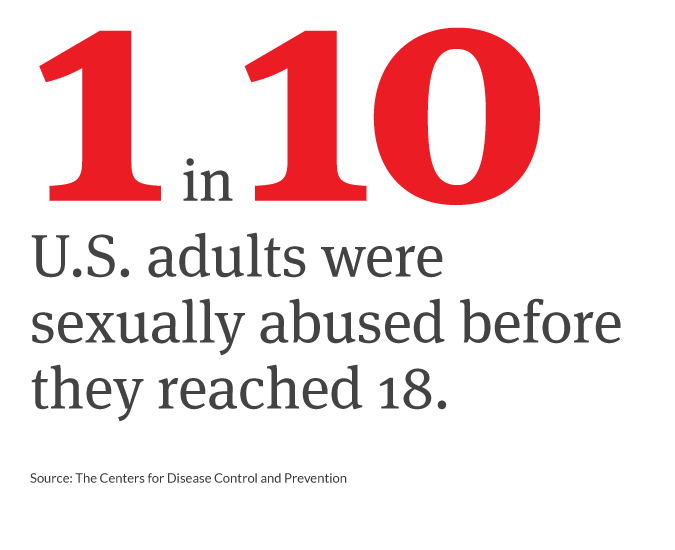
The Centers for Disease Control and Prevention considers child sexual abuse a public health epidemic. One in 10 U.S. adults were sexually abused before they reached 18 – that’s 24 million people. And abuse may lead to health issues years later, such as depression, sleep and eating disorders, substance abuse, and suicide.

Yet less than 40 percent of children who are sexually abused tell anyone – and a fraction of those cases end up being reported to authorities.

People who are victims of this kind of abuse often hear a refrain: Come forward and name your abuser. Justice will be done. But we rarely get to hear what happens next. Are most of those cases prosecuted? Do most victims get turned away? I didn’t know what would happen. That’s what kept me from coming forward earlier.

tennesee

I was 29 when I decided to dig back into what had happened to me. In 2010, I Googled the name of my old gym. I discovered that my coach, Parviz Youssefi, still was running GMS Gymnastics in Manassas, Virginia, with his wife and daughters. He still had access to young kids. That worried me. But I was conflicted about what to do next.

If I reported him, I was scared the response would be too punitive. I’d heard about cases in which prosecutors dished out overly harsh sentences. I wanted to address the abuse without traumatizing his family and the community.

But I also was scared nothing would happen. I’d heard story after story of prosecutors not believing victims of sexual violence or, even worse, treating them like it was their fault.

It took me three more years to call a special victims unit and leave this message: I’m calling to report a crime.

Detective Kimberly Norton from Prince William County, Virginia, called me back. The Manassas gym was in her jurisdiction. I gave her a brief run-down of what had happened 25 years earlier.

I was quick to explain that I didn’t so much care about prosecution of my case. I just wanted her to know this guy still had access to kids. But Norton told me that in Virginia, there’s no statute of limitations on felony sexual abuse. Youssefi still could be prosecuted.

She asked me to come to Virginia from New York, where I was living, to make a report in person. When I arrived at the airport, she picked me up in an unmarked police cruiser.

I told Norton all about Youssefi. To me, he didn’t fit the stereotypical image of a molester, the kind who lures children into his van with candy. To anyone watching us at the time, like fellow gymnasts and my dad, I was the loudmouth kid and he was the jovial coach.

I remember having this deeply shameful and sick feeling
Tennessee Watson

But he had figured out how to get me alone.

He said I wasn’t disciplined enough and needed to learn to focus. He offered me a special opportunity: private sessions with him. That’s when the abuse started. I was 7 years old.

The summer before second grade, Tennessee pretended to lose interest in gymnastics. She and her dad stopped going to the gym.
The summer before second grade, Tennessee pretended to lose interest in gymnastics. She and her dad stopped going to the gym. Credit: Courtesy of Tennessee Watson

My dad and I went to the gym together. While I worked one on one with Youssefi, my dad would work out in another corner of the gym, doing a routine the coach had given him to strengthen his bad knees. Youssefi would prop up a gym mat like a room divider, ostensibly to keep me from getting distracted by my dad. As I look back, I can clearly see the mat was meant to hide what was happening.

Youssefi would start a stretching routine with me and ask me to sit on the floor across from him with my legs wide open in a split. He’d reach out to grasp my hands to pull me forward, then I’d lean back to pull him toward me. We’d go back and forth like that, working our hips and hamstrings.

Then the crotch of my leotard would catch his eye.

He’d point out it wasn’t tight enough by hooking his fingers around the little piece of fabric between my legs. I remember feeling his knuckles and fingers rubbing back and forth on my labia.

I don’t know exactly how many times it happened, but I vividly remember thinking it was my fault. The summer before second grade, I pretended to lose interest in gymnastics. My dad and I stopped going to the gym.

As I told Norton the details, I began to realize the extent of the manipulation. That made me even more worried about the coach’s ongoing access to kids. With tears streaming down my face, I told Norton that if Youssefi lived at the end of a dirt road and never saw a kid, I probably wouldn’t have reported him. If he could say to me, “You were the only one,” then I probably wouldn’t pursue this.

Norton suggested it might be a good time to call Youssefi and ask him to take responsibility for what he’d done. If he admitted it, or even just apologized, that would help build the criminal case against him.

I was recording her as we talked, but she set up her own recorder so she could record the call. She gave me a small microphone to press between my ear and my phone.

I gave it a go, but it didn’t work. Youssefi told me over and over that he didn’t know what I was talking about. By the end of the call, he was denying I had ever been his gymnastics student.

I’m calling to see if I can get an apology for what you did
Tennessee Watson

This is a point at which a lot of cases like mine end. I had reported Youssefi to the police. I had tried the sting phone call. There wasn’t much else I could do. It would be up to the prosecutor assigned to my case to decide whether to move forward.

Before I parted ways with Norton, she cautioned me not to get my hopes up.

But my case didn’t end there. When I met Kristina Robinson, an assistant prosecutor in Prince William County, she told me she thought Youssefi might have abused other kids. She said: “In a school setting, in a gym setting, in any kind of setting where adults are supervising children, if there’s one victim, often there’s more.”

Even if no one else came forward, she told me she could charge Youssefi based solely on my account. Because I was approaching this as a reporter, I asked lots of questions about how bringing a case worked. Robinson explained that in Virginia case law, Fisher v. Commonwealth of Virginia establishes that the testimony of a victim, if believed, may be enough for a conviction.

The tough part is getting a jury to believe a victim. Jurors need proof beyond a reasonable doubt that the crime happened. They expect physical evidence – injuries, DNA, blood swabs, all the stuff you see on crime shows.

But if abusers first groom kids to trust them, they often don’t have to use force or worry about being reported. With Youssefi, my grooming was the special private lessons with an elite coach.

With a case like mine, far in the past, the best Robinson could do was find a way to prove that the abuse could have happened. She asked if I had check stubs or other records of payment for the private lessons, a photo of the two of us together. I didn’t have any of that stuff.

So my best hope – and also my worst fear – was that Youssefi had other victims.

Norton, the detective, went to police departments all around Virginia hunting for reports about Youssefi. In nearby Arlington County, she found one. In 1997, Jeanna Dodd had reported to police that Youssefi had sexually abused her in the 1980s.

Through Norton, I learned that Dodd grew up one town over from me and was older than me at the time she said she was abused – about 10. She had told a counselor at her school back then what had happened, and the counselor contacted the police. But her parents didn’t push for prosecution. They were scared to put her through a trial at which she’d have to testify.

Like me, though, Dodd couldn’t put it behind her. She came forward again in 1997.

Norton found Dodd’s police report from 1997 and wanted Arlington County to reopen the case.

Dodd’s case was even stronger than mine, Norton said. She had come forward multiple times, first as a kid, and her report about what happened more clearly demonstrated sexual intent. It still would be my word against Youssefi’s in Prince William County, but Norton thought media coverage would link the two cases for the public to see.

Five months later, in April 2014, we got the official word that the Arlington County prosecutor was not going to move forward on Dodd’s case. Robinson decided to charge based on my testimony alone. She was hoping coverage of the arrest would bring forward other victims in Prince William County, where she would have more control over charges.

Parviz Youssefi (left), Tennessee Watson’s childhood gymnastics coach, heads to the Prince William General District Court in Manassas, Va., accompanied by his wife and a daughter. His original charge of aggravated sexual battery was reduced to contributing to the delinquency of a minor and then dismissed after a one-year probation.
Parviz Youssefi (left), Tennessee Watson’s childhood gymnastics coach, heads to the Prince William General District Court in Manassas, Va., accompanied by his wife and a daughter. His original charge of aggravated sexual battery was reduced to contributing to the delinquency of a minor and then dismissed after a one-year probation. Credit: Kate Patterson for Reveal

On May 5, 2014, Youssefi was arrested and charged with felony aggravated sexual battery. He spent two days in jail, then got out on bail.

A couple of days after the arrest hit the news, two women came forward in Maryland. They’d gone to a school where Youssefi worked as a gym teacher. Both said he’d touched them inappropriately, too. They had tried to bring charges in the 1980s, they said, when they were kids, but nothing was done.

The prosecutor in the Maryland county where their reports were made wouldn’t reopen those cases, either. That’s when I started to realize how few prosecutors take these cases further.

I asked Norton to tell the other victims about me and see if they’d talk to me as part of my reporting. Dodd agreed – but I waited too long to call her. On May 22, 2014, she died of a drug overdose.

I found out the following month, as I was about to face Youssefi in court for the first time at a preliminary hearing. Norton had been calling Dodd to let her know my case was moving forward, but she couldn’t get ahold of her. When she figured out why, she called to tell me. Thoughts of Dodd became my constant companion during the hearing.

Youssefi’s defense attorney cross-examined me for over an hour while Youssefi watched. He asked about details I didn’t remember, such as the exact months the abuse happened. I was 7 years old. How would I possibly know that? But every time I said, “I don’t know,” I was like “Damn! He’s getting me.”

It was a taste of how hard the trial was going to be – minus the 12 jurors who would be scrutinizing me then. I thought of Dodd. I wouldn’t give up.

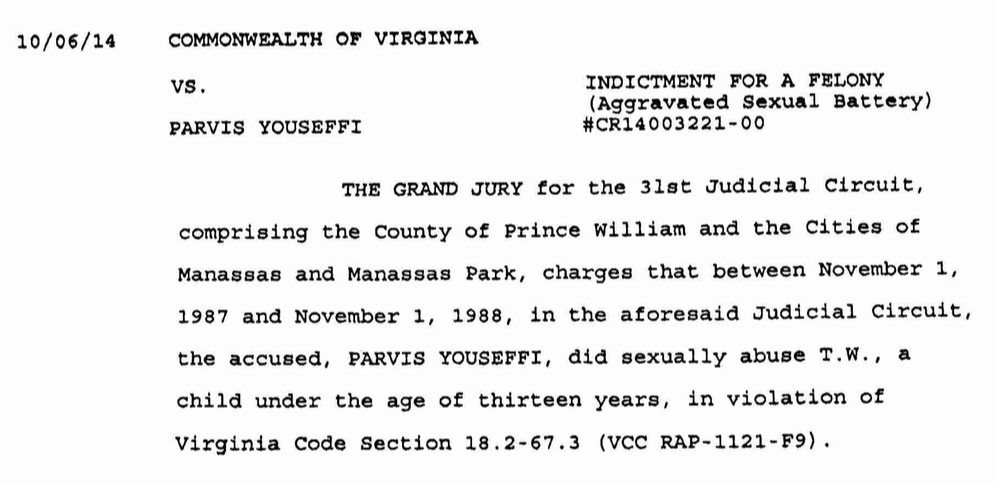
After the preliminary hearing, the case went before the grand jury, which indicted him and approved a jury trial.

grand_jury_snippet
A date was set: June 8, 2015. A year away.

As the trial approached, I heard the defense attorney had gathered hundreds of letters of support for Youssefi and lined up 20 character witnesses. Four days before the trial, I got a call from Robinson, the assistant prosecutor. She told me she’d been thinking about the case. It sounded like the preamble to some bad news.

I can never predict exactly what a jury is going to do
Kristina Robinson, assistant prosecutor

“I can never predict exactly what a jury is going to do,” she said. “But I just can’t see them saying the memory of a young woman in her 30s remembering something that happened when she was 6 or 7 years old is enough beyond a reasonable doubt.”

She’d hoped more victims would come forward, but none had. So all we had was my word and no corroborating evidence. Her boss, Commonwealth’s Attorney Paul Ebert, had told her she was going to lose. He instructed her to offer Youssefi a plea deal.

And what a deal it was: Instead of a trial, Youssefi would appear in court and plead “not guilty facts sufficient,” which means he wasn’t admitting guilt but also wasn’t contesting my testimony. And his charge would be reduced from a felony, for which he could have faced 20 years in prison, to a misdemeanor charge of contributing to the delinquency of a minor. The charge is a catch-all for adults who expose a minor to something that might harm him or her, like buying a kid a pack of cigarettes or a six-pack of beer.

Why was Robinson offering him a deal that didn’t require him to even admit guilt? It’s a procedure called suspended imposition. It was a way to get Youssefi on probation. He’d have to wait a year for the final disposition of the case. And until then, he was not allowed to be around kids under 12 and would have to go to counseling. If he complied, then he’d officially be not guilty and the charge would be dismissed.

I felt hurt and confused. Yet at least it was something. Youssefi started his probation.

The reporter in me couldn’t just walk away, though. It nagged at me that nothing was done in response to the allegations against Youssefi in other jurisdictions. I was told the victims in Maryland had wanted to put the ordeal behind them. But in Arlington County, Dodd had wanted to hold Youssefi accountable, yet the prosecutor refused to reopen the case.

Those kinds of discrepancies signaled a breakdown in the system to me, but according to Camille Cooper, prosecutors have the power to do whatever they want with a case. Cooper is the director of legislative affairs at Protect, an organization that pushes for a stronger response to child abuse.

“The prosecutor is the one that sets the level of priority in his or her community,” she said. “You know the buck stops with him. He can reject a case just because he doesn’t want to do it.”

I assumed we had ways to compare how prosecutors in different jurisdictions respond to child sexual abuse. But I found that prosecutors don’t have to explain any of their decisions to the public – why they charge certain cases and not others. Their right not to disclose information is protected by a slew of U.S. Supreme Court cases, some of which also protect them from being held accountable except in the most egregious cases of misconduct.

The prosecutor’s office is kind of like a black hole, and I was desperate to find out what was going on in there. How many victims get turned away, told by prosecutors that there just isn’t enough to charge? Where do things get halted and why?

I worked with the Investigative Reporting Workshop at American University and the data team at Reveal from The Center for Investigative Reporting to look at thousands of child sex abuse cases going back 15 years in Prince William County, where my case was handled. It turned out to be impossible to track each case all the way through the system. The police, Prince William County Circuit Court, Prince William General District Court and state Supreme Court all have different ways of filing cases. There’s no universal tracking number or serial code. They don’t even keep a count of how many sex crime charges have involved children.

So to a large degree, we still couldn’t see much of what was going on. But from police data, we could see that about half of reported cases of child sexual abuse had not made it past the police. Some were closed for lack of evidence, and some were rejected by the prosecutor.


What happens with the cases that do make it past the police? It was hard for me to believe that the Prince William County commonwealth’s attorney’s office wasn’t keeping track, even for itself. Five special prosecutors there work on child sex abuse cases.

But Ebert, the county’s top prosecutor, who has been elected 13 times, says even he doesn’t track how many cases his office decides to prosecute versus how many they turn down.

He explained it to me this way: “If the public doesn’t like what I do, they can kick me out of office. That’s our system.”

Rose Corrigan, a researcher at Drexel University’s law school in Philadelphia, also struggled to get data from prosecutors’ offices about how they handle sexual assault cases. Corrigan traveled to six states, interviewing victim advocates about their experience with the legal process.

What she found affirms 40 years of research on sexual assault prosecution, which she summed up this way: “Middling to bad is what to expect.”

A victim advocate told her that in one county, the local prosecutor hadn’t brought a sexual assault charge in a decade. But she also found a small group of prosecutors, scattered around the country, who were going above and beyond. She described them as “unusually driven to seek justice for victims of sexual violence.”

Corrigan says my prosecutor, Robinson, fits that profile. Until then, I’d been thinking that Robinson had let Youssefi off easy. Now I realized that maybe she’d squeezed everything she could out of my case.

Robinson acknowledges that other prosecutors might think what she’s doing is “overreaching or trying to press a case that maybe can’t be proven.” And she gets angry, “because they don’t understand how important this is.”

Theo Stamos is the commonwealth’s attorney in Arlington County, Virginia. That’s where Jeanna Dodd had tried to bring charges against Youssefi multiple times. Stamos’ office didn’t charge him. Stamos wouldn’t say why not.

Then she was asked to talk hypothetically about my case for this story. Would she have prosecuted Youssefi?

“It would be a very odd situation where I would authorize a prosecution to go forward against that individual,” Stamos said. “I’m not saying it can’t be done. But absent an admission by the defendant, or a confession to law enforcement, it’s virtually impossible to go forward.”

Lots of thoughts were colliding in my brain. Numerous states now waive the statute of limitations for reporting child abuse, but what is that worth if prosecutors are reluctant to charge? And if prosecutors won’t put these cases before a jury, the testimony of victims never gets heard. That leaves us with no power to convince jurors and no power against our abusers.

That sense of powerlessness can have devastating consequences. It did for Dodd.

I reached out to her parents to find out what had happened. They didn’t want to talk. It was too painful. But they introduced me to Becky Newton, one of Dodd’s close friends.

Newton said Dodd had an edgy sense of humor and spent years working with rescue animals. But inside, she struggled because of the abuse.

“It was huge. It impacted every aspect of her life,” Newton said. “I think it was just this incredible weight that she was never meant to carry … this dark cloud that she carried around.”

To cope, Dodd started using drugs, Newton said, and struggled with addiction most of her adult life.

In her early 20s, Dodd got a job at a Starbucks near where she grew up. Youssefi began coming in regularly. Dodd couldn’t take it, Newton said. “At one point, before she quit, she actually looked him in the eye and said, ‘I just want you to know: You ruined my life.’ ”

That’s when Dodd decided to go back to the police. In 1997, she tried a sting phone call with the help of a detective just like mine. And, like mine, it didn’t work. Then, in 2013, when I brought my case, she got the phone call from Detective Kimberly Norton about her police report.

Newton remembers that day: “She was just so excited. Because she … had been informed about you, informed that they were looking at pursuing the case. And just a deep sense of relief that this might actually be pushed forward this time.”

But then, Newton said, “there was just some resistance in pursuing the case.”

I remember hearing that from Norton, too. She told me Arlington County was reluctant to take the case because Dodd wasn’t a great witness. I wondered if that was because of her history of drug use.

Having her case dropped again hit Dodd hard, Newton said. “Every time she brought herself to a place to be able to confront this, to be able to be honest about it, to voice what happened, and then nothing was done, I think the weight just grew. And then, you know, ultimately Jeanna’s death.”

When Dodd overdosed, she left behind a 10-month-old daughter. She left even those who knew her best unsure of whether she had intentionally taken her own life or overdosed by accident.

I had wanted to go to trial not just for myself, or for Dodd, but for all the women who’d been silenced by the trauma of abuse. I wanted Youssefi to have to explain himself. At a trial, he would have been cross-examined by Robinson. At the plea hearing, all he said was, “Not guilty.”

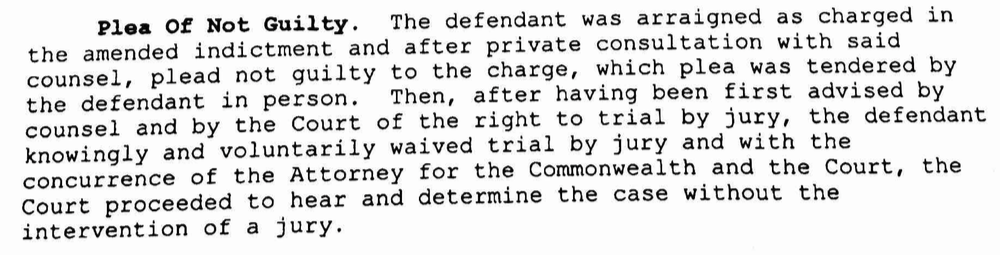
plea

The final hearing happened last month, on July 11. Youssefi pleaded not guilty to the reduced charge, contributing to the delinquency of a minor. He had complied with the terms of his probation – spending the year away from kids and going to counseling – so now in the court files, his case is marked as dismissed.

If you look up his arrest record, it does show that he originally was charged with a felony for aggravated sexual battery. And his mug shot does turn up in an internet search. But he never was put on the sex offender registry, and he’s free to work with kids again.

People always ask me what I think should have happened to Youssefi. Years in prison?  Intensive counseling?

Even after all my reporting, I’m still not sure.

But I do know one thing: When Dodd told her school counselor about Youssefi, I hadn’t started taking gymnastics yet. If the prosecutor then had decided to charge Youssefi, maybe he never would have become my coach.

Friday, 5 August 2016

Sex-for-Drugs Sting Nabs Virginia Mayor on Meth Dealing Charges

Another American Mayor caught up in a scandal

Yesterday I posted a piece on the Mayor of Stockton, California who was arrested for involvement in a strip poker game with youth at a youth camp. Today, from the other side of the country...

Mayor of the City of Fairfax Richard 'Scott' Silverthorne. © Fairfax Country Police Department

The mayor of Fairfax, Virginia, has been arrested in an undercover sting during which he allegedly tried to arrange a drug deal with cops via a ‘sex’ website.

Fairfax County police created a fake profile on a website used to organize sexual encounters between men in an operation to catch a person suspected of dealing methamphetamine online.

After a string of text messages to and from the suspect, during which he allegedly promised to provide meth in exchange for sex, the Organized Crime and Narcotics team arrested Fairfax Mayor Richard ‘Scott’ Silverthorne.

Silverthorne holds the office of mayor of the City of Fairfax, an affluent area in the DC suburbs, and is in his third term. He has, according to the Fairfax government website, championed “quality of life issues” and worked to promote “a healthy lifestyle.” 

He was among a group of Virginian 'Mayors for Hillary' who endorsed Hillary Clinton's presidential election candidacy ahead of the state's primary in March.

The 50-year-old, who also served on the city council from 1990 to 2012, was arrested Thursday at the Crowne Plaza Hotel Tysons Corner as he tried to deal “methamphetamine to the undercover detectives,” say police.

Silverthorne has been charged with “felony distribution of methamphetamine and misdemeanor possession of drug paraphernalia.”

Two other men, 34-year-old Juan Jose Fernandez and Caustin Lee McLaughlin, 21, both from Maryland, were later arrested on suspicion of supplying the hardcore drug. Police say McLaughlin was tasered as he resisted arrest, but there were no reported injuries in the altercation.

All three men were taken to Fairfax County Adult Detention Center.

A spokesperson for the City of Fairfax told RT.com that they had no comment regarding the arrest, but that a statement on the matter is expected.

    Fairfax, Virginia has a population of about 25,000.

Wednesday, 3 August 2016

Supreme Court Halts Trans-Student Bathroom Order for Virginia Schools

© Shannon Stapleton
© Shannon Stapleton / Reuters

The Supreme Court has blocked a previous federal court ruling ordering a Virginia school board to allow a transgender student access to a bathroom matching his gender identity.

In a 5-3 decision on Wednesday, the nation’s top court put a hold on an order from the US Court of Appeals for the Fourth Circuit, pending a writ of certiorari, or a review, of the lower court decision.

The court’s decision came after the Gloucester County School board filed an emergency appeal asking Chief Justice John Roberts, who handles requests from the Fourth Circuit which includes Virginia, to ban 17-year-old Gavin Grimm from using the boys’ restroom, until the decision is reached on whether the court would review the case.

Grimm, who was born female but identifies as male, argued the school board’s policy requiring students to use either the restroom that corresponds with their biological gender or a private, single-stall restroom violated Title IX, a federal law that bars sex discrimination in schools.

The Virginia school board argued that forcing the school to let Grimm use the boys’ bathroom raised privacy concerns and could cause some parents to remove their children from the school.

The Supreme Court ruling said that if the justices agreed to hear Grimm’s case, the order would remain on hold until the court makes a final ruling.

Justices Ruth Bader Ginsburg, Sonia Sotomayor and Elena Kagan dissented, while Justice Stephen Breyer said he agreed to put the case on hold to “preserve the status quo” until the court decides whether to weigh in.

An American Civil Liberties Union attorney representing Grimm said he was disappointed the teenager would begin another school year being “stigmatized and isolated from the rest of his peers just because is transgender.”

Just because he/she is transgender? Like it's the difference between wearing a tee shirt or a dress shirt. Stigmatism and isolation are part of being trans. If he/she is not stigmatized by that, having to use a private bathroom is not going to do it.

The Fourth Circuit sided with Grimm in April, arguing that the federal judge who previously dismissed the teen’s Title IX discrimination claim had ignored a US Department of Education rule that transgender students in public schools must be allowed to use the restroom that corresponded to the gender identity.

Saturday, 19 March 2016

Child Rape Loophole: US States Seek to Ban Underage Brides


© Mihai Barbu
© Mihai Barbu / Reuters

Girls as young as pre-teens are legally able to marry in the US state of Virginia if they are impregnated by their future husband, but now a new bill that just passed the legislature would ban the controversial tradition.

Although they can’t buy alcohol, smoke, vote, or consent to sex, girls old enough to bear children can enter a lifelong commitment of marriage.

The new legislation would establish a minimum age for marriage at 18, with an exception for 16 and 17-year-olds who are legally emancipated from their parents. Bill 415 passed the state House Monday by a vote of 65-29 after passing the Senate last month.

The former Confederate state allows men of any age to marry a girl at any age, as long as she is pregnant and has parental consent.

Four 13-year-olds and 24 14-year-olds, were granted marriage licenses between 2000 and 2013, rather than receive protection from the state’s Child and Family Services department.

4,500 minors in total were wed in Virginia during those 13 years, with nearly 220 under the age of 16.

Ninety percent of those married underage were girls - and 90 percent of them married older adults, according to Tahirih Justice Center.

Thirteen children under 15 are currently married to spouses more than 20 years older than them. In 2013, nine brides were aged between 14 and 15 in Virginia. All were white.

Virginia state Senator Jill Vogel decided to push for the bill after hearing about a man in his 50s in Middleburg who married a teenage girl to avoid questions from authorities. The girl’s mother gave consent, according to AP.

“We make sex with a child under 16 a crime, so it aligns our marriage laws to that so you don’t have situations where young girls are being married off into an abusive relationship,” said Richmond Democrat Jennifer McClellan, who sponsored companion House Bill 703.

Marriage applications for minors are currently filed with court clerks with no judge involvement. The new bill would require minors to go through a family court judge.

The bill seeks to address the issue of coercion or forced marriage, with parental consent no longer being enough to allow a child to be married off.

Parents can be the ones who are forcing their children into marriage, in order to avoid the “shame” of ‘bastard’ grandchildren and the possibility of abuse by an older predator.

The age of consent in Virginia is 18, although some states are as low as 16.

A similar measure has been introduced in Maryland, and a pending bill in New York goes even further. It would make the state the first to ban marriage altogether for anyone under 18.

Worldwide, according to UNICEF, there are more than 700 million women who were married before 18. Numerous studies have concluded that the practice is detrimental to girls’ health, education and economic opportunities, and increases their vulnerability to abuse and violence.

Critics say the practice poses a largely unseen threat in the United States as well.


Although marital rape has been made illegal in the States since 1993, a husband in Virginia can avoid prosecution if he goes to counseling.

One of the senators who voted against the bill to end child marriage, Robert Black, previously argued against criminalizing spousal rape in 2002.

The issue of marital rape made its way into the 2016 presidential election after one of Donald Trump’s lawyers, Michael Cohen, said, “you can’t rape your spouse.”

Trump denounced Cohen’s statements and tried to distance himself from the lawyer, even though Trump’s ex-wife Ivana used the word “rape” to describe an incident between them during a divorce deposition more than 20 years ago, an incident Trump denies.

Here is the list of the Virginia politicians who voted against the ban on underage marriage and legal rape, according to the Virginia legislature website.

Senate: Black, Deeds, Edwards, Locke, Newman, Petersen, Surovell

House: Adams, Austin, Bell, Richard P., Byron, Cline, Cole, Cox, Dudenhefer, Edmunds, Freitas, Garrett, Gilbert, Head, Helsel, Jones, Kilgore, Landes, LaRock, Marshall, D.W., Marshall, R.G., Morris, O'Quinn, Pillion, Pogge, Ransone, Rasoul, Taylor, Ware, Wright

Sunday, 13 March 2016

A Councillor, a Teacher, and a Firefighter on Today's List of US Pedophiles

Ex-Tennessee firefighter charged in child sex abuse case
Bristol Herald Courier
Associated Press |

NASHVILLE, Tennessee (AP) — A former Tennessee firefighter has been charged in a sexual abuse case involving a child.

The Tennessee Bureau of Investigation says 37-year-old David Wilber was arrested Friday on three counts of sexual battery by an authority figure.

The TBI says in a news release that an investigation found the child was sexually abused on several occasions between August 2014 and August 2015.

Portland Mayor Ken Wilber, who is David Wilber's uncle, says in the news release that his nephew resigned from the Portland fire department last week.

Sumner County Jail records show David Wilber was released on bond.


Richmond teacher faces child sexual abuse charges
Bristol Herald Courier
Robert Sorrell

RICHMOND, Virginia (AP) — Richmond police say a local high school teacher has been charged with sexually assaulting a student.

Click on photo for WTVR report
Authorities say 24-year-old Courtney B. Steward was arrested Thursday and charged with sexually abusing a male student attending Huguenot High School.

The Richmond Times-Dispatch reports (bit.ly/21odqma) that Stewart has been charged with two felony counts of taking indecent liberties while in a supervisory role.

A spokeswoman for Richmond Public Schools said Stewart, who was hired at the start of the school year, has been suspended without pay pending the outcome of the investigation.

Court records show the first alleged assault occurred last year, and the second sometime last month.


Councilman turns himself in after child sexual abuse allegations
By Jennifer Bauer - Reporter
KPRC Houston

DAISETTA, Texas - A well-known city councilman is locked up inside the Liberty County jail and charged with one count of sex abuse of a child.

Dennie Howell, 57, was indicted and turned himself in to the authorities on Feb. 23.  He is currently being held without bond.


Detectives in the case tell Channel 2, a 14-year-old girl came forward and said Howell molested her.

Police began their investigation several months ago.  Recently three more girls, all under the age of 13, came forward and made similar allegations. Police are continuing to investigate and more charges could come.

“I trusted him.  I trusted the wrong person, obviously,” said one of the girls’ mother’s.  She spoke exclusively to Channel2, and her identity is not being released to protect her daughter.

“He had her convinced that nobody would believe her and that she would be the one that would be in trouble.”

The girl’s mother said her daughter is 12, and the alleged abuse was happening for about two years.  Her daughter got the courage to come forward after she heard Howell had been arrested.

The mother told Channel 2 their families had known each other for many years, and they were very close friends.  The alleged abuse was happening at Howell’s Daisetta home.

“It’s shocking,” said Huey Palmer, who has known the Howell family for more than two decades.

Everyone in town knows Howell because of his work with the city, and a lot of people are surprised about the allegations.

“You would never suspect somebody like that,” said Jimmie Dee. “He’s always been friendly with the kids.”

Wednesday, 25 March 2015

Sensational Rolling Stone Campus Rape Story Completely Unravels

I'm just grateful that the University of Virginia is not in Spotsylvania. I couldn't stand 3 consecutive stories from Spotsylvania.

Charlottesville Police Chief Timothy Longo told reporters Monday that a
five-month police investigation into an alleged gang rape at the University
of Virginia that Rolling Stone magazine described in graphic detail
 produced no evidence of the attack and was stymied by the accuser's
unwillingness to cooperate. (The Associated Press)
Neil MacDonald (CBC)
For a group of young fellows who may never be able to scrub off the stench of rape allegations, the Phi Kappa Psi frat-boys at the University of Virginia are behaving like gentlemen.

"These false accusations have been extremely damaging to our entire organization," said the group's president in a statement after the local police chief sort of exonerated them of gang rape this week.

"But," he added, with a touch of noblesse oblige, "we can only begin to imagine the setback this must have dealt to the survivors of sexual assault."

I say "sort of exonerated" because, after a gullible, scoop-hunting journalist recounted a female student's tale of being gang-raped in 2012 on the floor of the UVA frat house, as shards of broken table glass tore into her back, and now after having endured nearly a year of investigations that not only turned up no evidence supporting the story, but actually seems to conclusively prove it false, neither the university nor the police could bring themselves to conclusively and explicitly declare anyone innocent.

Instead, after citing evidence that discredited just about every detail of the explosive story in last November's Rolling Stone magazine, Charlottesville Police Chief Tim Longo nonetheless referred to the accuser as a "survivor."

He then expressed hope that eventually, the woman known only as "Jackie" finds "a place where she feels comfortable" so that she might reveal what, if anything, actually did happen on the night of Sept. 28, 2012.

One would think something must have happened to Jackie to cause her to give Rolling Stone her story, albeit a false story. Or perhaps the girl is mentally ill. In any case, she needs some serious help and I hope the university will ensure that she gets it.

Until then, evidence that her story was false, said Longo, "doesn't mean something terrible did not happen to Jackie … we are just not able to gather sufficient facts to conclude what that something may have been."

Investigation still 'open'

As of now, the investigation is suspended, but still open.

To close it, said Longo, would be "a disservice to Jackie," which, incidentally, is not the accuser's real name. Most news outlets are respecting her wish to accuse from under a cloak of anonymity.

Not one of the reporters at the news conference had the wit to ask how much of a disservice the chief thinks his open-ended inconclusiveness might be to the frat members, whose identities are not, unfortunately for them, shielded from the public. It's easy enough to research their names.

Given the permanent memory of the internet, any prospective employer down the road who makes any effort to research the past of some Phi Kappa Psi alum will immediately see references to rape, national scandal and continuing investigation.

Right after the Rolling Stone article appeared in November, UVA rector
George Martin and University president Teresa Sullivan met students
and promised to do a better job dealing with rape complaints on campus
Here, briefly, are the findings of police so far.

Jackie originally told a story of sexual assault and battery to a university dean in 2013, but did not wish to pursue it. Nearly a year later, after telling the same dean another story of gang rape, she agreed to meet with police.

But she refused to provide specific details, other than naming the Phi Kappa Psi fraternity. She was insistent: She wanted no police investigation. She feared retaliation by the rapists.

But she was, evidently, willing to co-operate with the investigation — if you can call it that — of Rolling Stone reporter Sabrina Rubin Erdeley.

Last November, when Erdely published Jackie's account of being lured into a frat party and raped by seven fellow students, it made national headlines, explosively validating the "rape culture" that activists say permeates university campuses here in the U.S.

The account brimmed with telling details, such as the rapists referring to Jackie as "it."

The school was accused of ignoring predators. Fellow students were accused of encouraging her to keep her mouth shut. Frat-boys in general became national villains. The fraternity in question was vandalized. Students marched.

Unsupported

At the request of the university president, Charlottesville police reactivated their investigation.

More than 70 people eventually co-operated. Fraternity members rather sensibly hired lawyers, but consented to police searches, and submitted to interviews.

The police talked to Jackie's friends, co-workers and fellow students. They searched records and databases for corroborating evidence.

Jackie, though, refused to co-operate, says the official police report. She began communicating only through her lawyer.

"Despite numerous attempts to gain her co-operation, Jackie has provided no information whatsoever to investigators."

Police quickly discovered there had been no frat party on the night in question. The student who Jackie said lured her to the gang rape appeared not to exist. Neither did his phone number, provided by Jackie to her friends.

Essentially, her entire story turned out to be either false in its essentials or, charitably, unsupported.

By December, Rolling Stone was backing down. Almost unbelievably, the magazine admitted its reporter had agreed, out of some sort of weird courtesy, not to check Jackie's story.

Rolling Stone soon decided it could no longer stand by the story; it was a straight repudiation, declaring that the magazine’s naïve trust in Jackie was "misplaced."

 Then, this week Chief Longo appeared before the cameras with his extraordinary dual message: No evidence to support the story, but no evidence that something bad didn't happen, either.

What? No evidence that something bad didn't happen? You have to prove something bad didn't happen? How absurd! Where do you start? "Something bad" can mean a million things - do we just pick one? Where and when did something bad happen? By whom was it perpetrated? You can't even begin to answer questions like that without some honesty from the victim, if there was a victim.

Should someone be sued?

Would Jackie be charged with lying to police on the two occasions she did agree to speak with them? "Absolutely not," the chief said.

Would the force ever charge someone who falsely cried rape? Well, not unless the chief prosecutor agreed, said the chief, and maybe not even then. A charge like that might have a "chilling effect" on reporting sex crimes.

None of the reporters present asked why in heaven's name Jackie still qualifies as a "survivor" or what's wrong with "chilling" false claims.

Protesters picketed and vandalized the Phi Kappa Psi fraternity house
at the University of Virginia campus in Charlottesville after the
Rolling Stone article appeared. (The Associated Press)
But there would probably have been no satisfactory answer. Under pressure from anti-rape activists, authorities are beginning to treat campuses as islands disconnected from the world, places where the normal rules establishing guilt, innocence, crime and punishment don't apply. And they are right to do so since most campus rapes go unreported to police and are dealt with very gently, if at all.

Hence the spectacle of Chief Longo on live TV, advising that a rape victim's options are, in this order: Doing nothing at all, seeking medical help, letting the university handle it, and, finally, perhaps, going to the police.

The ground has truly shifted when a policeman actually says it's perfectly reasonable for a rape victim to just do nothing, or to let educational officials handle a crime that is serious enough to rank with murder and kidnapping.

The University of Virginia's separate inquiry, triggered by the Jackie case, continues, meanwhile, even though, when asked if a rape culture exists on the campus, the police chief answered: "We could find no evidence that would corroborate such an assertion."

And the Phi Kappa Psi frat-boys are, as respectfully as possible, considering whether, and whom, they should sue: Jackie, who has since said she stands by her story, or the important magazine that decided her story was too good to bother checking.