Everyday thousands of children are being sexually abused. You can stop the abuse of at least one child by simply praying. You can possibly stop the abuse of thousands of children by forwarding the link in First Time Visitor? by email, Twitter or Facebook to every Christian you know. Save a child or lots of children!!!! Do Something, please!

3:15 PM prayer in brief:
Pray for God to stop 1 child from being molested today.
Pray for God to stop 1 child molestation happening now.
Pray for God to rescue 1 child from sexual slavery.
Pray for God to save 1 girl from genital circumcision.
Pray for God to stop 1 girl from becoming a child-bride.
If you have the faith pray for 100 children rather than one.
Give Thanks. There is more to this prayer here

Please note: All my writings and comments appear in bold italics in this colour

Showing posts with label evidence. Show all posts

Monday, 4 May 2026

Islamic Vignettes from around the World > UK mother and son in jail after hiding evidence of child rape; Islamic madness - What's a watermelon worth?


UK: Muslim mayor helped her son hide incriminating evidence after he raped unconscious 15-year-old girl


Sure, she wants to protect her boy, but there’s more to it than that. As Holy Hell: Islam’s Abuse of Women and the Infidels Who Enable It shows, on numerous occasions Muslim rape gangs’ gang-rape of British girls involved fathers and sons, brothers, uncles, and other relatives. This is because the people involved didn’t consider it shameful. After all, the rape of infidel women is sanctioned in the Qur’an (4:3, 4:24, 23:1-6, 33:50, 70:30). So what could be wrong with it? Why should a mother want to see her son go to prison for behavior that she didn’t consider to be any big deal?

Naheed Ejaz, Hampshire Police


Ex-Labour mayor slammed by judge for helping hide her son’s phone after he raped a 15-year-old girl as he jails her for three years and locks up her son for 12 years

by Andy Dolan, Daily Mail, April 30, 2026:

A female ex-Mayor was today jailed for three years for helping her son hide incriminating evidence after he raped an unconscious 15-year-old girl.

Former Labour Mayor Naheed Ejaz, 61, was slammed by a judge for trying to cover up her son’s crime after he raped the teenager while she was blacked out.

Ejaz refused to let police officers into her home for over a minute and a half and spoke Urdu to her son, Diwan Khan, so he could hide his phone which contained damning evidence.

Jailing the former Mayor of Bracknell in Berkshire, a judge told Ejaz that she ‘chose to protect’ her 41-year-old son despite knowing that his crime involved an ‘underage girl’.

The judge added that because of her actions, ‘there was a real risk Khan might have avoided prosecution for the rape of an unconscious child’.

A court heard today that the girl failed her GCSEs and tried to kill herself following the attack.

Prosecutors previously said Ejaz let her ‘mother’s love’ cloud her judgement and hindered police at her home in Bracknell with a ‘conspiracy of silence’.

The phone, which was said to have had footage of the sex attack on it, was never recovered….


India: Muslims slit throat of 13-year-old Hindu boy, killing him, for taking watermelon from his own family’s farm


“When you meet the unbelievers, strike the necks…” (Qur’an 47:4)

Street view of State Highway 39 close to Idgah bus station, Agra, India, by Marcin Białek, Creative Commons Attribution-Share Alike 4.0


UP: 13-year-old Hindu boy killed by Muslim farmers in Agra for plucking watermelon from his own family’s farmland, FIR registered against 13 including Saddam and Riyaz

OpIndia, May 2, 2026:

A shocking and brutal murder of a 13-year-old boy by Muslim farmers has created tension in a village of the Agra district in Uttar Pradesh. The incident took place under the Jagner police station area, where the body of the child, identified as 13-year-old Amrit Kushwaha, was found with severe injuries. Locals said his throat had been slit with a sharp weapon, and his eyes were also gouged out, making the crime particularly disturbing.

Amrit was a resident of Randhirpura village. According to his family, he had left home around 12 noon on Friday, 1st May, after telling his sister that he was going to get a watermelon from their own farm. The farmland had been rented out by his father, Naresh Kushwaha, to some Muslim farmers who were cultivating watermelons and muskmelons there. When Amrit did not return home till evening, the family began searching for him. His blood-soaked body was later found lying on a path not far from the house.

A bag containing a watermelon was found near the body, along with a blood-stained knife. It was Amrit’s sister who first spotted the body when she went looking for him in the field, and her screams alerted others in the area. Soon after, the police reached the spot and tried to take the body for post-mortem, but angry villagers refused to allow it for several hours….


Tuesday, 9 June 2020

German Prosecutor: Evidence Indicates Madeleine McCann Died

Suspect possibly linked to two other disappeared girls
By Clyde Hughes

(UPI) -- A German prosecutor investigating the disappearance 13 years ago of toddler Madeleine McCann says there's evidence indicating the girl is dead.

Hans Christian Wolters said there's not yet enough evidence to prosecute suspect Christian Bruckner and appealed to the public for help in the case.

Wolters said evidence points toward McCann being dead, but noted that he couldn't specify details. He also said there's insufficient evidence to arrest Bruckner.

"That's why we need more information from people especially places he has lived so we can target these places especially and search there for Madeleine," he said.

German authorities said last week Bruckner is being investigated for possible involvement in the disappearance of 5-year-old Inga Gehrike five years ago, in circumstances they say was similar to McCann's. He's also being eyed for the 2001 disappearance of 9-year-old Peggy Knobloch in Bayreuth.

Authorities said Bruckner has a list of convictions that include child sexual abuse, theft and drug dealing. He was convicted in December for a 2005 rape and is serving a seven-year sentence in a German prison.

McCann disappeared while on a family vacation in Portugal in 2007. Her parents were initially suspects but were ultimately cleared by police.

Some confusion over the suspect's name as it is spelt Bruckner and Brueckner in different reports. It is actually 'Brückner' and seems to be pronounced, Brook' nar.


Monday, 21 May 2018

The Dangers of Transgender Ideology in Medicine

Casualties of a Social, Psychological, and Medical Fad
by  Daniel Payne

Dr. Paul McHugh is optimistic that the ascendency of transgender ideology is a passing fad. Yet the damage that transgender ideology can wreak in even just ten or fifteen years—the hormones, the surgery, the irreversible decisions, the mutilated bodies—is considerable.


If popular opinion is to be believed, living as if one were the opposite sex is simply a healthy variant on a spectrum rather than a mental disease in need of serious treatment. What transgender individuals need, the thinking goes, is not to be told that they are delusional and in need of psychotherapy; it is for society to accept them as they are, and for medical and psychological professionals to help them “transition” to their “true gender.”

There is precious little evidence to support such a claim. Yet there seems to be a determined campaign, waged by activists and politicized medical officials, to suppress or otherwise ignore any dissent on the matter, even within the medical and psychiatric professions.

The “misalignment” of one’s body and one’s gender identity is one of the core tenets of transgender ideology. Most (though not all) transgender individuals feel the need to alter their physically healthy bodies—with genital surgery, with hormones, with breast augmentation or elective mastectomies—in order to reflect their “true” identities.

What drives so many doctors, psychiatrists, and therapists to affirm transgenderism rather than deny it? Where is the evidence to support such bizarre clinical practice?

Where's the Evidence?

You might be surprised to learn that the evidence is sorely lacking. We have been led to believe that there is a scientific consensus on this issue: that gender affirmation and “transitioning” have been scientifically proven to be the correct approaches to dealing with transgenderism in both children and adults. This appears to be largely false.

A few years ago, the medical consultation company Hayes, Inc., released several overviews of the numerous medical and scientific studies that have been performed on transgender populations. Hayes, which bills itself as promoting “better healthcare decisions using fiercely unbiased evidence,” is a low-profile but longstanding player in the medical evidence field. Since its founding in 1989, Hayes “has become an industry leader in providing unbiased, timely, clinically focused, evidence-based research and analysis to health plans, insurers, hospitals, healthcare systems, ACOs and government agencies.”

The Hayes reports are the damning indictments of the transgender industry that you’ve never heard of. Getting my hands on the reports entailed some difficulty; Hayes, Inc., did not respond to my requests for them, and indeed they did not respond to any of my inquires at all, leaving me to seek them out elsewhere. Eventually a sympathetic doctor offered me some copies. What they revealed was, to put it mildly, rather shocking.

The reports, released between May 9 and May 19, 2014, survey the three major types of medical treatment most often sought by transgender individuals: “sex reassignment surgery,” “hormone therapy,” and “ancillary procedures and services.” The reports draw from the literature of peer-reviewed publications over the span of at least a decade’s worth of studies and concern themselves with outcomes ranging from “psychological well-being” and “sexual function and satisfaction” to “safety outcomes” and “quality of life.”

Though the surveys note certain positive post-treatment changes in patient populations—say, an improvement of quality of life for some individuals who underwent “sex reassignment surgery,” and a reduction in anxiety and depression in some patients subject to “hormone therapy”—the overall “quality of evidence” for every category of treatment was rated “very low.”

The low-quality ratings were given for a variety of reasons: “limitations of individual studies,” “lack of randomization of patients to treatment groups,” “failure to control for confounders,” “unknown or short follow-up intervals,” “variable follow-up duration,” “possible recall bias and selection bias,” “lack of objective and validated outcome measures,” “lack of blinded outcome assessments,” “lack of baseline data for self-rated outcome measures,” and many others. In other words, there appears to be very little evidence to support the treatment plans proposed by the modern medical transgender zeitgeist.

Gender Dysphoria in Children 

This troubling dearth of evidence would be alarming enough if this phenomenon were limited solely to adults. But in recent years, transgender activists have set their sights on encouraging children to embrace transgender identities.

The Endocrine Society, a professional medical organization based in Washington, DC, recently stipulated that children under sixteen years old can safely begin hormone treatment therapy, even though its own research indicates that there are insufficient data to support its recommendations. In a recent “Clinical Practice Guideline” surveying the state of “Endocrine Treatment of Gender-Dysphoric/ Gender-Incongruent Persons,” the Endocrine Society laid out a “Summary of Recommendations” detailing how physicians and mental health professionals should treat individuals who experience gender dysphoria. The Society rates each of its recommendations on a four-point scale of quality of evidence: “very low,” “low,” “moderate,” or “high.”

Not a single one of the guidelines is backed by “high” quality evidence. Of the twenty-eight recommendations, only three scored “moderate.” The rest were either “low” or “very low.”

Among the recommendations that scored “low” are those that adolescents experiencing gender dysphoria should “undergo treatment to suppress pubertal development;” that sixteen-year-olds should be allowed to undergo “partly irreversible” hormone therapy; and that children younger than sixteen should be allowed to receive hormone therapy in some cases. Some of the very low ratings include permitting individuals to undergo “genital surgery” and “breast surgery.”

The guidelines also make several ungraded recommendations for which “direct evidence . . . was either unavailable or not systematically appraised and considered out of the scope of this guideline.” Among those ungraded statements: the suggestion that clinicians consider whether or not hysterectomies (the removal of the uterus) and oophorectomies (the removal of the ovaries) are “medically necessary” as part of “gender-affirming surgery.” That is to say, the Society does not even give the lowest possible grade on its evidentiary scale for a surgical medical directive that renders women permanently, irreversibly sterile.

This past June, the American College of Pediatricians released a policy statement titled “Gender Dysphoria in Children” that asserts that there is a “vigorous, albeit suppressed, debate among physicians, therapists, and academics regarding what is fast becoming the new treatment standard for GD [gender dysphoria] in children.” Disputing the growing trend of using hormone therapy to treat children with gender dysphoria, the College states that “a review of the current literature suggests that this protocol is founded upon an unscientific gender ideology, lacks an evidence base, and violates the long-standing ethical principle of ‘First do no harm.’”

“There is not a single large, randomized, controlled study,” the College points out, “that documents the alleged benefits and potential harms to gender-dysphoric children from pubertal suppression and decades of cross-sex hormone use. Nor is there a single long-term, large, randomized, controlled study that compares the outcomes of various psychotherapeutic interventions for childhood GD with those of pubertal suppression followed by decades of toxic synthetic steroids.”

Noting the proliferation of transgender clinics and transgender-affirming doctors across the country in recent years, the College notes the staggering levels of persistent gender dysphoria among young patients placed on puberty blockers:

In a follow-up study of their first 70 pre-pubertal candidates to receive puberty suppression, de Vries and colleagues documented that all subjects eventually embraced a transgender identity and requested cross-sex hormones. This is cause for concern. Normally, 80 percent to 95 percent of pre-pubertal youth with GD do not persist in their GD. To have 100 percent of pre-pubertal children choose cross-sex hormones suggests that the protocol itself inevitably leads the individual to identify as transgender. There is an obvious self-fulfilling nature to encouraging a young child with GD to socially impersonate the opposite sex and then institute pubertal suppression. Given the well-established phenomenon of neuroplasticity, the repeated behavior of impersonating the opposite sex will alter the structure and function of the child’s brain in some way—potentially in a way that will make identity alignment with the child’s biologic sex less likely…

“The treatment of GD in childhood with hormones,” the College declares, “effectively amounts to mass experimentation on, and sterilization of, youth who are cognitively incapable of providing informed consent.”

Branding Heterodoxy as Hate

Dr. Michelle Cretella, the president of the American College of Pediatricians and the lead author of the above-cited policy statement on gender dysphoria in children, says that the deck is stacked against professionals who wish to speak out against the current fashionable stance on transgenderism. “Not only is there a profound lack of diversity of philosophical worldviews among medical school faculty and professional medical guilds,” she told me, “but also, staunch transgender physician activists—some of them trans-identified—[have] achieved positions of authority allowing them to craft the current standards of care.” In this environment, Cretella argues, “no one is free to dissent without being punished. Such punishments range from being “passed over for promotions” to “demoted from Chairmanship positions” to suffering “loss of research funding” and being subject to “severe harassment by peers [and] death threats from activists.”

“And this censorship continues,” she says, “even as those ‘expert’ physicians admit that their recommendations have no long term scientific evidence to back them.”

Consider the example of Paul McHugh, a renowned physician who has been put through the wringer for his stance on gender dysphoria. Dr. McHugh, who is a distinguished professor of psychiatry at Johns Hopkins Medical School, was for twenty years the Psychiatrist in Chief at Johns Hopkins Hospital. By his own account, he has had extensive experience in observing and interacting with individuals identifying as transgender. In 1979 he shut down the gender identity clinic at Johns Hopkins, claiming that the treatments it offered were ineffective for helping people with gender dysphoria.

McHugh’s ongoing heterodoxy on transgender ideology—he has been outspoken in his belief that it is deeply flawed and misguided—has earned him the unrelenting ire of progressive activists across the country. The Human Rights Campaign devotes an entire website to “exposing” McHugh, accusing him of providing “junk science” to “anti-LGBT activists.” The Daily Beast directly accused McHugh of being “anti-LGBT.” ThinkProgress claimed that “social conservatives depend on [McHugh] to justify anti-transgender hate.” Slate called him “a dinosaur” with “outdated, anti-LGBTQ views.” The Huffington Post accused McHugh of “endanger[ing] the lives of transgender youth.”

“They try to stop you in any way they know how,” McHugh told me over the phone when I asked about the often vicious criticism directed toward him. “They’ll brand you a hate person. They’ll try to get your university downgraded.” McHugh claims there are many more professionals who believe as he does on the subject of transgenderism who are keeping their mouths shut. “There are lots of people who agree with me,” he says, “but who don’t want to be brought forth. They fear the difficulties aren’t worth it.”

That is not an unreasonable fear. Take the case of Dr. Kenneth Zucker. For several decades Zucker ran Toronto’s Child Youth and Family Gender Identity Clinic (GIC). The clinic was the subject of some controversy due to its cautious approach to identifying and treating gender dysphoria: rather than go full steam ahead when a child experienced gender dysphoria, psychiatrists and clinicians at the GIC were more circumspect, mindful of the possibility that an overwhelming majority of children end up “desisting,” or abandoning their transgender identity.

By reliable accounts, the GIC under Zucker was a warm, welcoming, therapeutic environment. But the clinic’s wary approach to transgender affirmation earned it the ire of activists; an external review of the clinic eventually led to Zucker's being fired from his long-held position there, to the delight of transgender partisans. Yet in a fantastic piece at New York Magazine last year, Jesse Singal detailed the utterly shoddy and tissue-thin charges on the basis of which Zucker was publicly smeared and eventually dismissed. The external review itself ended up being a slapdash, largely unverified document that took the accusations against Zucker at face value without verifying any of them.

Beyond such smear campaigns and professional ramifications, there is a quiet but critical effort underway to criminalize professional dissent on the matter of gender identity—not simply as a matter of public debate but as a matter of private practice. The Therapeutic Fraud Prevention Act, put forward in April of this year in Congress, would expressly forbid mental health professionals from attempting to “change another individual’s . . . gender identity.” If the TFPA passes, medical professionals who try to offer psychological treatment to patients with gender dysphoria to help them accept their bodily identity will be treated like criminals by the federal government of the United States.

Cause for Optimism?

Yet Paul McHugh is optimistic—more optimistic, anyway, then you would expect from a man who has spent many recent years being slandered as some kind of Nazi devil-doctor. “This has happened before,” he told me. “This isn’t the only psychiatric craze I’ve been involved in. The ‘recovered memories’ of child sex abuse from the 1990s had exactly the same kind of pressure behind it. People insisted you’d better not speak against it, because then you’d be considered a champion of pedophilia.”

In the past, McHugh points out, activists have “seized on psychiatry to defend things that are indefensible.” Psychiatry, he says, “goes into a craze once every twenty to twenty-five years. They always do it for the same reasons . . . You had the eugenics business with [the support of] Oliver Wendell Holmes, frontal lobotomies that won the Nobel Prize, the psychoanalysis craze with the influx of European psychoanalysts . . . and now this one.”

These crazes do not go on forever, McHugh says. “They last for ten or fifteen years. Eventually they fall apart. And that’s what will happen here.”

He is probably right. But the damage that transgender ideology can wreak in ten or fifteen years—the hormones, the surgery, the irreversible decisions, the mutilated bodies—is considerable. When this ideological zeitgeist collapses, we will be left with thousands and thousands of individuals whose lives will have been forever altered by a passing fad. What will we say to them then? And what will the promoters and enablers of this fad say to themselves?

Daniel Payne is an assistant editor at The College Fix, a daily higher education news website that trains young student reporters in the craft of journalism. His work has appeared at The Federalist, National Review Online, Reason, Front Porch Republic and elsewhere. He lives in Virginia and he blogs at Trial of the Century.

Sunday, 15 May 2016

Indonesia To Use Chemical Castration to Punish Pedophiles: Attorney General

   Neil Bantleman, Canadian teacher in Indonesian prison for child sex abuse

Indonesia's president will soon sign a decree authorizing the use of chemical castration to punish pedophiles, the attorney general said, following a string of headline-grabbing child sex crimes.

Indonesia will join a small group of nations that allows such punishment, including Poland, Russia, and Estonia, as well as some U.S. states. In 2011, South Korea became the first Asian country to use chemical castration as a punishment.

"We are very concerned about child molestation abuse cases. This phenomenon has reached extraordinary levels," Attorney General H.M. Prasetyo told reporters after a cabinet meeting late on Tuesday.

"It has been agreed that there will be additional punishment in order to make people think a thousand times before doing this," he said.

President Joko Widodo is expected to issue a presidential decree soon approving the punishment after the cabinet agreed to the measure late on Tuesday, Prasetyo said.

Chemical castration would involve injecting convicted pedophiles with a female hormone in the hope "his sexual desire will vanish", he said.

The rape last year of a 6-year-old student by a group of janitors at the U.S.-embassy backed Jakarta Intercultural School rekindled calls for tougher punishments.

There have been a number of other high-profile child sex crimes since then. A 9-year-old schoolgirl was raped and killed in the capital, Jakarta, earlier this month.

A 39-year-old man has been arrested in relation to that case. Police believe the girl was strangled with a cellphone charger cable, Indonesian media has reported.

(Reporting by the Jakarta bureau; Writing by Randy Fabi; Editing by Paul Tait)

This is a scary thing for Canadian teacher Neil Bantleman who taught at the Jakarta International School, now the Jakarta Intercultural School. Bantleman was convicted and sentenced to ten years in prison for child rape. He was convicted even though there is not a shred of credible evidence against him. Bantleman was found guilty, then acquitted on appeal, then found guilty again when the state appealed.

Indonesia's courts system is very shaky and I have no confidence in their getting it right. Consequently, I expect a lot of innocent men will be castrated and microchipped.


Digital Journal also reports: Rapists to be fitted with microchips

Under a new law, Indonesia will plant microchips on all its convicted child rapists so that they can be monitored at all times.

The microchip will be fitted before the criminals are released from prison, and is needed to monitor and locate them after they are freed.The decree could be signed in the coming days.

Tuesday, 10 May 2016

Prosecutors Mull Criminal Charges Against Cliff Richard Over Sex Abuse Claims

Prosecutors in the UK may pursue criminal charges against singer Cliff Richard over alleged sex abuse. The 75-year-old has claimed his innocence for several years, but the net seems to be tightening.


The Crown Prosecution Service (CPS) - the state prosecutor - said in a statement Tuesday it will "carefully consider" evidence of historic sex abuse handed to it by South Yorkshire Police, in the north of England.

The case appeared to have been dropped in 2015, after its reportedly prejudicial coverage by the national broadcaster, the BBC, followed by claims in parliament that any case against Richard would also therefore be compromised.

The pop star - who has had 14 No 1 hits in Britain, including "Living Doll" and "Congratulations" - denies any wrongdoing and would not comment on the most recent developments.

A national icon for over 50 years, Richard is the only singer to have topped the UK singles chart in five consecutive decades, from the 1950s to the 1990s. He was knighted by Queen Elizabeth II in 1995.

Systemic abuse

There are several ongoing investigations and inquiries - criminal and non-criminal - into historical sex abuse allegations at institutions across the UK.

After the death of the feted and politically-connected BBC television star Jimmy Savile in 2011, it emerged - although not without resistance from within the BBC - that he had been a serial pedophile for many years. The BBC was accused of covering up the allegations, as were the police and various high-profile politicians.

There has been speculation that several such high-profile UK politicians, some of whom are now dead, and members of royalty, were also involved in systemic and systematic child abuse and the subsequent cover-up.

The backlash against the apparent impunity with which they operated, involving systemic abuse of boys taken from children's homes and orphanages, has infused the public's desire to see child abusers punished before they are unable to face justice in the post-Savile era.

It has been rumored, for example, that Richard was long associated with the Elm Guest House in south-west London, where celebrities reportedly met for sex parties in the 1970s and 1980s often involving underage boys.

Jimmy Savile
 Jimmy Savile


Sufficient evidence?

The CPS will now determine if there is "sufficient evidence" to provide a reasonable chance of conviction and whether a prosecution is in the public interest.

Richard's country home has been raided twice in recent years and Richard has twice voluntarily met officers from South Yorkshire Police after it launched an inquiry in 2014 into allegations against him that date back to the 1980s. He wasn't arrested or charged.

Reports have suggested in recent years that Richard had been accused of sexually abusing a 15-year-old at a Christian rally led by the US evangelist Billy Graham in Sheffield, northern England, in 1985.

The allegations emerged in public in August 2014 when the BBC showed police officers raiding Richard's Berkshire home near London.


BBC stumbles

A report for the county's former police and crime commissioner found that the BBC's move "certainly interfered with his privacy and may well have caused unnecessary distress."

That raid led to criticism from members of parliament (MPs) who described co-operation between the police and BBC as "inept" and causing "irreparable damage" to the singer's reputation.

Last year the star's representatives attacked a parliamentary select committee for publishing a letter from Chief Constable David Crompton revealing that the police investigation had increased "significantly" in size and involved more than one allegation.

The CPS said Tuesday it will now go back and look at the evidence compiled by the police. “We have received a full file of evidence from South Yorkshire police," a CPS spokeswoman said.

A spokesman for Richard said: "It would be inappropriate to comment while the matter is under review."

jbh/kms (Reuters, AP)

Tuesday, 3 May 2016

Child Sex-Abuse Victim Finally Gets Justice


WISCONSIN'S EXTENDED STATUTE OF LIMITATIONS HELD ABUSER ACCOUNTABLE AFTER 30 YEARS.

Nora G. Hertel, USA TODAY NETWORK-Wisconsin

WAUSAU, Wisconsin - Heidi Wolfe is angry that she could never set fire to her grandfather’s old leather chair, to burn away her painful childhood memories.

It was Grandpa’s big upholstered recliner with an ottoman. He touched her in that tan-colored chair, she said, and he did the same thing to her cousin. It sat in the living room, next to a coffee table where he kept his newspaper. He would watch Brewers games there, and decades later his grandchildren would say he committed sexual assault there, too.

The chair did burn — in a June 2013 house fire. But that didn’t give Wolfe the satisfaction she wanted. She’d hoped to inherit that chair when her grandfather died and destroy it herself.


Heidi Wolfe poses for a Christmas-themed photo as a
                      Heidi Wolfe poses for a Christmas-themed photo as a child. Year unknown.
                                               (Photo: Photo courtesy of Heidi Wolfe)

Wolfe was in elementary school when her grandparents would occasionally babysit her, and she said Edward Heckendorf would take her to that chair, put her in his lap and touch her beneath her underwear.

After Wolfe told her mother, around fifth grade, Heckendorf stopped molesting her, she said.

She kept those memories secret, withheld even from her husband, who knew only that Wolfe wanted to keep their children clear of her grandfather.

Then in summer 2014, Heckendorf and Wolfe crossed paths at her father's house and Grandpa reached down her shirt, she said. In the following week, Wolfe went to the police and told them everything — the repeated visits to his chair, the summer groping. After Wolfe, two of her cousins came forward.

When the first charges were filed against him, Heckendorf was 90.

Behind bars

Heckendorf, a retired carpenter and Wausau native, is now in the Marathon County Jail and could stay locked up for the rest of his life. In February, a jury convicted the 92-year-old on eight counts of first-degree sexual assault of a child involving Wolfe’s cousin, who was between ages 8 and 11 when the molestation happened. He is eligible for a sentence of up to 160 years.

He was scheduled to be sentenced on Wednesday, but the hearing moved to July 5 . The same day, he has review hearings for two separate fourth-degree sexual assault cases, including the alleged groping of Wolfe two summers ago.

"I definitely want to see Edward behind bars forever," said Wolfe’s husband, Ross. When first he learned of the alleged assaults of Wolfe as a child and an adult, he said, "my natural reaction was just to want to go over there and beat the crap out of him."

But he supported the route Heidi Wolfe wanted, the route through the justice system.

Wolfe and her cousins reported molestations by Heckendorf dating back to the 1980s.

Heckendorf cannot be tried for the crimes that Wolfe alleges from her childhood, because they are past the statute of limitations, a time limit for prosecution that has since changed in Wisconsin. That statute of limitations expired by the time Wolfe was about 16 or 17, six years after the alleged assaults, based on state law at that time.
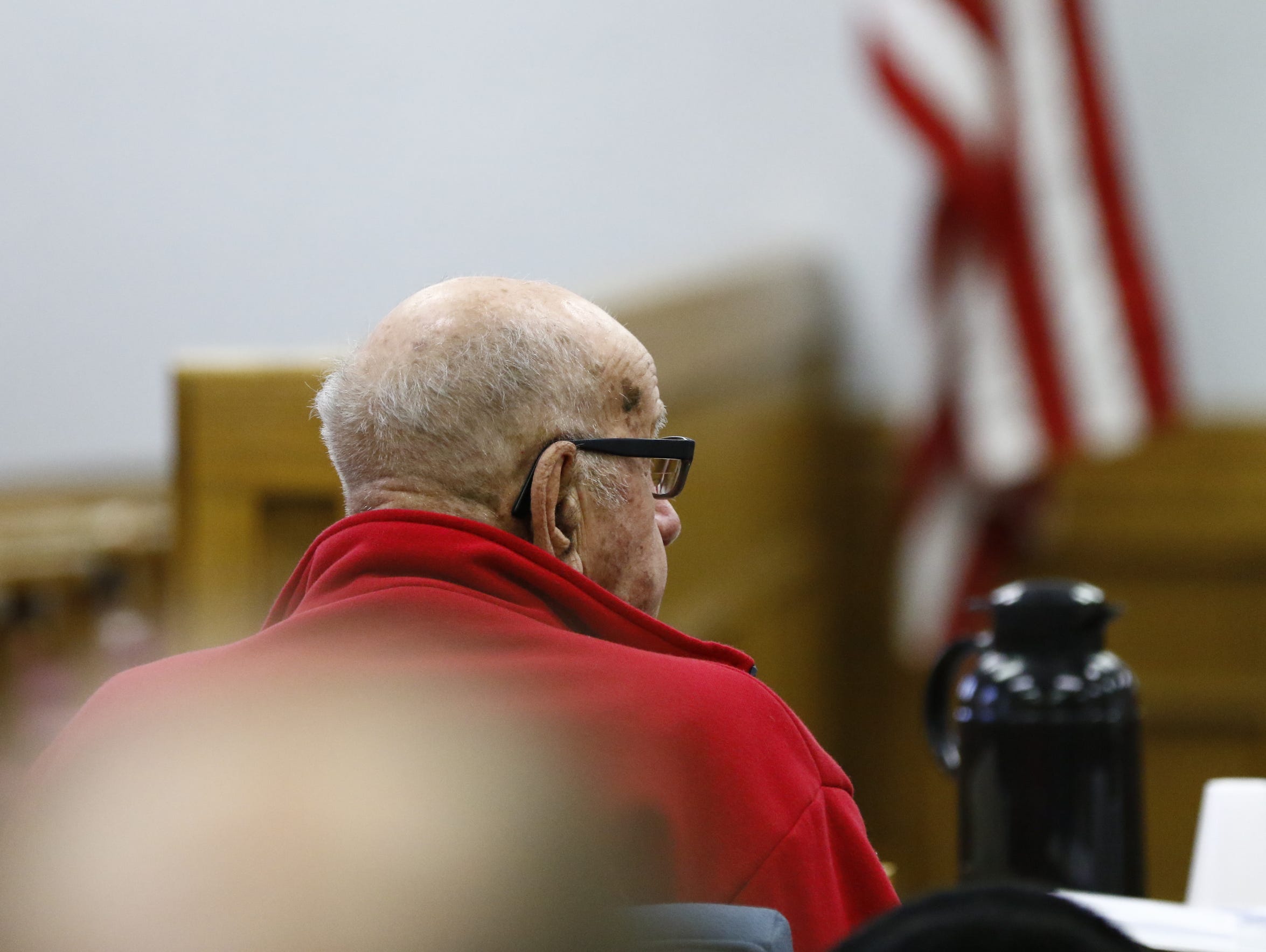
Edward Heckendorf, 92, sits through a trial on Feb.
Edward Heckendorf, 92, sits through a trial on Feb. 17, 2016. He was convicted by jury on eight counts of sexual assault of child under 13. (Photo: T'xer Zhon Kha/USA TODAY NETWORK-Wisconsin)

Compared with other states, Wisconsin's criminal statutes of limitation on child sex abuse are favorable for victims, said law professor Marci Hamilton at Yeshiva University in New York City. She tracks changes to those statutes nationwide. Wisconsin and 36 other states have no criminal statute of limitations for first-degree sexual assault of a child.

"Pedophiles typically do not stop once they get older,"
 Marci Hamilton 

States have been dismantling statutes of limitations over the past few decades, she said, in recognition of the fact that victims often take decades to work up the courage to come forward. A typical age for revealing childhood molestation is about 40 years old, Hamilton said.

Wolfe is 42 now. She was 41 when she first came forward to report Heckendorf.

Heckendorf is one of the oldest known perpetrators of sexual assault tried in the United States. He’s the oldest prosecuted by Marathon County Deputy District Attorney Theresa Wetzsteon.

During Heckendorf’s trial, Wolfe and other family members testified as "other acts" witnesses, a classification that allowed them to share details of alleged crimes that took place too long ago for separate charges and trials.

Heidi Wolfe poses for a picture with two kittens. Year
Heidi Wolfe poses for a picture with two kittens. Year unknown.
(Photo: Photo courtesy of Heidi Wolfe)

Wolfe calls herself a whistleblower, and she opened up to tell her story to her family members, police and the media. First, she said, she wanted to protect her daughters, now 13 and 15, from Heckendorf. Second, she wanted to encourage other victims to come forward and hold their abusers accountable.

As Heckendorf aged, he seemed less of a threat to Wolfe. But when he groped her, she realized he was still active, she said. She didn't want him near her children once that crystallized in her mind.

Years of silence 

Wolfe had issues dating as she grew up. She struggled to feel good enough or pretty enough. Those insecurities didn't stop her from becoming a cheerleader at Wausau East High School and pursuing a degree at Northcentral Technical College.

Wolfe said she developed an independent spirit in spite of the abuse she experienced as a child.

But she still spent time around her grandfather at holidays and family events. He seemed always to need to be dominant or superior, she said. Heckendorf ate first at the holidays and spoke up if the meal started late or the food was a little burned, she said.

Heidi Wolfe was a high school cheerleader in the late
Heidi Wolfe was a high school cheerleader in the late 1980s.
(Photo: Photo courtesy of Heidi Wolfe)

He would always tickle or poke women in the family, Wolfe said, and she tried to avoid him. Her cousin did as well, according to a police report.

Growing up, Wolfe knew vaguely that others in the family had bad experiences with her grandfather, including multiple generations of women, she said. But those experiences weren't shared openly.

‘Society’s lack of tolerance’

People who experience sexual assault as children often are reluctant to report the crime until years later, if ever.

The older a crime, the harder it is to defend against. Memories fade, witnesses die or become hard to find, evidence disappears. In the case of Heckendorf, potential evidence burned down with his leather chair.

Old cases also are hard to prosecute, and for the same reasons. But district attorneys can choose whether to charge a case based on whether they believe they have enough corroborating evidence. Defense attorneys have to react to those charges.

For murder, a suspect can be tried in Wisconsin no matter how much time has passed. As of today, no child sexual assault committed before July 1, 1989 can be brought to court. For crimes after that date committed against children under 13, the statute of limitations lasts the life of the victim.

Wisconsin lawmakers have progressively lengthened those limits on different degrees of sexual assault, against children and adults, over the past 25 years. It used to be that Wisconsin officials could not prosecute child sexual assaults committed more than six years before they were charged.

The length of a statute of limitation on any particular crime shows "society’s lack of tolerance for that behavior," said Ian Henderson, the director of legal and systems services for the Wisconsin Coalition Against Sexual Assault.

Henderson said longer statutes of limitations are good for public safety, because some molesters harm multiple victims. Plus, the more time after the crime to prosecute, the longer a victim can take to come to terms with an assault and approach the authorities.

"Like anything in the law, it cuts two ways," said Dick Lawson, a Wausau-based attorney specializing in criminal and traffic defense. A long charging period can be good for victims who have repressed memories, but old sexual abuse cases become harder to defend, he said.

Lawson is not involved in the Heckendorf case.

Heckendorf’s attorney, Peter Rotter, would not comment for this story, because all of Heckendorf’s cases are still unfolding. Rotter said his client would not comment, either.

More charges pending

Wolfe's mother helped deliver Wolfe's oldest children. The two would grocery shop together as adults. They were best friends.

And since Wolfe's mother died unexpectedly in her sleep 13 years ago at age 49, Wolfe has struggled with returning to her childhood home.

But in the summer of 2014, she stopped by to borrow her dad's trailer and clear some wood out of it for him. She had a surprisingly enjoyable time, joking around with her father, her son, who's now 11, and even her grandfather, as she tells it.

Heckendorf was staying at the house, displaced by the same fire that burned his leather chair, and Wolfe hoped to avoid him.

But as she prepared to leave, while her father and son climbed into the truck nearby, Heckendorf reached down her shirt and groped her, she said.

He has been charged with but not convicted of assaulting Wolfe that day.

Heidi Wolfe poses for a photo at the Wausau Daily Herald
Heidi Wolfe poses for a photo at the Wausau Daily Herald office on April 11, 2016.
(Photo: T'xer Zhon Kha/USA TODAY NETWORK-Wisconsin)

"My dad and my son were within 10 feet," Wolfe said. She knew, at family gatherings, she wouldn't be able to watch her kids at every moment. "I had to do something to protect my girls."

First, she stopped by her aunt and uncle's place to tell them what happened. Then she called a close friend, a police chief, for some guidance.

Wolfe took time off work and reported the crime officially. She got a restraining order against Heckendorf.

And as she talked the matter over with a cousin, that cousin decided to come forward. Another followed.

Still, Wolfe struggled privately after the groping, she said, and she struggled throughout her pursuit for justice.

"I took my foot scrub and was just scrubbing my chest. I just felt so dirty," Wolfe said, cinching up her shoulders, disgusted.

That was the beginning of two challenging years for Wolfe and those closest to her. She has trouble sleeping, becomes distant sometimes and other times buries herself in work, said her husband.

"Heidi is nowhere near being herself again," he said. "This has really taken a toll on her and the family."

‘Our word, against his’

Heckendorf will face Judge Michael Moran for sentencing on July 5, for the eight guilty convictions of crimes dating back more than two decades.

Heckendorf’s attorney, Rotter, said in his closing argument the case against the aging man was unfair. The house and chair where the alleged molestations took place are destroyed. Heckenforf’s wife has died and cannot testify, Rotter said.

"The loss of the house deprives Ed of one piece of physical evidence that would have cleared his name," Rotter said, according to a court transcript. He pointed out that sight lines could have shown the house was too open to conceal molestations while other adults were nearby.

"We were up against a lot," Wolfe said. "He is a 92-year-old man, so, age. There was no DNA. There were no witnesses. So it was really our story, our word, against his."

Old sexual assault cases often come down to a "he said, she said," said Nina Ginsberg, a defense attorney in Alexandria, Virginia. Motivations are hard to pin down years after the event, whether it's the accused's motive to commit the crime or the victim's motive to report it. And it's really hard to reconstruct events and corroborate stories.

"It's almost insurmountable," Ginsberg said, of the defense. It's hard for prosecutors, as well. "It's very unusual (for the prosecution) to bring a really old case," she said.

These cases can play out in civil court, without a state attorney involved at all. If guilty, the defendant could owe damages but wouldn't end up in prison. States have different sets of statutes of limitations for civil and criminal charges.

Reported sexual assaults end up in a database, whether or not they're prosecuted. And that information can be used by police and prosecutors if perpetrators strike multiple times. A lack of DNA doesn't mean the charge is too old to pursue.

"The testimony is the evidence," said Deputy District Attorney Theresa Wetzsteon, who prosecuted the Heckendorf case. "We look for other corroborating facts."

And those "other acts" witnesses of other alleged crimes can help prosecutors give a motive for the crime at hand.

The morning Wolfe testified as an other-acts witness, she went for breakfast at a downtown Wausau diner, but her stomach churned. She was so nervous to face her molester and a skeptical jury, when she arrived at the courthouse she threw up.

Her biggest fear: the 12 jurors wouldn’t believe her story or her cousins’ stories of abuse.

Other victims

At least 1,000 kids were sexually abused in 2014 in Wisconsin, according to Child Protective Services records. Much of that abuse was at the hands of a caregiver and about 80 percent of the victims were girls.

Heckendorf and his wife were babysitting Wolfe when he molested her in that leather chair and another chair in the basement, she told police. He did it when the two were alone, away from her grandmother, over the course of third through fifth grade, according to a police report.

Her grandfather laughed at her when she shook, her body’s reaction to the abuse, Wolfe said.

Heidi Wolfe in roughly sixth grade.
(Photo: Photo courtesy of Heidi Wolfe)

After she learned in health class that it was not appropriate to be touched like that, she told her mother. They were sitting on the swings. She was about 11 years old.

Wolfe doesn’t know how, but her mother put an end to the abuse against her. And her mother told her, "if it happens again we’ll take it to the authorities."

That’s why she went to the police when Heckendorf groped her two years ago, Wolfe said.

It's hard for victims to come forward because shame and secrecy are hallmarks of sexual assault.

It’s particularly difficult to come forward with allegations against a family member, said Jessica Lind, sexual assault victim services program coordinator with The Women’s Community in Wausau.

The reporting and trial process has brought some extended family members closer in the Heckendorf family, but it’s also created some rifts. Ross Wolfe said his family might never speak to some relatives again.

Heidi Wolfe said some of her family members could have done more to support the victims. Only two of Heckendorf's four sons came to the trial, she said. "All the aunts were there for us girls."

Not an easy road

When Wolfe entered the police station to report her grandfather, she was nervous. It was tough to have to write and re-write her testimony. When she faced the paperwork for a restraining order, she felt overwhelmed by the options and legalese on the forms.

A Wisconsin law passed this year allows victims to have an advocate by their sides during legal and medical proceedings.

Wolfe recommends that victims write out their testimony before going in to report. She recommends they "stay the course" and take care of themselves throughout the whole process.

"It is a long road," Wolfe said. "For us, it was a roller coaster."

It’s important for victims to get emotional support, said Lind with The Women’s Community.

The Women's Community offers one-on-one counseling, peer support groups and a 24-hour crisis line. There are similar groups around the state and country.

"It’s never too late to tell. It’s never too late to seek support," Lind said. "I feel like it’s so important to know that you don’t have to live with that secret."

Wolfe’s husband has struggled with how to help her over the past two years. He received advice from a therapist.

"A guy doesn’t know what to do," he said. "The best advice is just to be supportive. … It’s hard."

Conviction

Wolfe thought she would feel victorious as the judge read the jury’s verdict in February.

She and her cousins were nervous, crying, and Wolfe thought Heckendorf seemed calm.

As she remembers Judge Moran reading the verdict on charges one through eight, guilty on all counts, she chokes up.

"There was a weight lifted, I would say," she said. "But yet, there’s also a part of me that kind of died in that courtroom. You know, because you carried it for so long. You masked it and now that it’s out there, now I can try to figure out who I really am."

Heidi Wolfe had her fingernails painted with ribbons
Heidi Wolfe had her fingernails painted with ribbons for sexual assault 
awareness month. She holds them for a photo on April 11, 2016.
(Photo: T'xer Zhon Kha/USA TODAY NETWORK-Wisconsin)

On a small level, the conviction offers the relief that Wolfe never has to host Heckendorf again and cater to his particular requests for coffee a certain way and meals at a certain time, she said.

"Everybody makes their own coffee," she said. "I'm done making coffee."

Wolfe donned teal ribbons on her fingernails throughout April to mark Sexual Assault Awareness Month. She’s on a mission to educate people about sexual assaults. That’s why she’s opened up with her story.

She may have taken some missteps in her quest for justice, she said, but she hopes her daughters will recognize why she pressed the matter. As a mother, she wanted to shield them from the bad experiences she endured.

People tell her that she’s strong for what she’s done.

"I hope someday I really feel that strength," Wolfe said.

Nora G. Hertel: nora.hertel@gannettwisconsin.com or 715-845-0665; on Twitter @nghertel.