Everyday thousands of children are being sexually abused. You can stop the abuse of at least one child by simply praying. You can possibly stop the abuse of thousands of children by forwarding the link in First Time Visitor? by email, Twitter or Facebook to every Christian you know. Save a child or lots of children!!!! Do Something, please!

3:15 PM prayer in brief:
Pray for God to stop 1 child from being molested today.
Pray for God to stop 1 child molestation happening now.
Pray for God to rescue 1 child from sexual slavery.
Pray for God to save 1 girl from genital circumcision.
Pray for God to stop 1 girl from becoming a child-bride.
If you have the faith pray for 100 children rather than one.
Give Thanks. There is more to this prayer here

Please note: All my writings and comments appear in bold italics in this colour

Showing posts with label kidnapping. Show all posts

Tuesday, 19 May 2026

Dozens more school kids kidnapped in Nigeria


Unfortunately, the ages and genders of these kids are not mentioned in this report. But boys will be recruited into the gang as either warriors or possibly suicide bombers. Girls will become child brides or possibly traded for ransoms. 


Dozens of schoolchildren abducted in Nigeria

Gunmen invaded an institution in Mussa Biri community in Borno State on Friday when classes were in session, a local civil society group has said

Published 18 May, 2026 09:21 | Updated 18 May, 2026 10:25

Dozens of schoolchildren abducted in Nigeria


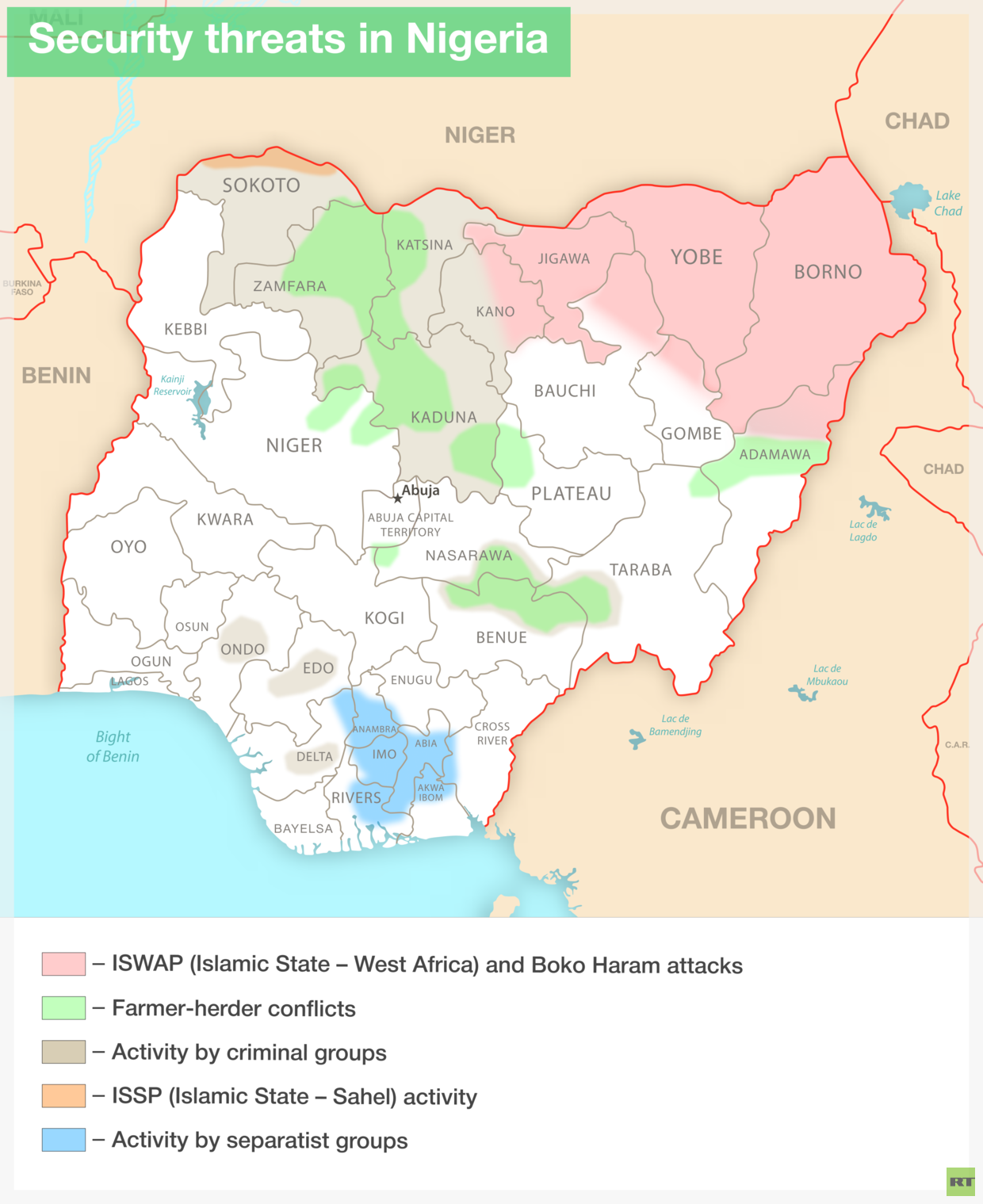
More than 40 pupils have been kidnapped after militants, suspected to be members of the jihadist group Boko Haram, attacked a school in Borno State in northeastern Nigeria, according to a senior lawmaker and local residents.

The gunmen reportedly stormed the Primary and Junior Government Day Secondary School (GDSS) in Mussa-Biri community, located in Askira-Uba Local Government Area, last Friday.

In a statement cited by local media, Senator Mohammed Ali Ndume, who represents Borno South, said 32 students were seized from classrooms and another ten from nearby homes.

The Network of Civil Society Organizations – Borno State said on Sunday that 48 students were abducted in the “heinous attack” that has left “the entire community in profound shock and psychological trauma.”

The organization said the insurgents breached the school’s perimeter when classes were in session, causing pandemonium that forced “dozens of other students to flee into the surrounding bushes.”

The attack occurred near Sambisa Forest, a known base for militants. No group has claimed responsibility, but Boko Haram and its splinter group, Islamic State West Africa Province (ISWAP), have previously targeted schools in the northeast. The region has been at the centre of a longstanding Islamist insurgency, with mass abductions, including the 2014 kidnapping of more than 270 Chibok schoolgirls.

On Saturday, the authorities in Abuja and Washington announced that a joint military operation in the Lake Chad Basin killed senior Islamic State commander Abu Bilal al Minuki, described by US President Donald Trump as the group’s global second in command.

The Nigerian police and military have not issued any public statement confirming the Mussa village incident. The raid comes amid a wave of violent attacks across Africa’s most populous nation, despite increased security measures, including a state of emergency declared by the government.

In a separate incident, gunmen attacked two primary schools in the Oriire area of Oyo State in the early hours of Friday, killing a staff member and abducting an unspecified number of victims. On Saturday, Inspector-General of Police Olatunji Rilwan Disu condemned the assault and announced that security forces have intensified rescue operations and deployed additional tactical units to the area.

A week earlier, 17 police officers were killed when terrorists launched an assault on the Nigerian Army Special Forces School in Buni Yadi, Yobe State. Authorities described the May 8 raid as “a coordinated attack on the facility from multiple directions.”

Last Thursday, the Nigerian Police Force announced it had conducted internal purges, dismissing officers involved in kidnapping, extortion, and armed robbery.

RT


Monday, 13 April 2026

April is Sexual Abuse Awareness month > The Natasha Kampusch story


Natasha's story is one of a few stories that inspired me to begin this blog on Child Sexual Abuse 13 years ago.


She was ten years old, walking to school for the very first time on her own.
A quiet suburban morning. A little girl tasting independence for the first time.
She never made it to class.
A man named Wolfgang Přiklopil pulled her into a van and drove her to a house on the outskirts of Vienna. Behind a hidden trapdoor, past a heavy steel door, he locked her in a room barely bigger than a walk-in closet.
No windows. No sunlight. Concrete walls in every direction.
That room would be Natascha Kampusch's entire world for the next 3,096 days.
She was ten years old. And she was completely alone.
On her very first night, terrified and trembling in the dark, Natascha did something that would define her survival strategy for the next eight years.
She asked her captor to tuck her in and kiss her goodnight.
Not because she felt safe. But because she understood — instinctively, at ten years old — that to survive, she had to make him see her as a human being.
"Anything to preserve the illusion of normality," she later wrote.
That one insight — that psychological strategy — would carry her through years of darkness.
Přiklopil controlled everything.
He cut the electricity off at 8 PM every night. He barked orders through an intercom. He starved her, shaved her head, forced her to clean his home. He told her that her parents never paid a ransom. That they didn't want her back. That no one was coming.
But Natascha never stopped being Natascha.
She devoured every book he brought her. She clung to routine. She refused to let hatred consume her — not out of weakness, but because she knew: "That hatred would have eaten me up and robbed me of the strength I needed."
She was choosing, every single day, to protect her own mind.
Then came the night that changed everything.
She was 12 years old. The pitch-black cell. The crushing loneliness. The terrifying feeling that she might lose her grip on reality.
And in that darkness, she did something extraordinary.
She imagined herself at 18. Older. Stronger. Free.
And her future self reached out a hand.
"Right now, you cannot escape. You are still too small. But when you turn 18, I will overpower him. I will free you. I won't leave you alone."
That promise became her lifeline.
Every time Přiklopil hurt her, she whispered it to herself.
Every time the darkness felt permanent, she held onto it.
She is coming. She is getting stronger. She will not forget me.
The years crawled by. 13. 14. 15.
At 15, she punched her captor — and proved to herself she hadn't broken.
At 17, Přiklopil began taking her outside. Skiing. Shopping. Work sites. Always with threats. Always with fear. But the outside world existed, and she had seen it.
And on her 18th birthday, something shifted deep inside her.
She looked at Přiklopil and said: "This situation must come to an end. One of us has to go."
August 23, 2006. 12:53 PM.
Natascha was in the garden, vacuuming Přiklopil's car.
His phone rang. The vacuum roared. He stepped away.
For the first time in 3,096 days — she was outside. And she was alone.
Every cell in her body screamed one word.
Run.
She dropped the vacuum and bolted — through gardens, over fences, past startled strangers who stood and stared. She knocked on a window. A 71-year-old woman named Inge opened the door.
"I am Natascha Kampusch," she gasped.
Police arrived at 1:04 PM.
After 3,096 days — Natascha Kampusch was free.
She had freed herself. Not through luck. Not through rescue.
Through a promise she made to herself at 12 years old — and spent six years becoming strong enough to keep.
That evening, Přiklopil took his own life.
When police told Natascha, she wept — not from love, but because the complicated thread that had bound her survival to his existence had snapped all at once. Trauma doesn't follow a script.
She rejected the label of Stockholm Syndrome. "I have the right to describe my own experience in my own words," she said.
Today, Natascha Kampusch is 38 years old.
She wrote 3,096 Days, which became a film. She bought PÅ™iklopil's house — to stop it from becoming a tourist attraction, because that place, however dark, was part of who she became.
She has dedicated her life to advocacy, speaking, and healing on her own terms.
The 12-year-old girl who made a promise in the dark was right.
On the exact day she turned 18, she walked out of that prison.
Just like she promised she would.
Here's the thing that will stay with you:
No one rescued Natascha Kampusch.
In her darkest moment — a child in a concrete cell — she reached forward in time, created a version of herself who was stronger, and held onto that image for six years.
Most of us will never face what she faced.
But all of us know what it is to feel trapped — in a situation, a mindset, a season of life that feels permanent.
Natascha's story whispers the same thing her future self once whispered to her:
Hold on. A stronger version of you is already on the way.

Thursday, 26 March 2026

Drugs and Kids > Boy kidnapped because brother stole drugs from a Muslim dealer


Man found guilty of kidnapping Toronto teen gets 11.5-year prison sentence


A man found guilty of kidnapping a 14-year-old Toronto boy over his half-brother’s drug debt that triggered a province-wide Amber Alert has been sentenced to 11 and a half years in prison.

Samir Abdelgadir, 45, stood up and waved to his friend as he was handcuffed and led out of a downtown courtroom Thursday after Superior Court Justice Sandra Nishikawa handed down the sentence. Abdelgadir was tried by judge alone.

On March 4, 2020, the boy, whose name is protected by a publication ban, was kidnapped shortly after leaving his home to go to school on Driftwood Court near Jane Sreet and Finch Avenue.

Three men grabbed the boy and forced him into a Jeep as he screamed and struggled to resist. Two other vehicles, a white Mercedes and a black Tahoe, accompanied the Jeep to and from the Driftwood Avenue complex where the teen was kidnapped.

The boy was driven to a vacant house on Edgeforest Road in Brampton where he was bound and blindfolded.

At trial, the teen’s half-brother admitted that he had stolen 90 kg of cocaine from people for whom he worked. While the teen was held at the house, the kidnappers called and sent messages to the half-brother demanding that he return the cocaine that he had stolen.

Thirty-six hours after the teen was taken, he was released in a vacant lot in Caledon, where he was later located by police. The Jeep was found near the Forks of the Credit in Caledon. Two men admitted to setting the Jeep on fire but testified at trial that they believed it was for an insurance fraud scheme.

Nishikawa found that Abdelgadir was an associate of kilogram-level traffickers named Giovanni Raimondi and Scott McManus. She called it a “coordinated, planned event among a number of individuals.” The half-brother testified he regularly delivered cocaine to Abdelgadir.

“As one of the principals of the drug operation, Mr. McManus had a strong motive for the kidnapping,” the judge said.

“I did not find that Mr. Abdelgadir was the mastermind of the plot to kidnap the teen and hold him for ransom for the return of 90 kilograms of stolen cocaine or the proceeds thereof. I found that Mr. Abdelgadir knew in advance of the plan to kidnap the teen that morning and drove the Tahoe as backup at the ready, to assist if needed.

“He played an integral role in the kidnapping, which is a continuing offence, by ensuring that it took place. After the teen was forced into the Jeep, Mr. Abdelgadir drove away from Driftwood Avenue in tandem with the Jeep and the Mercedes. He did not drive to the house on Edgeforest where the teen was eventually held. At no time, did Mr. Abdelgadir attempt to assist the teen regain his liberty.”

She pointed out that four days after the kidnapping, Abdelgadir met with one of the two men who pleaded guilty to setting the Jeep on fire.

“I found it was reasonable to infer that the meeting was to discuss damage control, including the destruction of the Jeep.”

The judge noted the harmful and lasting impact that the kidnapping had on the boy and his family, as outlined in their victim impact statements.

Nishikawa said the teenaged boy described how his life completely changed from one day to the next. After the kidnapping, the teen could not sleep on his own, because when he tried to sleep, he relived every detail of the abduction.

“He has difficulty finding words to describe the experience, stating, ‘There was so much aggression directed towards me that I thought I was going to die and that feeling has never left me,'” Nishikawa said.

The teen’s mother also passed away after the kidnapping before the trial and said his support system has been lost. The teen’s mother said in his victim impact statement that his son’s kidnapping made him feel that he failed in his mission to protect him, and that he does not know how to repair that.

In considering her sentence, Nishikawa took into account Abdelgadir’s lack of criminal record, an impact of race and culture assessment (IRCA) that was done, a pre-sentence report, and aggravating and mitigating factors.

Abdelgadir was born in North Sudan into a Muslim family. When he was 19, he moved to Mississauga where he lived with his aunt and later with his mother. He moved to Hamilton where he attended McMaster University and served as vice-president of the African-Caribbean Association. He lost his father’s financial support during this time.

According to the author of the pre-sentence report, Abdelgadir turned to selling marijuana after being unable to find employment. He also reported being harassed by police in Hamilton.

The IRCA report states that Abdelgadir has been imprisoned up to 20 times for long periods of time on previous charges, including drug possession, cocaine possession and curfew violations.

In the report, Abdelgadir emphasized that his stagnation was not the result of lack of ambition or ability, but rather the consequence of systemic racism, repeated police targeting, and unjust criminalization that disrupted his educational and employment trajectory.

The IRCA report states that Abdelgadir blames the current charges on systemic racism and police targeting.

The author of the pre-sentence report notes that Abdelgadir does not accept responsibility for the offence and believes he was unfairly prosecuted. “He is described by the Officer as ‘reluctant or unable to consider the impact his behaviur has had upon others,'” said Nishikawa.

The Crown had asked for a 16-year penitentiary sentence whereas defence suggested a five-year sentence would be more appropriate.

Nishikawa pointed out that the mandatory minimum for kidnapping involving a person under 18 years old is five years. The maximum sentence is life imprisonment.

The judge noted that the teen was taken as leverage to extort from his half-brother either the return of the stolen drugs or repayment.

“It is an agreed fact that the teen heard the driver tell the person in the backseat that if the teen moved, he should shoot him. I find that the teen believed that the men who kidnapped him had a firearm. However, based on the evidence before me, I cannot find beyond a reasonable doubt that a firearm was used,” said Nishikawa.

Nishikawa found it aggravating that the victim was a 14-year-old Black boy in Grade 9, living in an economically disadvantaged neighbourhood.  The teen was not involved in the drug trade nor any other illicit conduct.

She also noted that the parents did not know their son was missing until after school because school authorities failed to report his absence to his parents. As a result, the parents did not contact police until over nine hours after the teen had been kidnapped.

“The harm caused to the teen is immeasurable. His life changed forever the day Mr. Abdelgadir and others decided to kidnap him as leverage for his brother’s actions,” said Nishikawa.

The judge noted that while Abdelgadir expressed sympathy to the teen at the sentencing hearing with the harm caused and the loss of his mother, he continues to deny his involvement in the kidnapping.

“Needless to say, Mr. Abdelgadir has not expressed remorse. I note that a lack of remorse is not an aggravating factor but the absence of a mitigating factor,” she concluded.

After subtracting enhanced credit for 260 days spent in pre-sentence custody,  harsh conditions spent in pre-sentence custody and credit for time spent living under house arrest, Abdelgadir has 9.5 years left to serve on his sentence.

The teenaged boy and his family were not in court Thursday.